Jump to: At-a-glance comparison | How the two drugs work | Average weight loss in trials | Side effects compared | The daily tablet vs the weekly injection | UK availability and cost | Who might prefer each option | Frequently asked questions | Take home message
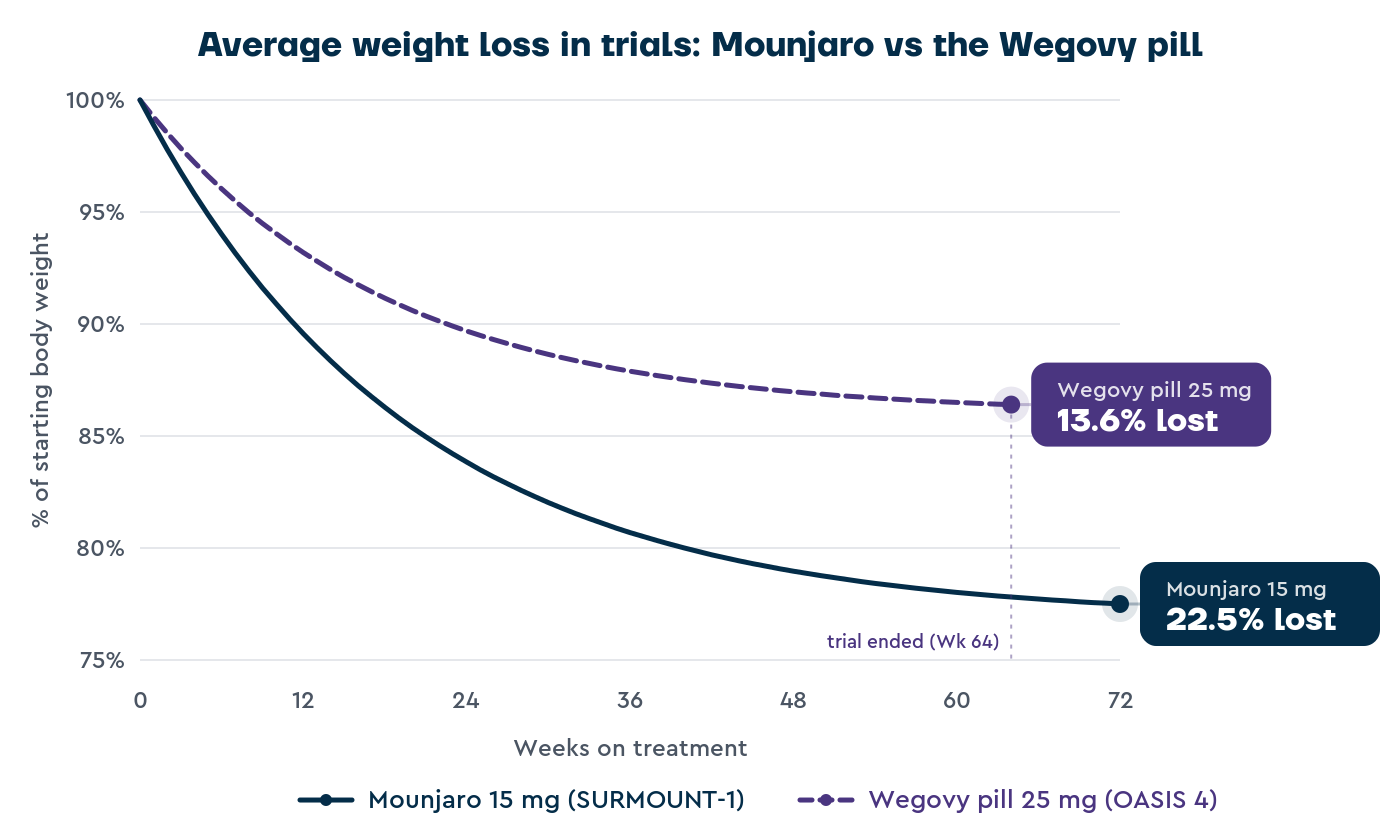
Mounjaro produces more weight loss than the Wegovy pill. In trials, Mounjaro led to an average weight loss of around 22% at its highest dose of 15 mg, compared with 13.6% for the Wegovy pill (oral semaglutide 25 mg).1,2
The two aren’t the same drug. The Wegovy pill is semaglutide, which mimics one gut hormone.
Mounjaro is tirzepatide, which mimics two, and that dual action is the main reason it tends to produce more weight loss.
The pill’s appeal is in how it’s taken. It’s a daily tablet instead of a weekly injection, which is appealing for individuals who are needle-averse.
Plus, the Wegovy pill can still produce significant weight loss; 13.6% is just the average.
For example, the average weight loss among participants in the OASIS-4 trial who completed the trial and adhered to the daily pill routine was 16.6%, with over 30% losing more than 20% of their body weight.
The headline weight-loss figures often get overstated, but the average effect of these drugs is irrelevant to the individual.
The potential effect of the Wegovy pill for an individual is that it could lead to significant weight loss of over 20% of body weight, if needed.
Both drugs are now licensed in the UK. Mounjaro has been available since 2023, and the Wegovy pill was approved by the MHRA on 11th June 2026, the first GLP-1 weight-loss tablet licensed in the UK.4
The pill is now rolling out through private providers, including weight-loss programmes supported by registered nutritionists and dietitians, such as Second Nature, if you’re eligible.
Important safety information: Mounjaro (tirzepatide) and Wegovy (semaglutide) are prescription-only medications for managing obesity, and Mounjaro is also licensed for type 2 diabetes. Both are licensed in the UK; the Wegovy pill was approved by the MHRA in June 2026. This article is for informational purposes only. Always consult your healthcare provider before starting, switching, or stopping a weight-loss medication.
At-a-glance comparison
| Feature |
Wegovy pill (25 mg) |
Mounjaro (up to 15 mg) |
| Drug |
Semaglutide |
Tirzepatide |
| Drug class |
GLP-1 receptor agonist |
Dual GIP and GLP-1 receptor agonist |
| Manufacturer |
Novo Nordisk |
Eli Lilly |
| How you take it |
A tablet every morning on an empty stomach, with up to 120 ml of water, then a 30-minute wait before food, drink, or other medicines |
An injection under the skin once a week, any time of day, with or without food |
| Maintenance dose |
25 mg once a day |
5, 10, or 15 mg once a week |
| Average weight loss in trials |
13.6% over 64 weeks (OASIS 4)1 |
22.5% over 72 weeks (SURMOUNT-1, 15 mg)2 |
| Most common side effects |
Nausea, vomiting, diarrhoea |
Nausea, diarrhoea, vomiting, constipation |
| Time to a maintenance dose |
About 12 weeks |
About 16 to 20 weeks |
| UK status |
MHRA-approved June 2026; available privately |
Licensed since 2023; available privately and on the NHS through a phased rollout |
How the two drugs work
The Wegovy pill and Mounjaro both reduce hunger and quieten food noise, the constant and intrusive thoughts about food that usually ease within the first few weeks on either medication. They just use different drugs to do it.
The Wegovy pill is semaglutide. It mimics GLP-1, a hormone our body releases in the gut after eating, which slows how quickly the stomach empties and signals fullness to the brain.
Mounjaro is tirzepatide. It mimics GLP-1 and a second gut hormone, GIP, which works alongside GLP-1 to reduce appetite and help the body manage blood sugar.
Mimicking two hormones rather than one is the main reason why Mounjaro produces more weight loss than semaglutide on average. There’s also a second difference in how the drug reaches the bloodstream.
Mounjaro is injected under the skin once a week, allowing the full dose to be absorbed slowly and reliably over several days.
The Wegovy pill has a harder route into the bloodstream because semaglutide is a peptide, the kind of drug stomach acid normally breaks down before it can be absorbed.
To get around this, Novo Nordisk pairs the semaglutide in the tablet with a small molecule called SNAC (an added ingredient that helps the drug cross the stomach lining).
Even so, only about 1% of each tablet reaches the bloodstream, which is why the pill is a 25 mg daily dose, over 10x more than the Wegovy 2.4 mg dose.
Between the dual-hormone drug and the more reliable delivery, Mounjaro produces more weight loss than the Wegovy pill, and more than the 2.4 mg semaglutide injection.
Average weight loss in trials
The Wegovy pill and Mounjaro haven’t been compared directly in a single trial. The closest evidence comes from their separate Phase 3 trials (large human studies with hundreds to thousands of participants), plus one trial that directly compared Mounjaro with the Wegovy injection.
The Wegovy pill was tested in OASIS 4. OASIS 4 randomised 307 adults with overweight or obesity (without type 2 diabetes) to the pill or placebo for 64 weeks, alongside lifestyle support.
Participants on the pill lost an average of 13.6% of their starting body weight, compared with 2.2% on placebo.1
OASIS 4 reported two weight-loss figures, and both are valid in different contexts.
The 13.6% figure is the treatment-policy figure, which includes everyone who enrolled, regardless of whether they completed the trial.
Among those who stayed on the pill, completed the trial, and reached the 25 mg dose, the average was 16.6%.1
We use the 13.6% figure throughout our guides because it reflects what tends to happen across a real-world group, rather than only the people who complete a full course.
Mounjaro was tested in SURMOUNT-1. SURMOUNT-1 randomised 2,539 adults with obesity, or overweight with a weight-related condition (without type 2 diabetes), to one of three Mounjaro doses or placebo for 72 weeks.
Average weight loss was 16.0% on 5 mg, 21.4% on 10 mg, and 22.5% on the 15 mg dose, compared with 2.4% on placebo.2
The one trial that compared the drugs directly, SURMOUNT-5, tested Mounjaro against the Wegovy 2.4 mg injection, not the pill.
Over 72 weeks, Mounjaro produced an average weight loss of 20.2%, compared with 13.7% for the Wegovy injection.3
Mounjaro’s figure is slightly lower in this direct comparison than the 22.5% in its own SURMOUNT-1 trial, which is normal across trials, but it produced more weight loss than semaglutide in both trials.
The Wegovy pill produces similar average weight loss as the 2.4 mg injection. The pill averaged 13.6% in OASIS 4, and the injection averaged 13.7% in SURMOUNT-5.
So while no trial has compared the pill directly with Mounjaro, the pill produces a similar amount to the Wegovy injection used in that direct comparison.
Given Mounjaro’s dual-hormone action, we’d expect it to produce more weight loss than the pill. But because the two haven’t been compared directly under the same conditions, we can’t put an exact figure on the difference.
The direction is consistent across the trials. Mounjaro produced more weight loss than the Wegovy pill and than the standard 2.4 mg injection it was directly compared with.
If you’re comparing the higher-dose Wegovy 7.2 mg injection rather than the pill, our Wegovy vs Mounjaro guide covers that comparison, where the difference between the medications is much smaller.
If you’re choosing between the pill and the Wegovy injection rather than Mounjaro, our Wegovy pill vs injection comparison covers that in more depth.
Side effects compared
Both medications have similar side effect profiles due to how they interact with the gut and our digestive system.
The most common side effects are related to the digestive system: nausea, diarrhoea, vomiting, and constipation. They tend to be worse in the first few weeks while the dose increases, then settle.
In OASIS 4, on the Wegovy pill, nausea affected 46.6% of people and vomiting 30.9%, with some form of gastrointestinal side effect in 74.0% overall. About 6.9% stopped because of side effects, compared with 5.9% on placebo.1
In SURMOUNT-1, on the top 15 mg dose of Mounjaro, nausea affected 31.0% of people, diarrhoea 23.0%, vomiting 12.2%, and constipation 11.7%. About 6.2% stopped because of side effects.2
Nausea and vomiting were reported more often with the pill than with Mounjaro at its highest dose of 15 mg.
These figures come from separate trials with different participants, so they can’t be compared exactly. But they don’t support the common assumption that a tablet will lead to fewer side effects than the injections.
The pill does avoid injection-site reactions completely. Redness, soreness, or itching where the injection goes in affects a small number of people on Mounjaro, and a tablet has no injection site.
The daily-versus-weekly dosing schedule of the drugs can impact how often we experience side effects.
With Mounjaro, any nausea is usually worst in the day or two after the weekly injection, then eases. With the daily pill, the effects can be more evenly distributed throughout the week.
Serious side effects are uncommon with both, and include pancreatitis and gallbladder problems.
Neither medication should be taken by anyone with a personal or family history of medullary thyroid cancer or multiple endocrine neoplasia type 2.
The daily tablet vs the weekly injection
The biggest day-to-day difference is the morning routine the pill requires.
The Wegovy pill must be taken first thing in the morning on an empty stomach, with no more than 120 ml of plain water.
After taking it, you wait 30 minutes before eating, drinking anything else (including tea or coffee), or taking other tablets.5
If you regularly take it with food, with too much water, or too soon before eating, much less of the dose is absorbed, and it won’t be as effective.
Mounjaro doesn’t have the same daily protocol. It’s one injection a week, on any day, with or without food, into the thigh, abdomen, or upper arm, and it takes about a minute.
The pen is preloaded and designed for use at home. The needle is short and fine, and a dislike of needles is one of the main reasons people look at the pill instead, though most find the injection gets easier with practice.
The two medications have slightly different dose-escalation schedules: Mounjaro has 6 doses, while the Wegovy pill has 4.
The Wegovy pill reaches its maximum dose of 25 mg in about 12 weeks, with the dose increasing every 4 weeks.
Mounjaro starts at 2.5 mg and increases by 2.5 mg roughly every four weeks, reaching a maintenance dose of 5, 10, or 15 mg over about 16 to 20 weeks, depending on the target dose and how well it’s tolerated.6
UK availability and cost
Both are licensed in the UK and available privately. Mounjaro has been licensed since 2023 and is the more established of the two, with a real-world safety record now built up over more than two years.
It’s available through private prescriptions and, increasingly, on the NHS through a phased rollout that began in 2025, starting with people with the highest BMI.6
The Wegovy pill was approved by the MHRA on 11th June 2026, the first GLP-1 weight-loss tablet licensed in the UK.4
It’s private-only for now, including through Second Nature if you’re eligible. NHS access would follow a separate NICE appraisal and isn’t likely to be available before 2027.
There’s no tablet form of Mounjaro. Tirzepatide is injection-only, so if you specifically want a tablet, the Wegovy pill is currently the only licensed GLP-1 weight-loss tablet in the UK.
On cost, neither is inexpensive, and there’s no fixed UK price for either, so it varies by provider, dose, and any first-month discount.
At lower and middle doses, the two are broadly similar, while Mounjaro’s top 15 mg dose is usually the most expensive of the range.
Our free cost comparison tool breaks down current UK GLP-1 prices in more detail.
Who might prefer each option
Mounjaro might suit you better if:
- You want the most weight loss available from a single weight-loss medication
- You’re comfortable with a weekly injection, or willing to get used to one
- You’d like the option of an NHS route, which the pill doesn’t yet have
- You want the medication with the longest real-world track record in the UK
The Wegovy pill might suit you better if:
- You strongly dislike or have a phobia of needles and would rather take a tablet
- You travel often and want to avoid carrying and refrigerating an injectable pen
- A 30-minute fasting window in the morning fits your routine
- You’ve struggled with injection-site reactions and want a needle-free option using a proven drug
Choosing between Mounjaro and the Wegovy pill comes down to how much weight loss you’re aiming for and whether you’d rather take a tablet or an injection. Second Nature has worked with the NHS since 2017, combining Mounjaro and Wegovy with structured habit support so the weight loss lasts. Take our 3-minute eligibility quiz, and a clinician will review your answers.
Frequently asked questions
Is the Wegovy pill better than Mounjaro?
For weight loss, Mounjaro produced greater results in trials, averaging around 22% compared with 13.6% for the pill.1,2
The pill is the better choice mainly if you’d prefer to avoid needles, since it’s a tablet rather than a weekly injection.
Can I lose 30 pounds in 3 months on Wegovy or Mounjaro?
It’s possible, but we don’t recommend losing weight too quickly as it increases the risk of bone and muscle loss, hair loss, and nutrient deficiencies.
We recommend losing weight slowly at a rate of around 1lb per week.
Which has worse side effects, the Wegovy pill or Mounjaro?
Both cause side effects related to the digestive system in the first few weeks.
In their trials, nausea and vomiting were reported more often with the pill (nausea 46.6%) than with Mounjaro at its top dose (31.0%).1,2
The figures come from separate trials, so they can’t be compared exactly, but the pill has a similar side effect profile to injections.
Can I switch from Mounjaro to the Wegovy pill?
Yes, with your prescriber’s agreement. People sometimes switch because they want to come off injections, or because of side effects or cost. Our guide on switching to the Wegovy pill covers how that works.
Is there a Mounjaro tablet or pill?
No. Mounjaro (tirzepatide) is only available as a weekly injection in the UK.
Eli Lilly’s oral GLP-1 tablet, Foundayo (orforglipron), was approved in the U.S. in 2026, but it’s a different drug and isn’t licensed in the UK yet.
Is the Wegovy pill cheaper than Mounjaro?
Yes, the Wegovy pill will be cheaper than Mounjaro at comparable doses.
Can you take the Wegovy pill and Mounjaro together?
No. They’re both GLP-1-based medications, and taking two at once raises the risk of side effects without good evidence of extra benefit.
You take one or the other, not both.
Why does Mounjaro cause more weight loss than the Wegovy pill?
Mounjaro mimics two gut hormones, GLP-1 and GIP, while the Wegovy pill mimics one, GLP-1.
The dual action of Mounjaro is the main reason Mounjaro produces more weight loss on average.3
The pill also reaches the bloodstream less efficiently, since only about 1% of each tablet is absorbed.
Is Wegovy 0.25 mg the same as Mounjaro 2.5 mg?
No. They’re different drugs, and their doses don’t convert into each other.
The 0.25 mg is the starting dose of the Wegovy injection, and 2.5 mg is the starting dose of Mounjaro.
A bigger number doesn’t mean a stronger medicine. The Wegovy pill uses higher numbers again, up to 25 mg, only because so little of a tablet is absorbed.
In trials, even Mounjaro’s lower 5 mg dose produced around 16% weight loss, similar to the 2.4 mg dose of the Wegovy injection.
Is the Wegovy pill stronger than Ozempic?
For weight loss, yes. Ozempic is low-dose semaglutide licensed for type 2 diabetes, and it produces less weight loss than the 25 mg Wegovy pill.
Ozempic isn’t licensed for weight loss in the UK, so if weight loss is the goal, the Wegovy pill is the licensed oral option.
I had bad side effects on Mounjaro. Will the Wegovy pill be easier?
Not necessarily. The side effects are similar because both act on the gut, and in trials nausea was more common with the pill.
Individual responses do vary, and some people tolerate one better than the other, so it’s worth discussing with your prescriber rather than assuming the pill will be easier.
Why are people stopping Wegovy?
The most common reasons are side effects in the early weeks, the monthly cost, or reaching a weight they’re happy with.
The risk is stopping suddenly. If you come off a GLP-1 medication abruptly without having built the eating and activity habits to maintain your weight, appetite tends to return, and some regain is likely.
Coming off slowly, with healthy habits in place, can help prevent weight regain in the future.
Our free weight regain prevention planner can help you design a personalised plan to maintain weight loss after coming off GLP-1 medications.
Are the Wegovy pill and Mounjaro good for heart health?
The Wegovy 2.4 mg injection is licensed in the UK to reduce the risk of heart attack and stroke in adults with cardiovascular disease and obesity, based on the SELECT trial. That licence doesn’t automatically extend to the pill, which would need its own evidence.
Mounjaro’s cardiovascular outcomes trial is still under way, so neither the pill nor Mounjaro currently carries a heart-protection licence in its weight-loss form.
Still, Mounjaro has been shown to support significant cardiovascular benefits.
Take home message
Mounjaro and the Wegovy pill are different drugs, and in trials Mounjaro produced more weight loss, an average of around 22% compared with 13.6% for the pill.
The main reason is that Mounjaro mimics two gut hormones while the pill mimics one, and because it’s injected, it has better absorption than oral medication.
The pill’s appeal is its format. It’s a daily tablet instead of a weekly injection, which may be beneficial if you’d rather not use needles.
Side effects are broadly similar. The clearest practical differences are the pill’s morning fasting routine and Mounjaro’s weekly injection.
Whichever you choose, the medication works best when combined with a healthy lifestyle.
You’re more likely to avoid weight regain when the medication is paired with the habits that support it than when it’s prescribed on its own.
Second Nature has worked with the NHS since 2017, combining Mounjaro and Wegovy with structured habit support built around the balanced plate model of half vegetables, a quarter protein, a quarter complex carbohydrates, and a serving of fat.
Our published research found an average weight loss of 19.1% at 12 months in active subscribers on a GLP-1-supported programme, with 77.7% losing at least 10%.7
Second Nature's Mounjaro and Wegovy programmes
Second Nature provides Mounjaro or Wegovy as part of our Mounjaro and Wegovy weight-loss programmes.
Why choose Second Nature over other medication providers, assuming you're eligible?
Because peace of mind matters.
We've had the privilege of working with the NHS for over eight years, helping people across the UK take meaningful steps toward a healthier, happier life.
Our programmes are designed to meet people where they are, whether that means support with weight loss through compassionate one-to-one health coaching, or access to the latest weight-loss medications (like Mounjaro and Wegovy) delivered alongside expert care from a multidisciplinary team of doctors, psychologists, dietitians, and personal trainers.
At the heart of everything we do is a simple belief: real, lasting change comes from building better habits, not relying on quick fixes. We're here to support that change every step of the way.
With over a decade of experience, thousands of lives changed, and a long-standing record of delivering programmes used by the NHS, we believe we're the UK's most trusted weight-loss programme.
We hope to offer you something invaluable: peace of mind, and the support you need to take that first step.