At-a-glance comparison
| Feature |
Wegovy 2.4 mg injection |
Wegovy 7.2 mg injection |
Wegovy pill (25 mg) |
| Drug |
Semaglutide |
Semaglutide |
Semaglutide |
| Drug class |
GLP-1 receptor agonist |
GLP-1 receptor agonist |
GLP-1 receptor agonist |
| Manufacturer |
Novo Nordisk |
Novo Nordisk |
Novo Nordisk |
| Maintenance dose |
2.4 mg once a week |
7.2 mg once a week |
25 mg once a day |
| How to take it |
An injection under the skin, any time of day, any day of the week, with or without food |
An injection under the skin, any time of day, any day of the week, with or without food |
A tablet on an empty stomach, with up to 120 ml of water, then a 30-minute wait before food, drink, or other oral medicines |
| Average weight loss in trials |
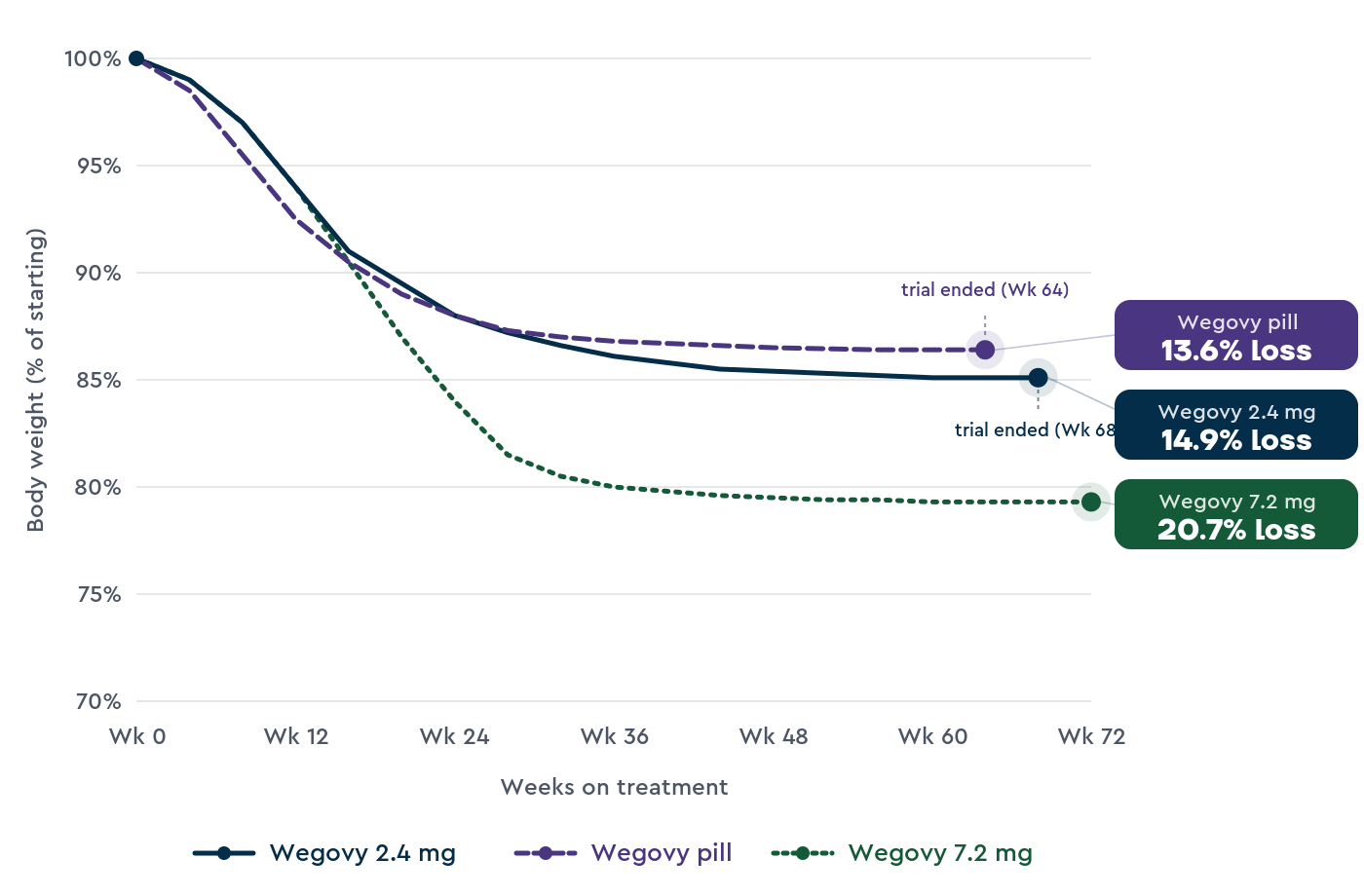
14.9% over 68 weeks (STEP 1)2 |
20.7% over 72 weeks (STEP UP)1 |
13.6% over 64 weeks (OASIS 4)3 |
| Most common side effects |
Nausea, diarrhoea, vomiting, constipation |
Nausea, diarrhoea, vomiting, constipation |
Nausea, vomiting, diarrhoea, constipation |
| Time to maintenance dose |
About 16 weeks |
About 28 weeks |
About 12 weeks |
| UK status |
Licensed; available privately, with some NHS access |
MHRA-approved January 2026 (single-injection pen April 2026); available privately |
MHRA-approved June 2026; available privately |
| FDA approval |
June 2021 |
March 2026 |
December 2025 |
The same drug in three formats
All three Wegovy products contain semaglutide.
Semaglutide mimics GLP-1, a hormone our body produces in the gut after eating, which slows stomach emptying and signals fullness to the brain.
People on any of the three formats typically describe a noticeable reduction in food noise within the first few weeks.
The formats differ in dose and in how the drug is delivered.
The 2.4 mg and 7.2 mg injections deliver semaglutide just under the skin, where it’s absorbed slowly and reliably over several days.
The difference in dose is what drives the difference in weight loss between the two injections. 7.2 mg is roughly three times the 2.4 mg dose, and that higher exposure to semaglutide produced greater weight loss in trials.
The pill has to survive stomach acid and cross the gut wall, neither of which peptide drugs like semaglutide manage well on their own.
To make the oral version work, Novo Nordisk pairs semaglutide with a small molecule called SNAC (an added ingredient that helps the drug pass through the stomach lining).
The pill needs a daily dose of 25 mg to produce roughly the same effect as the 2.4 mg weekly injection, because so little of each oral dose reaches the bloodstream.
Average weight loss in trials
The three formats haven’t been compared directly in a single trial.
The closest like-for-like comparison comes from the three Phase 3 registration studies (large human trials with hundreds to thousands of participants): STEP 1 for the 2.4 mg injection, STEP UP for the 7.2 mg injection, and OASIS 4 for the pill.
STEP 1 randomised 1,961 adults with overweight or obesity (without type 2 diabetes) to Wegovy 2.4 mg or placebo for 68 weeks, alongside lifestyle support.
Participants on Wegovy lost an average of 14.9% of their starting body weight, compared with 2.4% on placebo.2
STEP UP randomised 1,407 adults with obesity (without type 2 diabetes) to Wegovy 7.2 mg, Wegovy 2.4 mg, or placebo for 72 weeks.
Participants on the 7.2 mg dose lost an average of 20.7% of their starting body weight, compared with 17.5% on the 2.4 mg dose and 3.9% on placebo.
Over 90% of participants on 7.2 mg lost at least 5%, and around one in three lost at least 25%.1
The 20.7% is the trial-regimen figure, which reflects the result for participants who stayed on treatment. The treatment-policy figure, which includes everyone who joined the trial regardless of whether they kept taking the medication, was 18.7%.
OASIS 4 randomised 307 adults with overweight or obesity (without type 2 diabetes) to the Wegovy pill or placebo for 64 weeks, alongside lifestyle support.
Participants on the pill lost an average of 13.6% of their starting body weight, compared with 2.2% on placebo.3
OASIS 4 reported two weight-loss figures in the same paper, and both are valid in different contexts.
The 13.6% is the treatment-policy figure, which includes everyone who enrolled regardless of whether they completed the trial.
Among participants who stayed on the pill and reached the maintenance dose, the average weight loss was 16.6%.3
We use the 13.6% figure throughout our guides because it reflects what tends to happen across a real-world group, rather than only the people who complete a full course.
The 2.4 mg injection and the pill produce broadly similar weight loss, with the 2.4 mg injection producing about a percentage point more on average (14.9% versus 13.6%). The 7.2 mg injection produced the most, around 6 to 7 percentage points more than either.
If you’re choosing between the 7.2 mg and 2.4 mg doses specifically, our 7.2 mg vs 2.4 mg comparison covers that decision in more detail.
How absorption differs
Peptide drugs like semaglutide are normally broken down in the stomach before they can be absorbed.
The two injections avoid this by going under the skin, where most of each dose reaches the bloodstream over several days.
The pill’s absorption is far less efficient, even with the SNAC absorption enhancer. Only around 1% of each oral dose reaches the bloodstream.
At 25 mg taken every day, that 1% is enough to produce a meaningful effect.
This is why the pill is a higher dose than the injection, not a stronger medicine. The 25 mg daily tablet and the 2.4 mg weekly injection deliver a broadly similar amount of semaglutide to the bloodstream; the tablet simply has to start with much more, because so little is absorbed.
The pill is also more sensitive to small disruptions than the injection.
Eating too soon after the pill, drinking more than 120 ml of water with it, or taking it alongside another oral medicine can all reduce how much semaglutide reaches the bloodstream that day. Neither injection has this problem.
Across a 64-week trial, these small disruptions average out, and the weight-loss result still ends up close to the 2.4 mg injection.
The lower-dose oral semaglutide approved for type 2 diabetes (Rybelsus 7 mg and 14 mg) produces only 3 to 4 kg of weight loss, because the daily dose isn’t high enough to offset the low absorption.
A 25 mg daily dose roughly matches the 2.4 mg weekly injection on weight loss. Matching the 7.2 mg injection in a tablet would need a higher oral dose, which hasn’t been approved yet.
Side effects compared
All three formats share the same side-effect profile, because the drug is the same.
The most common side effects are gastrointestinal: nausea, vomiting, diarrhoea, and constipation. They tend to be worse in the first few weeks while the dose is increasing, then settle.
In STEP 1, on the 2.4 mg injection, nausea affected 43.9% of people, diarrhoea 29.7%, vomiting 24.5%, and constipation 24.2%. About 4.3% stopped the medication because of side effects, compared with 0.7% on placebo.2
In STEP UP, gastrointestinal side effects were more common on 7.2 mg than on 2.4 mg, in line with the higher dose, and stopping because of side effects was a little more common too, though most participants still reached the maintenance dose.1
STEP UP also reported altered skin sensation (tingling, prickling, numbness, or reduced sensitivity) in around 22% of participants on 7.2 mg, compared with 6% on 2.4 mg and 0.3% on placebo. It’s usually mild and resolves on its own, and it’s one of the few side effects that separates the two doses.1
In OASIS 4, nausea affected 46.6% of people on the pill, vomiting 30.9%, constipation 20.1%, and the overall rate of any gastrointestinal side effect was 74.0%. About 6.9% stopped the medication because of side effects, compared with 5.9% on placebo.3
So side-effect rates are slightly higher with the pill than with the 2.4 mg injection, and slightly higher again with the 7.2 mg injection. For most people they become manageable once the dose is stable.
Two side-effect differences set the formats apart:
- Injection-site reactions: redness, soreness, or itching where the injection was given. These affect a small minority of people on either injection dose and are usually mild, and the pill removes this risk entirely.
- Daily versus weekly rhythm: with the weekly injection, side effects tend to be worse in the day or two after the dose, then settle for the rest of the week. With the daily pill, any effects are more even across the days.
Serious side effects such as pancreatitis, gallbladder problems, and, rarely, acute kidney injury are listed for all three formats. The risk follows the drug, not the format or the dose.
Anyone with a personal or family history of medullary thyroid cancer or multiple endocrine neoplasia type 2 should not take Wegovy in any form.
The daily tablet vs the weekly injection
The biggest day-to-day difference between the pill and either injection is the morning routine the pill requires.
The 2.4 mg and 7.2 mg injections have the same once-a-week schedule and identical timing rules; the only difference between them is the dose in the pen.
The Wegovy pill must be taken first thing in the morning on an empty stomach, with no more than 120 ml of plain water.
After taking it, you need to wait 30 minutes before eating, drinking anything else (including tea or coffee), or taking other oral medicines.4
The occasional slip is fine, but if you regularly take the pill with food, with too much water, or too soon before eating, much less of the dose is absorbed and it won’t work as well.
For many people the 30-minute window fits around the morning without difficulty. For others, particularly those whose morning starts with a coffee or who take medicines that need food, the timing can be harder to keep up every day.
This daily discipline is the trade-off people weigh most often. A common reason people give for sticking with the injection is knowing they won’t keep up a daily tablet.
The injection, at either dose, doesn’t change your morning routine. It’s taken once a week, on any day, with or without food, as one injection in the thigh, abdomen, or upper arm that takes around a minute.
The pen is preloaded and designed to be self-administered. The needle is short and fine, and a fear of needles is one reason some people prefer the pill, though most people find the injection becomes easier with practice.
UK availability and cost
All three Wegovy formats are now licensed in the UK and available through private providers.
The 2.4 mg injection has been available since 2023, through private prescriptions and a limited number of NHS specialist weight-management services.
The 7.2 mg injection was approved by the MHRA in January 2026, initially as a stacked-dose regimen using the 2.4 mg pen, with a single-injection 7.2 mg pen approved in April 2026.7
It’s available privately, with NHS access likely to follow a separate NICE appraisal later in 2026 or in 2027.
The Wegovy pill was approved by the MHRA on 11th June 2026, the first GLP-1 weight-loss tablet to be licensed in the UK.5
It’s now rolling out through private providers, including by pre-order through Second Nature if you’re eligible. NHS access would follow a separate NICE appraisal and is unlikely before 2027.
Is the pill cheaper than the injection? Not in the way many people expect.
In the United States, where the pill launched in January 2026, the tablet is priced well below the injection. That difference doesn’t carry over to the UK.
There’s no official UK list price for either format yet, so each provider sets its own.
Private monthly prices for the pill and the injection are currently broadly similar, with some providers pricing the pill a little lower. Because prices vary by provider, dose, and any first-month discount, it’s worth comparing the two at whichever provider you use.
All three formats are now available to UK patients privately, so the practical choice is a genuine three-way one between the two injection doses and the pill.
If a tablet appeals more than an injection, you can pre-order the pill through Second Nature once a clinician confirms you’re eligible. Our Wegovy pill UK guide covers the rollout in more detail.
If you’re choosing between Wegovy and Mounjaro, our Wegovy vs Mounjaro guide covers that comparison.
Who might prefer each option
The 7.2 mg injection might suit you better if:
- You want the highest average weight loss available from a Wegovy product
- You’re comfortable with the longer dose-increase schedule (around 28 weeks to reach maintenance) and the slightly higher side-effect rates that come with the higher dose
- You’ve reached a plateau on the 2.4 mg dose and your prescriber agrees an increase is appropriate
The 2.4 mg injection might suit you better if:
- An average weight loss of around 14.9% is in line with your goal
- You’d prefer a shorter dose increase (around 16 weeks) and the more established side-effect profile of the 2.4 mg dose
- You’re managing a condition or routine that makes the gentler increase more practical
The pill might suit you better if:
- You strongly dislike or have a phobia of needles and have tried injections before without getting comfortable with them
- You travel often and want to avoid the storage and transport of an injectable pen, which is kept refrigerated until first use
- You already take other oral medicines at consistent morning times, so a 30-minute morning window fits your existing schedule
- You’ve had injection-site reactions on a Wegovy pen and want an alternative that uses the same drug
If you’re weighing the pill against another oral GLP-1 like Foundayo (orforglipron) rather than an injection, our Wegovy pill vs Foundayo guide covers that comparison.
Choosing between the pill and the injection comes down to the routine that fits your life and the dose that’s right for you. Second Nature has worked with the NHS since 2017, combining Wegovy and Mounjaro with structured habit support so the weight loss lasts. Take our 3-minute eligibility quiz, and a clinician will review your answers.
Frequently asked questions
Is the Wegovy pill as effective as the injection?
It depends which injection. In trials, the pill produced slightly less average weight loss than the 2.4 mg injection (13.6% versus 14.9%), and substantially less than the 7.2 mg injection (13.6% versus 20.7%).
All three produce meaningful weight loss compared with lifestyle changes alone.
Can I lose 20 pounds in 3 months on Wegovy?
Some people do, but it’s faster than the average and not the goal to aim for.
Weight comes off gradually as the dose increases, so the first three months are usually a smaller share of the total, with a quicker drop in the first few weeks as appetite and food noise settle.
Losing weight too quickly raises the risk of losing muscle as well as fat, so steady, sustainable weight loss with enough protein is the safer aim.
Is the Wegovy pill cheaper than the injection in the UK?
Not in the way many people expect. In the United States the pill launched well below the price of the injection, but that difference doesn’t carry over to the UK.
There’s no official UK list price for either format yet, so each provider sets its own. Private prices for the pill and the injection are currently broadly similar, with some providers pricing the pill a little lower, so it’s worth comparing the two at whichever provider you use.
Does the Wegovy pill have fewer side effects than the injection?
No. The drug is the same, so the side effects are the same, mostly nausea, vomiting, diarrhoea, and constipation in the first few weeks.
If anything, nausea was slightly more common with the pill (46.6%) than with the 2.4 mg injection (43.9%), though the pill removes the small risk of injection-site reactions.
Can I switch from the Wegovy injection to the pill?
Yes. The MHRA’s guidance is that people treated privately with the 2.4 mg weekly injection can move straight to the 25 mg daily tablet, and switching between the two injection doses is also possible.5
Any switch should be decided with your prescriber.
Does the Wegovy pill start working straight away?
Appetite and food noise often start to settle within the first couple of weeks, but weight loss is gradual rather than immediate.
The dose starts low (1.5 mg) and increases roughly every four weeks to the 25 mg maintenance dose, so the strongest effect builds over the first few months.
What are the disadvantages of the Wegovy pill?
The main trade-off is the daily routine, a tablet every morning on an empty stomach, with a 30-minute wait before food, drink, or other medicines.
It also relies on taking it consistently, side effects were slightly more common than with the 2.4 mg injection, and there’s no oral dose yet that matches the 7.2 mg injection.
How does the Wegovy 7.2 mg injection compare to the pill and the 2.4 mg dose?
The 7.2 mg injection produced an average weight loss of 20.7% over 72 weeks in STEP UP, around 6 percentage points more than the 2.4 mg injection (14.9%) and around 7 percentage points more than the Wegovy pill (13.6%).
It produces the most weight loss of the three, though it has a longer dose-increase schedule and slightly higher rates of side effects than the 2.4 mg injection.
Can I drink coffee in the morning if I’m on the Wegovy pill?
Yes, but you’ll need to wait 30 minutes after taking the pill before having coffee, tea, or any drink other than the small amount of plain water taken with the tablet.
The simplest approach is to take the pill as soon as you wake up, then have your coffee with breakfast half an hour later.
What happens if I miss a dose of the Wegovy pill?
Skip the missed dose and take the next one at the normal time the following morning. Don’t double up.
Missing the occasional day won’t undo your progress, but missing several days in a row will reduce the effect and may mean more side effects when you restart.
Do the heart-protective benefits of Wegovy apply to all three formats?
The 2.4 mg Wegovy injection is licensed in the UK to reduce the risk of cardiovascular events (heart attack, stroke, and cardiovascular death) in adults with established cardiovascular disease and obesity, based on the SELECT trial.
The 7.2 mg injection and the pill use the same drug, so a similar benefit is biologically expected, but the regulatory approval is separate for each format and would need its own evidence.
Take home message
The three Wegovy formats use the same drug, work the same way, and differ mainly in dose, delivery, and the amount of weight loss they produce on average.
The 7.2 mg injection produces the most, at an average of 20.7%. The 2.4 mg injection and the pill produce similar amounts, at 14.9% and 13.6%.
In the UK, all three are now available privately, so the practical choice is a three-way one between the 2.4 mg injection, the 7.2 mg injection, and the pill.
No format is meaningfully safer than the others, and side-effect profiles are broadly similar. The biggest day-to-day difference is the routine, as the pill has a morning fasting rule and the injections don’t.
Second Nature has worked with the NHS since 2017, combining Wegovy and Mounjaro with structured habit support built around the balanced plate model of half vegetables, a quarter protein, a quarter complex carbohydrates, and a serving of fat.
The research suggests you’re more likely to avoid weight regain when the medication is paired with that kind of habit support than when it’s prescribed on its own.
Our published research found an average weight loss of 19.1% at 12 months in active subscribers on a GLP-1-supported programme, with 77.7% losing at least 10%.6
Second Nature's Mounjaro and Wegovy programmes
Second Nature provides Mounjaro or Wegovy as part of our Mounjaro and Wegovy weight-loss programmes.
Why choose Second Nature over other medication providers, assuming you're eligible?
Because peace of mind matters.
We've had the privilege of working with the NHS for over eight years, helping people across the UK take meaningful steps toward a healthier, happier life.
Our programmes are designed to meet people where they are, whether that means support with weight loss through compassionate one-to-one health coaching, or access to the latest weight-loss medications (like Mounjaro and Wegovy) delivered alongside expert care from a multidisciplinary team of doctors, psychologists, dietitians, and personal trainers.
At the heart of everything we do is a simple belief: real, lasting change comes from building better habits, not relying on quick fixes. We're here to support that change every step of the way.
With over a decade of experience, thousands of lives changed, and a long-standing record of delivering programmes used by the NHS, we believe we're the UK's most trusted weight-loss programme.
We hope to offer you something invaluable: peace of mind, and the support you need to take that first step.