How coffee stimulates your bowels
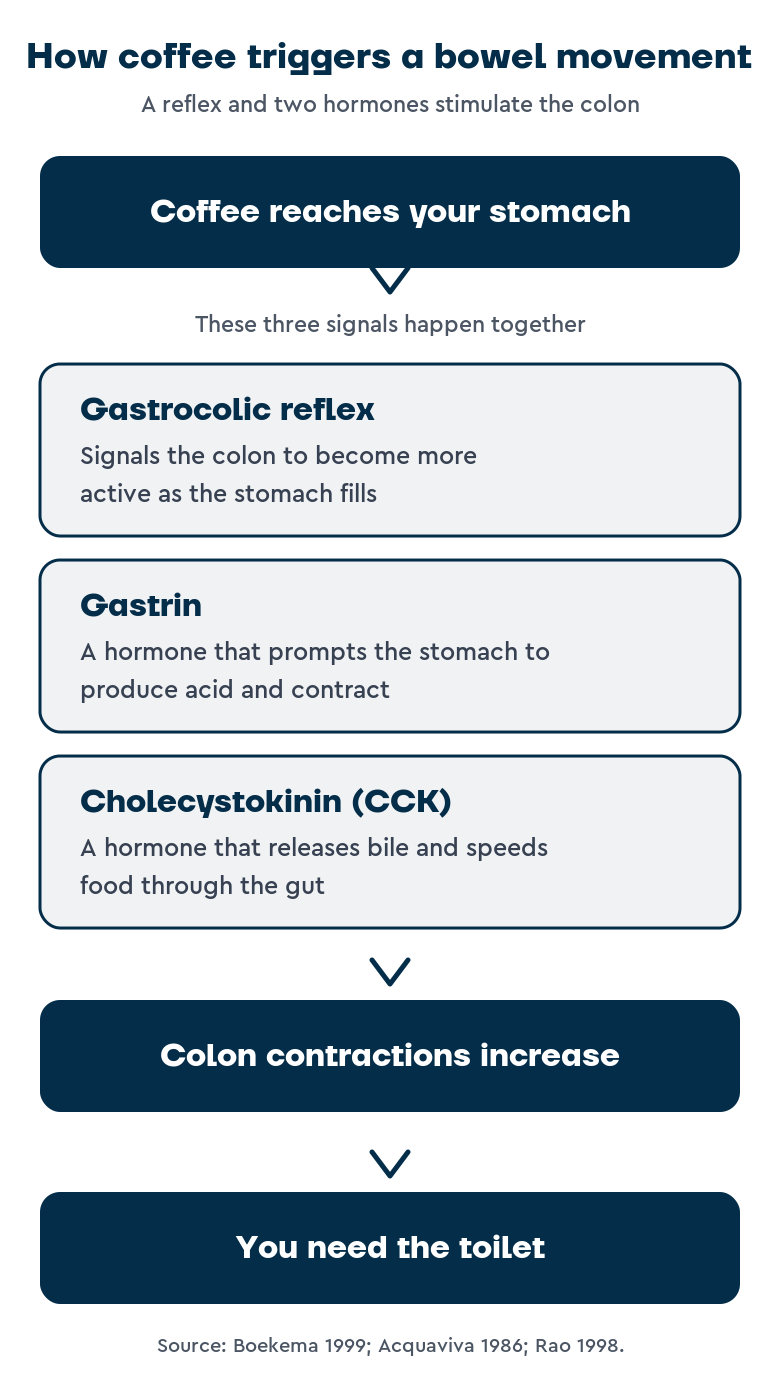
When coffee reaches your stomach, it triggers the gastrocolic reflex, the body’s natural response to food or drink arriving in the stomach.2
This reflex signals the colon to become more active and make space for what’s coming through.
Coffee also prompts the body to release two digestive hormones, gastrin and cholecystokinin (CCK).
Gastrin stimulates the stomach to produce acid and contract, part of the early stage of digestion.3
CCK triggers the gallbladder to release bile and speeds up the movement of food through the intestines.2
Together, these signals increase ‘colonic motor activity’, the wave-like muscle contractions (‘peristalsis’) that move stool towards the rectum.2
In one study that measured pressure inside the colon, caffeinated coffee produced about 60% more colonic activity than water, and as much as eating a 1,000-calorie meal.4
It’s mostly not the caffeine
Caffeine plays a part, but it isn’t the main reason that coffee makes us need to go to the toilet.
In a 1990 study published in the journal Gut, decaffeinated coffee produced the same effect as regular coffee, and just as quickly.1
A review of coffee and digestion concluded that “caffeine cannot solely account for” coffee’s effects on the gut.2
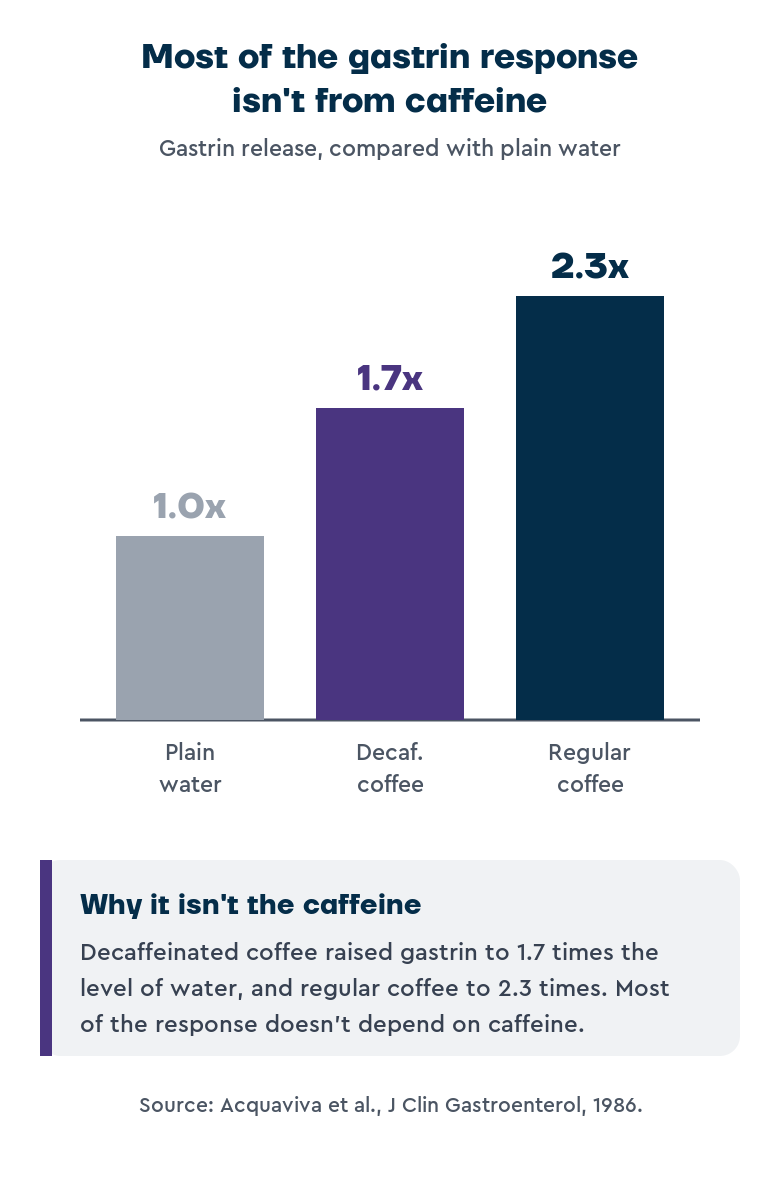
Decaffeinated coffee also strongly raises gastrin levels. In one study, it raised gastrin to about 1.7 times the level seen after plain water, and regular coffee to about 2.3 times.3
Still, caffeine does add to the effect on our gut. The same colon study found that caffeinated coffee was about 23% more stimulating than decaffeinated coffee, so it contributes without being the main cause.4
Most of coffee’s effect on the bowel comes from its other compounds, such as chlorogenic acids, which are thought to stimulate stomach acid and the hormone response.
The same review noted that coffee’s effects can’t be explained by its volume, acidity, or calories alone, suggesting it has a mild drug-like effect on the gut.2
One 2019 study found that both caffeinated and decaffeinated coffee suppressed gut bacteria and increased intestinal muscle contractions in rats. This was early research in animals and laboratory dishes, presented at a conference rather than published in a journal, so it can’t be applied directly to people.5
| Drink or stimulus |
Effect on the colon |
What this suggests |
| Caffeinated coffee |
About 60% more colonic activity than water, and as strong as a 1,000-calorie meal4 |
Coffee is a strong, fast trigger |
| Decaffeinated coffee |
Produces the same effect as regular coffee, with about 23% less colonic activity1,4 |
Most of the effect isn’t from caffeine |
| Hot water |
No measurable rise in colonic activity1 |
It isn’t the warmth or the liquid |
| A 1,000-calorie meal |
Strong stimulation, similar to caffeinated coffee4 |
Coffee affects the gut as strongly as food |
Why coffee works so fast
The speed at which coffee works shows that caffeine can’t be the main cause of its effect on our gut.
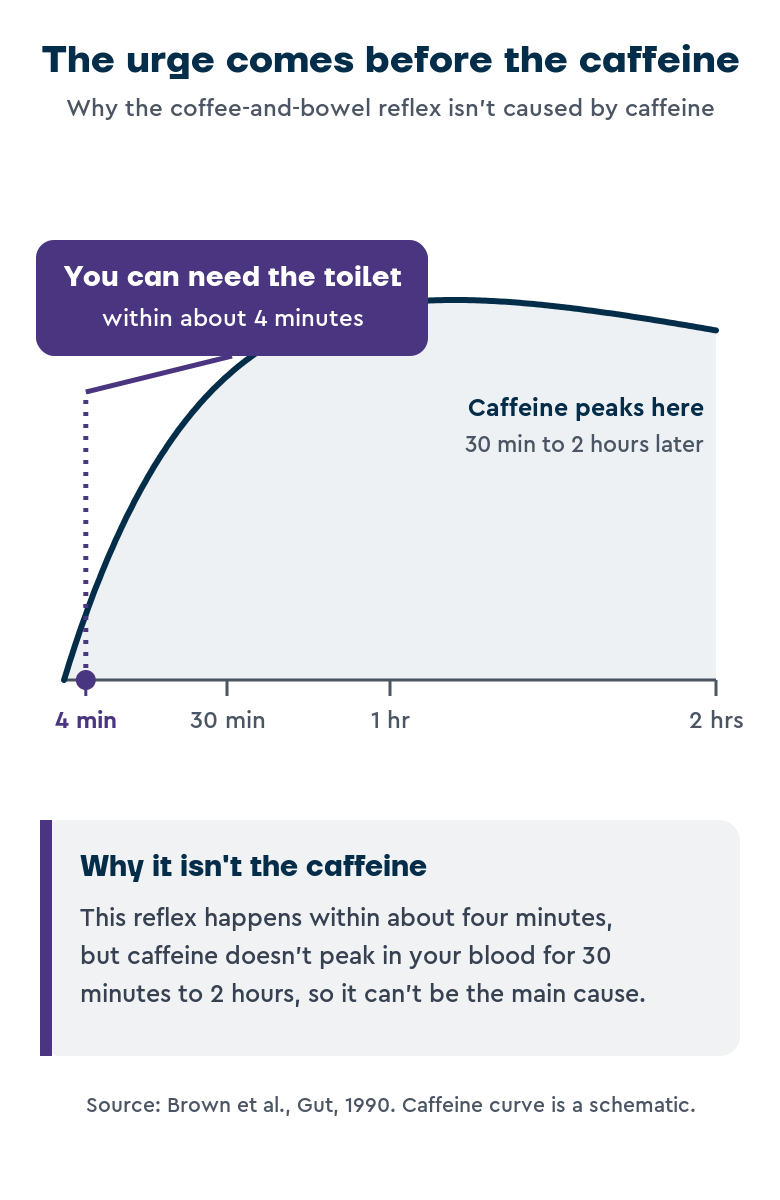
The urge to have a bowel movement can arrive within about four minutes of drinking coffee.1
That’s far too quick for the coffee to have been digested, and far too quick for caffeine to have reached your bloodstream in any meaningful amount.
Caffeine isn’t absorbed instantly. Blood levels build gradually and peak roughly 30 minutes to two hours after you drink it.
So the speed of the effect can’t come from caffeine circulating in your bloodstream. Instead, it happens through a reflex, where coffee reaching your stomach sends nerve and hormone signals to the colon almost immediately.1,2
Why coffee and not tea or energy drinks
If caffeine were the cause, any caffeinated drink would have the same effect. Many don’t, at least not as reliably.
What sets coffee apart is the non-caffeine compounds it contains.
The chlorogenic acids and related plant compounds that produce much of the gastrin and reflex response aren’t found in the same form in tea, cola, or energy drinks.2,3
Tea contains caffeine and other compounds, and it has a laxative effect for some people, but coffee is the more consistent trigger.
The warmth isn’t the cause either. In the 1990 study, hot water alone didn’t increase colonic activity, so it’s the coffee, not the temperature.1
Does coffee make everyone poop?
No, coffee doesn’t affect everyone in the same way. It produces a noticeable effect in some people and none at all in others.
In a 1990 study of 99 people, 29% reported that coffee gave them the urge to have a bowel movement.1
Among those who felt it, about 63% were women, so the effect appears more common in women than men.1
When the researchers measured colonic activity directly, coffee increased it in the people who reported the urge, but not in those who didn’t, so sensitivity varies from one person to the next.1
Exactly why some people respond, and others don’t, isn’t fully understood. Differences in gut sensitivity and the strength of the hormone response are the likely reasons.
Can coffee cause diarrhoea or constipation?
In some people, coffee can cause looser stools or even diarrhoea, but it rarely causes constipation, and may even help prevent it.
For most people, coffee simply brings on a normal bowel movement rather than diarrhoea.
When it does cause looser stools, it’s because coffee speeds up stool movement through the colon, leaving less time for the body to reabsorb water.
People living with IBS often find coffee a particularly strong trigger.⁷
It’s also worth considering what you add to your coffee. If you’re lactose intolerant, the milk rather than the coffee could be upsetting your digestion.
When it comes to constipation, coffee is more likely to relieve it than cause it. In a study of nearly 14,000 U.S. adults, people who consumed more caffeine were less likely to be constipated.⁶
So for most people, a morning coffee is a normal and helpful part of their routine rather than anything to worry about.
How to reduce the effect
If coffee makes you need the toilet more often than you’d like, a few simple changes can help.
- Eat something first: food triggers the same reflex, so coffee on a full stomach often has a milder effect than coffee on an empty stomach
- Check what you add to it: if dairy seems to be the trigger, try less milk or a different type of milk
- Don’t rely on decaffeinated coffee: it produces the same response, so switching won’t reliably stop the effect1
- Drink water alongside it: staying hydrated supports regular, healthy digestion
- Cut back if your digestion is sensitive: if you live with IBS, the NHS suggests no more than 3 cups of tea, coffee, or other caffeinated drinks a day7
- Eat a diet based on whole foods rich in a variety of plant foods; this will support good gut health and improve the regularity and consistency of our stool
When to see your GP
Needing the toilet after your morning coffee is usually completely normal and nothing to worry about.
It’s worth speaking to your GP if you notice a lasting change in your usual bowel habits, blood in your stool, persistent diarrhoea or urgency, unexplained weight loss, or stomach pain that won’t settle.
These symptoms usually have nothing to do with coffee, and they’re worth getting checked.
Frequently asked questions
Why does coffee make me poop almost immediately?
Because the effect is a reflex, not digestion. Coffee reaching your stomach triggers nerve and hormonal signals that travel to your colon within about 4 minutes, well before any caffeine is absorbed.1
Does decaf coffee make you poop?
Yes. Decaffeinated coffee produces a response almost identical to that of regular coffee, which is one of the clearest signs that caffeine isn’t the main cause.1
Why does coffee make me poop, but other caffeinated drinks don’t?
Because it’s mostly due to coffee’s non-caffeine compounds, such as chlorogenic acids, rather than the caffeine itself.
Tea, cola, and energy drinks contain caffeine but not the same compounds, so they have a less reliable effect on the bowels.2,3
Does coffee make you poop or just pee?
Coffee’s laxative effect and any diuretic effect are separate.
The urge to have a bowel movement comes from a reflex in the gut, while caffeine’s mild and often overstated diuretic effect acts on the kidneys, so they aren’t the same process.
Does coffee make everyone poop?
No. In one study, about 29% of people said coffee gave them the urge to have a bowel movement, and the effect was more common in women.1
Can coffee cause diarrhoea?
It can be for some people, especially those living with IBS. Faster movement through the colon leaves less time for water to be reabsorbed, which can make stools looser.7
Can coffee help with constipation?
For many people, it can help. In a study of nearly 14,000 adults, higher caffeine intake was associated with lower odds of constipation.6
Is the ‘7-second poop trick’ real?
There’s no good evidence behind viral ‘poop tricks’. What reliably stimulates a bowel movement is the natural reflex triggered by coffee, food, and a regular morning routine.
Why does coffee make me poop more on an empty stomach?
On an empty stomach, there’s nothing to dampen the reflex, so the contractions and hormone release can feel stronger and faster. Eating first often reduces the effect.Howev
Our guides explain coffee and weight loss and how food and drink can affect symptoms of IBS.
Take home message
Coffee makes you poop because it triggers a fast reflex in the gut. Within minutes, it releases the hormones gastrin and CCK and increases the muscle contractions that move stool through the colon.2,3,4
However, caffeine isn’t the main cause of this effect on our gut. Decaffeinated coffee produces almost the same effect, and the urge to go to the toilet arrives far too quickly for caffeine to have been absorbed.1
Coffee’s other compounds, such as chlorogenic acids, are responsible for most of its effects on our gut, which is also why it affects the bowels more reliably than tea or energy drinks.2
Still, coffee doesn’t have this effect on everyone. Around 29% of people feel the effect, more often women, and sensitivity varies from one person to the next.1
For most of us, it’s a harmless and even helpful part of the morning. If coffee regularly causes diarrhoea or urgency, or you notice a lasting change in your bowel habits, it’s worth speaking to your GP.
At Second Nature, we help people build lasting habits around a diet based on whole foods, with enough protein, fibre, and complex carbohydrates to support steady digestion and overall health.
Our programmes are run by registered dietitians and have supported hundreds of thousands of people across the UK.