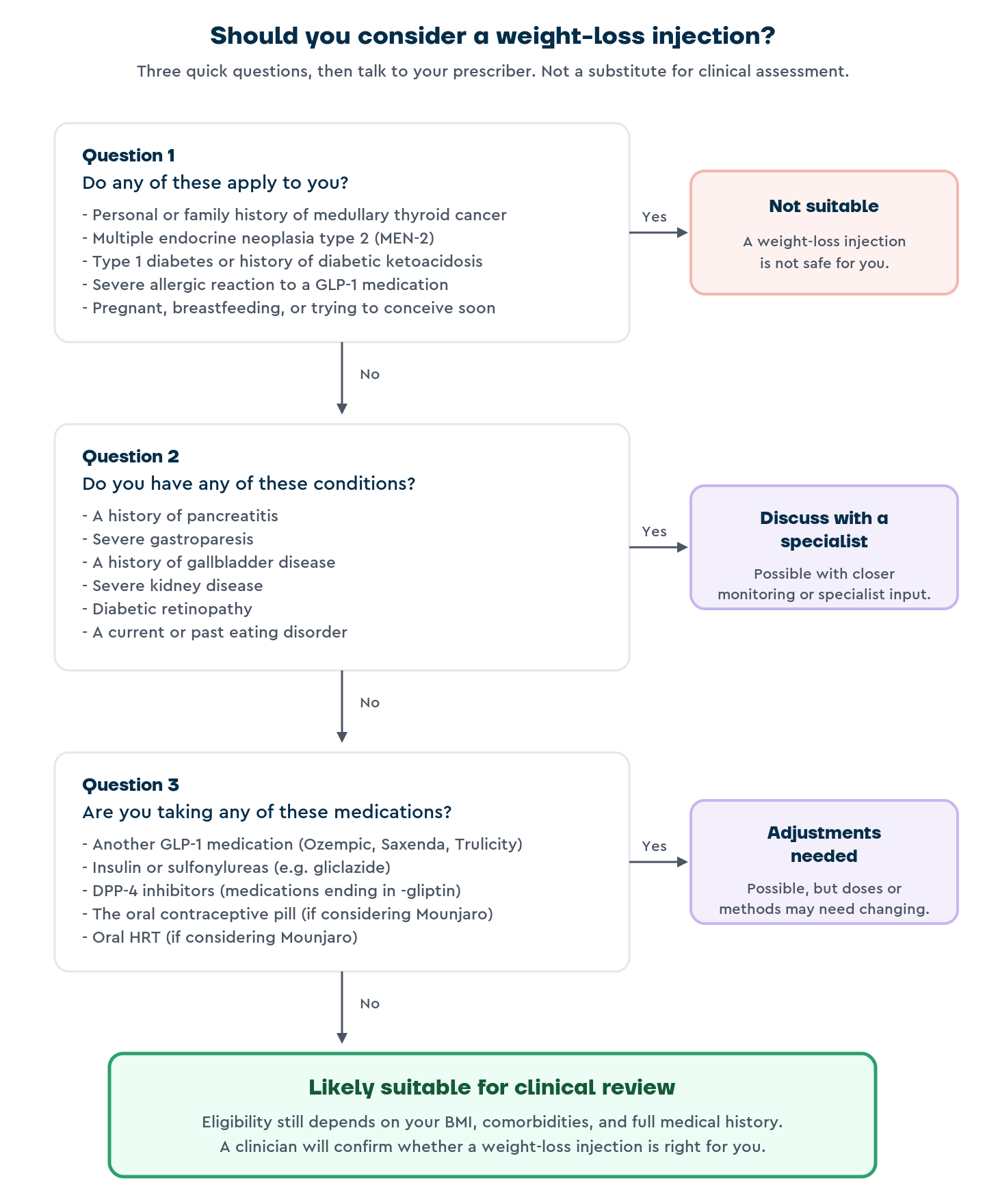
Who should never take weight-loss injections
Certain conditions are absolute reasons not to prescribe a GLP-1 medication for weight loss. These apply to Wegovy, Mounjaro, and other GLP-1 medications as a class.
A personal or family history of medullary thyroid cancer
Wegovy and Mounjaro are not prescribed to anyone who has had medullary thyroid cancer themselves, or who has a family member (parent, sibling, or child) who has had it.1,2
This restriction is based on animal studies where semaglutide and tirzepatide caused thyroid C-cell tumours in rats.
It’s not clear whether the same effect occurs in humans, and large reviews of human data from 2024 to 2025 have not shown an increased risk, but the family-history exclusion remains in place across all GLP-1 SmPCs.3
The exclusion only applies to medullary thyroid cancer, not to papillary, follicular, or Hürthle-cell thyroid cancers.
Multiple endocrine neoplasia type 2 (MEN-2)
MEN-2 is a rare inherited condition that raises the lifetime risk of medullary thyroid cancer.
People with MEN-2 are not prescribed weight-loss injections for the same reason as the family-history exclusion above.1,2
A serious allergic reaction to a GLP-1 medication
If you’ve previously had a severe allergic reaction to tirzepatide, semaglutide, liraglutide, or any other GLP-1 medication, you shouldn’t be re-prescribed one.
Serious reactions include anaphylaxis and angioedema (severe swelling of the face, lips, tongue, or throat).1,2
Type 1 diabetes or a history of diabetic ketoacidosis
Weight-loss injections aren’t licensed for type 1 diabetes. They lower blood glucose by supporting the body’s own insulin response, which doesn’t apply in type 1 diabetes, where the pancreas no longer produces insulin.1,2
If you’ve had diabetic ketoacidosis in the past, weight-loss injections also aren’t prescribed.1,2
Conditions that need extra caution
These conditions don’t automatically rule out weight-loss injections, but they do mean your prescriber will weigh the risks more carefully, monitor you more closely, or recommend a specialist review first.
A history of pancreatitis
Pancreatitis (inflammation of the pancreas) has been reported in people on GLP-1 medications, though it’s uncommon and the absolute risk increase is small.
Having had pancreatitis in the past doesn’t automatically rule out treatment, but your prescriber will weigh the risks more carefully before starting and will ask you to watch for warning signs (severe upper-abdominal pain that spreads to the back, with nausea or vomiting).
Severe gastroparesis
Gastroparesis is a condition where the stomach empties food more slowly than normal.
Because Wegovy and Mounjaro themselves slow stomach emptying as part of how they work, they’re not recommended for people with severe gastroparesis. Mild gastroparesis may still be treatable, but needs specialist input.4
A history of gallbladder disease
A 2022 systematic review of 76 randomised trials found that GLP-1 medications are associated with a relative risk of around 37% for gallbladder or biliary disease, with a higher relative risk in weight-loss trials than in diabetes trials.5
The absolute risk increase is small (around 3 extra cases for every 1,000 people taking the medication for a year), and the effect is partly explained by weight loss rather than the medication itself.5
If you’ve had gallbladder disease in the past, your prescriber will discuss the risks and watch for symptoms. Having had your gallbladder removed isn’t a barrier to treatment.
Severe kidney disease
The gastrointestinal side effects of weight-loss injections (nausea, vomiting, diarrhoea) can cause dehydration, which can worsen existing kidney function.1,2
People with moderate kidney disease can often take weight-loss injections with more frequent monitoring.
Severe or end-stage kidney disease usually needs specialist input before starting.
Diabetic retinopathy
For people with diabetes and existing diabetic retinopathy, rapid improvements in blood sugar control can sometimes temporarily worsen the retinopathy.
Your prescriber needs to know about any eye conditions before you start, and any new vision changes should be reported promptly.1,2
A history of eating disorders
A current or past eating disorder doesn’t rule out treatment outright, but your prescriber will weigh it carefully before starting.
GLP-1 medications reduce hunger, which can deepen the restrictive eating patterns of disorders like anorexia and have been linked to relapses in case reports.6
If you have a history of an eating disorder, this should be discussed openly with your prescriber and ideally with the clinician who treated the eating disorder.
Severe depression or active suicidal thoughts
The MHRA, FDA, and EMA have reviewed the evidence and found no causal link between GLP-1 medications and suicidal thoughts or behaviour. The FDA asked manufacturers to remove the warning from product labels in 2025.7
Even so, your prescriber should know about any history of severe depression or active suicidal ideation, and you should report any new mood changes while on the medication.
If you want to check your own conditions and medications against weight-loss injection compatibility in a few clicks, try our compatibility checker.
Medications that interact with weight-loss injections
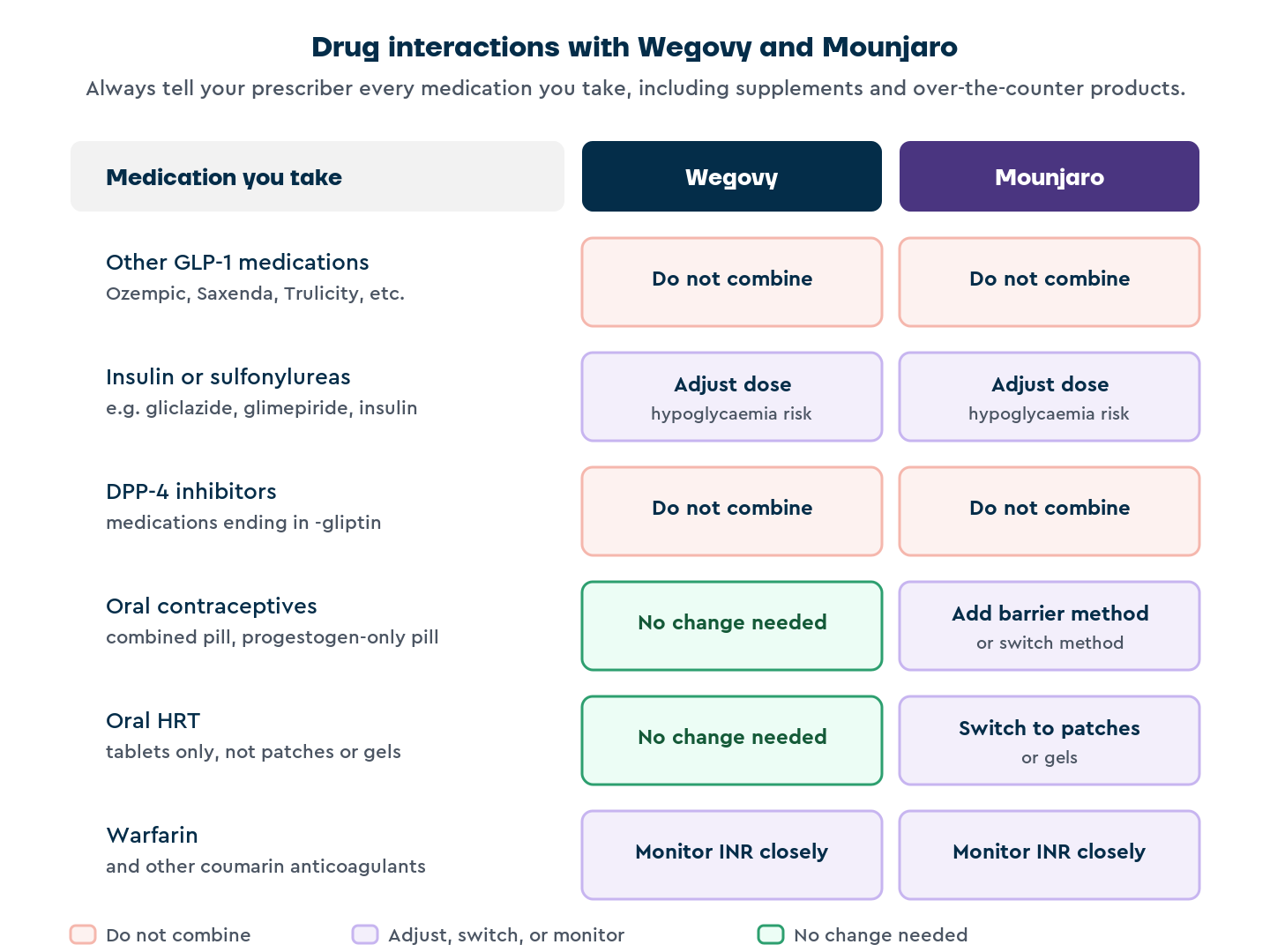
Tell your prescriber about every medication you take, including over-the-counter products and supplements.
Other GLP-1 medications
You can’t take two GLP-1 medications at the same time. This applies to Wegovy, Mounjaro, Ozempic, Saxenda, Victoza, Trulicity, Byetta, and Bydureon.
Combining them raises the risk of side effects without adding benefit.8
Insulin and sulfonylureas
If you take insulin or a sulfonylurea (such as gliclazide or glimepiride) for diabetes, starting a weight-loss injection significantly raises your risk of low blood sugar.8
Your prescriber will usually reduce the dose of insulin or sulfonylurea when you start Wegovy or Mounjaro. Insulin should never be stopped abruptly, as this can trigger diabetic ketoacidosis.
DPP-4 inhibitors
DPP-4 inhibitors (sitagliptin, linagliptin, vildagliptin, alogliptin, saxagliptin) work through a pathway similar to that of GLP-1 medications. They shouldn’t be taken together.
If you’re currently on a DPP-4 inhibitor, your prescriber will switch you to an alternative before starting a weight-loss injection.8
Oral contraceptives (Mounjaro only)
Mounjaro can reduce the effectiveness of the contraceptive pill, because slowed stomach emptying changes how the pill is absorbed.9
If you take the combined pill or the progestogen-only pill, you should either:
- Switch to a non-oral method (implant, injection, IUD, patch, or ring), or
- Use an additional barrier method (condoms) for 4 weeks after starting Mounjaro and for 4 weeks after each dose increase
This interaction doesn’t apply to Wegovy, and it doesn’t apply to non-oral hormonal contraceptives.9
Hormone replacement therapy (Mounjaro only)
The same absorption issue applies to oral HRT. If you’re taking oral HRT and starting Mounjaro, your prescriber may suggest switching to a transdermal preparation (patches or gels), which are absorbed through the skin rather than the gut.9
This switch isn’t required for Wegovy.
Warfarin and other coumarin anticoagulants
Weight loss and dietary changes can both affect INR (a measure of how quickly the blood clots) in people on warfarin.
INR should be monitored more frequently when starting Wegovy or Mounjaro, and at each dose increase.8
Oral medications
Because GLP-1 medications slow stomach emptying, the absorption of other oral medications can be slightly delayed.
For most drugs, this doesn’t matter, but if you take medications where precise timing is important (such as some antibiotics that need an empty stomach, or thyroid hormone replacement), mention this to your prescriber or pharmacist.9
Pregnancy, breastfeeding, and age
Pregnancy and planning a pregnancy
Weight-loss injections shouldn’t be used during pregnancy.
Animal studies have shown potential risks to the developing baby, and human pregnancy data are very limited.1,2
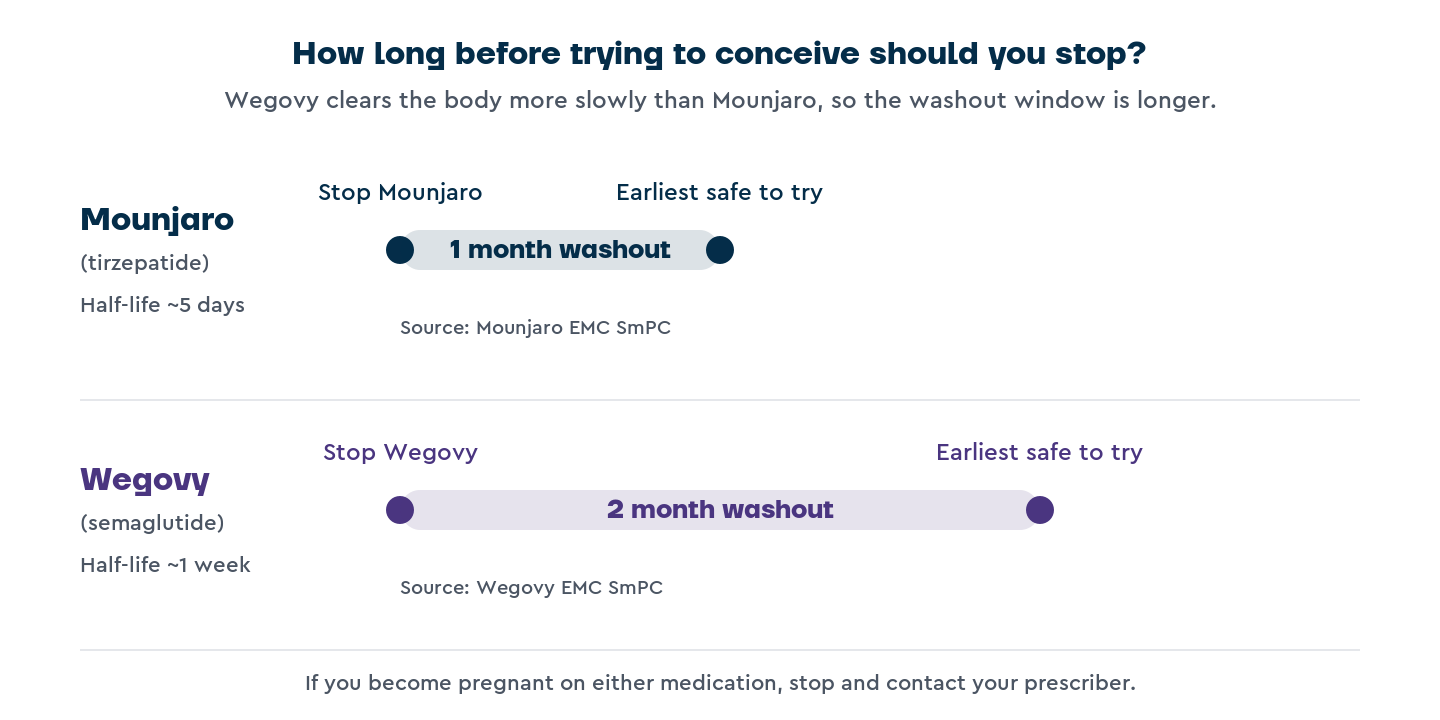
The washout period before trying to conceive differs between the two medications, because they clear from the body at different rates:
-
- Mounjaro: stop at least 1 month before trying to conceive2
- Wegovy: stop at least 2 months before trying to conceive1
If you become pregnant while on the medication, stop and contact your prescriber.
Inadvertent early exposure is not, on its own, a reason to end a pregnancy; your team will arrange individualised monitoring.
Breastfeeding
Wegovy and Mounjaro aren’t recommended during breastfeeding, because it isn’t known whether they pass into breast milk.1,2
Under 18
Wegovy is licensed in the UK for adolescents aged 12 and over who are living with obesity.
However, there is no NICE or NHS recommendation for adolescents aged 12-17.
Any use of Wegovy in this age group would need to be done under heightened clinical supervision and isn’t common in practice.
Second Nature does not accept anyone under the age of 18 onto our programme.
Mounjaro is licensed for adults aged 18 and over only.1,2
Any decision about weight-loss injections for someone under 18 should involve a specialist obesity service and the young person’s parents or guardians.
Over 65
Older adults can take weight-loss injections, but there are some additional considerations:
- Dehydration risk: gastrointestinal side effects can cause dehydration, which is more dangerous in older people and can worsen kidney function or cause falls
- Muscle mass: older adults already lose muscle with age, and rapid weight loss accelerates this. Eating enough protein and doing some resistance training matters more in this group
- Polypharmacy: older adults often take more medications, raising the risk of interactions
Clinical data in people over 85 is very limited, so prescribers are particularly cautious in this age group.10
If you are scheduled for surgery
Tell your surgical team and the anaesthetist that you’re taking a weight-loss injection, including the medication name, dose, and last injection date.11
Because GLP-1 medications slow stomach emptying, there’s a small risk of food or liquid still being in the stomach when you’re anaesthetised, which can be inhaled into the lungs (pulmonary aspiration).
The October 2024 international consensus guidance, including from the American Society of Anesthesiologists, took a more nuanced position than earlier blanket-stop advice:11
- Patients on stable doses, without GI symptoms, who are not in the dose-escalation phase can usually continue their medication before elective surgery
- Higher-risk patients (recent dose escalation, GI symptoms, very high doses) should follow a 24-hour clear-liquid diet before standard 6-hour fasting
- For emergency surgery, the anaesthetist will use techniques that protect against aspiration regardless of fasting
The specific plan should be agreed with your surgical team and anaesthetist in advance. UK practice can vary by hospital.
When to stop and seek help
Most side effects of weight-loss injections are mild and ease over the first few weeks; the risk of more severe side effects is low.
Stop the medication and contact your prescriber or NHS 111 (or 999 for the allergic reactions below) if you experience:
Signs of a severe allergic reaction
- Difficulty breathing or swallowing
- Swelling of the face, lips, tongue, or throat
- Widespread severe rash or itching
- Rapid heartbeat with feeling faint
Signs of pancreatitis
- Severe upper-abdominal pain that may spread to the back
- Pain that doesn’t go away and may worsen after eating
- Severe nausea and vomiting alongside the pain
Signs of gallbladder problems
- Pain in the upper right side of the abdomen, often after eating
- Fever
- Yellowing of skin or eyes (jaundice)
- Clay-coloured stools
Signs of severe dehydration
- Unable to keep fluids down for more than 24 hours
- Very dark urine, or not passing urine
- Severe dizziness or confusion
Signs of kidney problems
- Decreased urination
- Swelling in legs or ankles
- Persistent severe tiredness
Questions to ask your GP
Before starting a weight-loss injection, work through these with your prescriber:
Eligibility
- Are there any reasons I shouldn’t take this?
- Given my full medical history, am I a suitable candidate?
- What monitoring will I need, and how often?
Current medications
- Do any of my current medications interact with Wegovy or Mounjaro?
- Will any of my other doses need to be adjusted when I start?
- Do I need to change my contraception, HRT, or any oral medications?
Side effects and warning signs
- Which side effects are normal in the first few weeks?
- Which symptoms should make me stop and contact you?
- What should I do if my appetite drops too far and I can’t eat?
Follow-up
- How often will we review progress?
- What’s the plan if the medication isn’t working for me?
- If I want to stop, how should I come off it?
Frequently asked questions
What BMI do I need to get weight-loss injections in the UK?
For a private prescription, the MHRA licence covers adults with a BMI of 30 or higher, or a BMI of 27 or higher with at least one weight-related condition.12
NHS access is narrower and is being rolled out in phases under NICE Technology Appraisal TA1026.
Cohort 1 (active from June 2025) covers adults with a BMI of 40 or higher and at least four weight-related conditions. Cohort 2 (from June 2026) covers BMI 35 to 39.9 with four or more conditions.
Cohort 3 (from April 2027) covers BMI 40 or higher with three or more conditions.
The BMI threshold is reduced by 2.5 kg/m2 for people from South Asian, Chinese, other Asian, Middle Eastern, Black African, or African-Caribbean backgrounds.13
Can I take a weight-loss injection if I’ve had my gallbladder removed?
Yes. Having had your gallbladder removed isn’t a contraindication. Mention it to your prescriber so they can take it into account, but it doesn’t rule you out.
Can I take a weight-loss injection if I have PCOS?
Yes. Weight-loss injections are often beneficial for people with polycystic ovary syndrome, and weight loss can improve hormonal symptoms.
If you’re on Mounjaro and using the contraceptive pill, you’ll need a non-oral contraceptive method or barrier protection for the first four weeks of each dose.
Can I take a weight-loss injection if I have high blood pressure?
Usually yes. Weight loss often improves blood pressure, and your prescriber will monitor it as you lose weight.
Some blood pressure medications may need to be reduced as your weight drops.
Can a weight-loss injection cause cancer?
In rats, semaglutide and tirzepatide caused thyroid C-cell tumours. Human studies have not shown the same effect, but the family-history exclusion for medullary thyroid cancer is kept in place as a precaution.
Large reviews of human data from 2024 to 2025 have not shown an increased risk of other cancers with these medications.3
Are weight-loss injections addictive?
Weight-loss injections aren’t inherently addictive.
However, as they reduce hunger and cravings, it may feel challenging to come off them in the future if you haven’t developed the healthy habits to manage hunger naturally.
In this scenario, some people may feel dependent on the medication to manage hunger.
But obesity is a chronic condition, and many people may need to be on these medications for the long term to help them manage their weight.
Can I drink alcohol on Wegovy or Mounjaro?
There’s no direct interaction between alcohol and GLP-1 medications.
Alcohol can worsen nausea and other digestive side effects, and can affect blood sugar control in people with diabetes.
If you do drink, keep it moderate, particularly in the first few weeks.
What happens if I buy a weight-loss injection online from an unverified seller?
The MHRA has warned repeatedly that compounded and unlicensed GLP-1 products sold through online sellers, beauty clinics, and social media are not regulated, may contain incorrect doses, and have been linked to hospital admissions.14
Wegovy and Mounjaro should only be obtained from a registered UK pharmacy after a clinician review.
Take home message
Wegovy and Mounjaro are effective for managing obesity, but they’re not suitable for everyone.
The absolute reasons not to take them are a personal or family history of medullary thyroid cancer, MEN-2, type 1 diabetes, diabetic ketoacidosis, and a previous serious allergic reaction to a GLP-1 medication.
Several other conditions, including a history of pancreatitis, gallbladder disease, severe gastroparesis, severe kidney disease, diabetic retinopathy, and a history of an eating disorder, need extra clinical caution rather than being automatic exclusions.
Drug interactions are most clinically important with insulin and sulfonylureas (hypoglycaemia risk), DPP-4 inhibitors (don’t combine), and (for Mounjaro only) oral contraceptives and oral HRT.
Pregnancy and breastfeeding rule out treatment, with a 1-month washout before conception for Mounjaro and a 2-month washout for Wegovy. Tell your anaesthetist if you’re scheduled for surgery.
Second Nature’s clinical team reviews every applicant against the MHRA SmPC and NICE guidance before prescribing, and our wraparound habit-change support is designed to reflect the realities of being on and eventually coming off a GLP-1 medication.
A peer-reviewed study published in JMIR Formative Research in 2025 found that active subscribers on Second Nature’s GLP-1-supported programme lost an average of 19.1% of their body weight at 12 months, with 77.7% achieving at least 10% weight loss.15
Second Nature's Mounjaro and Wegovy programmes
Second Nature provides Mounjaro or Wegovy as part of our Mounjaro and Wegovy weight-loss programmes.
Why choose Second Nature over other medication providers, assuming you're eligible?
Because peace of mind matters.
We've had the privilege of working with the NHS for over eight years, helping people across the UK take meaningful steps toward a healthier, happier life.
Our programmes are designed to meet people where they are, whether that means support with weight loss through compassionate one-to-one health coaching, or access to the latest weight-loss medications (like Mounjaro and Wegovy) delivered alongside expert care from a multidisciplinary team of doctors, psychologists, dietitians, and personal trainers.
At the heart of everything we do is a simple belief: real, lasting change comes from building better habits, not relying on quick fixes. We're here to support that change every step of the way.
With over a decade of experience, thousands of lives changed, and a long-standing record of delivering programmes used by the NHS, we believe we're the UK's most trusted weight-loss programme.
We hope to offer you something invaluable: peace of mind, and the support you need to take that first step.