Jump to: What the research shows about stopping Wegovy | Why you might regain weight after stopping Wegovy | Can you keep the weight off after stopping Wegovy? | Use our free Weight Regain Prevention Planner | Do you need to stay on Wegovy forever? | Frequently asked questions | Take home message
Research suggests that most people regain some weight after stopping Wegovy (semaglutide), but how much you regain depends largely on whether you come off slowly and have built sustainable habits while taking the medication.
In studies where people stopped suddenly without further support, they regained about two-thirds of their lost weight within a year.1
In the STEP 1 trial extension, 327 adults taking Wegovy lost an average of 17.3% of their body weight over 68 weeks, compared with 2% on a placebo.1
One year after both the medication and their lifestyle support were stopped, average weight loss had fallen to 5.6%, while the placebo group sat at 0.1%.1 That means the people who had taken Wegovy regained about 11.6 percentage points of body weight, or roughly two-thirds of what they’d lost.
This trial also stopped people abruptly and removed their lifestyle support at the same time, rather than tapering the dose gradually, which is closer to standard medical practice for many medications.
So, this research doesn’t prove that weight regain is inevitable on weight-loss injections like Wegovy. But it does show that if you don’t use the time on the medications to build healthy habits and come off the medication slowly, your risk of weight regain is higher.
Important safety information: Wegovy (semaglutide) is a prescription-only medication for managing obesity. This article is for informational purposes only. Always consult with your healthcare provider before starting, stopping, or changing the dose of any medication.
What the research shows about stopping Wegovy
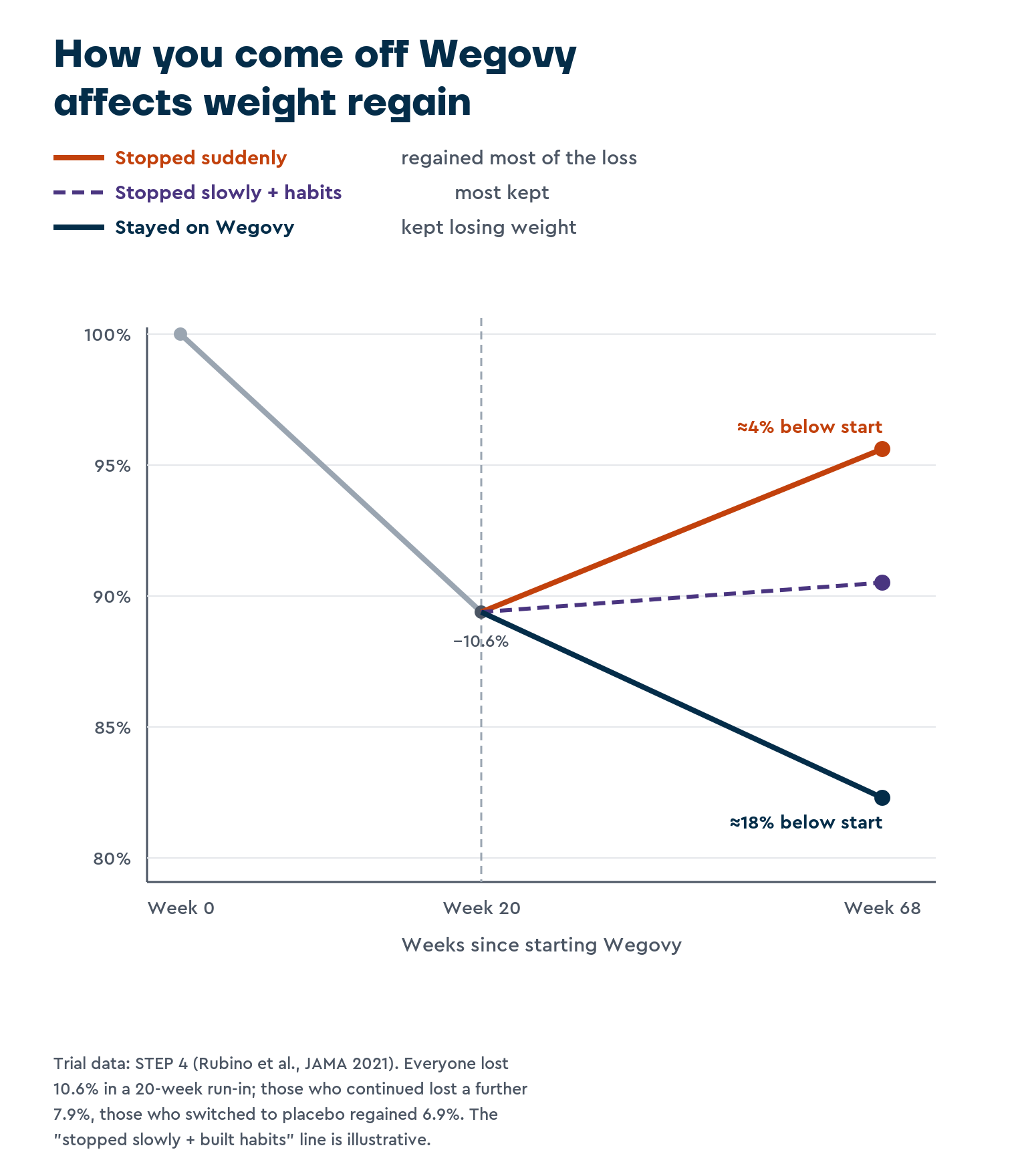
A second trial, STEP 4, was designed to compare staying on Wegovy with stopping it.2
Participants first took Wegovy for 20 weeks and lost an average of 10.6% of their body weight.2
The 803 people who reached that point were split into two groups. One group continued with Wegovy, while the other switched to a placebo, stopping the medication abruptly without a taper (a gradual reduction of the dose over many months before coming off).2
Over the next 48 weeks, the group that stayed on Wegovy continued to lose weight, reaching about 18% below their starting weight.2
The group that stopped regained most of what they’d lost, ending about 4% below their starting weight on average.2
| Group in STEP 4 |
Average weight lost at 20 weeks (before the split) |
Average by 68 weeks |
| Everyone (first 20 weeks on Wegovy) |
10.6% lost |
Split into the two groups below |
| Continued Wegovy |
10.6% lost |
About 18% lost |
| Stopped suddenly (placebo) |
10.6% lost |
About 4% lost (regained about 7% over the year) |
Even after regaining some weight, the group that stopped was still below their starting weight on average.
A loss of around 5-10% is enough to improve health markers such as blood pressure and blood sugar.
This pattern of regain is consistent across trials of weight-loss medications in which participants were suddenly taken off the medication without a tapering schedule (where the dose is gradually reduced over time).
The weight regain data is why many experts describe weight-loss injections as long-term, even lifelong, treatments.
We think that’s too black-and-white because these trials tested abruptly stopping the medication with no taper and no structured habit support. You could argue that in these conditions, weight regain was inevitable.
Why you might regain weight after stopping Wegovy
Wegovy works by mimicking one of your body’s own appetite hormones, GLP-1, which reduces hunger and food noise.
When you stop, that effect fades as the medication leaves your system. Hunger can return, food noise may come back, and it becomes harder to eat in a way to sustain a lower weight.
If you return to your old eating habits and gradually increase your calorie intake, you’re likely to regain weight.
How much you regain usually comes down to whether you used your time on Wegovy to change three things:
- You’re still eating mostly ultra-processed foods. Wegovy helps us eat less, whatever type of food we’re eating. However, if we stop taking the medication and we haven’t changed our eating habits, we’re likely to revert to old portion sizes and regain weight.
- You haven’t built regular movement into your week. Research suggests people who stay active after losing weight are more likely to keep it off.
- You haven’t addressed why you overeat, such as stress, low mood, or emotional eating. If those triggers are still there once Wegovy is no longer reducing your hunger, old eating patterns can return.
Second Nature has worked with the NHS since 2017, combining Wegovy with structured habit-change support to prevent future weight regain.
Take our 3-minute eligibility quiz, and a clinician will review your answers.
Can you keep the weight off after stopping Wegovy?
Weight regain isn’t inevitable, but avoiding weight regain is one of the hardest parts of weight loss, with or without medication.
Eat a diet based on whole foods
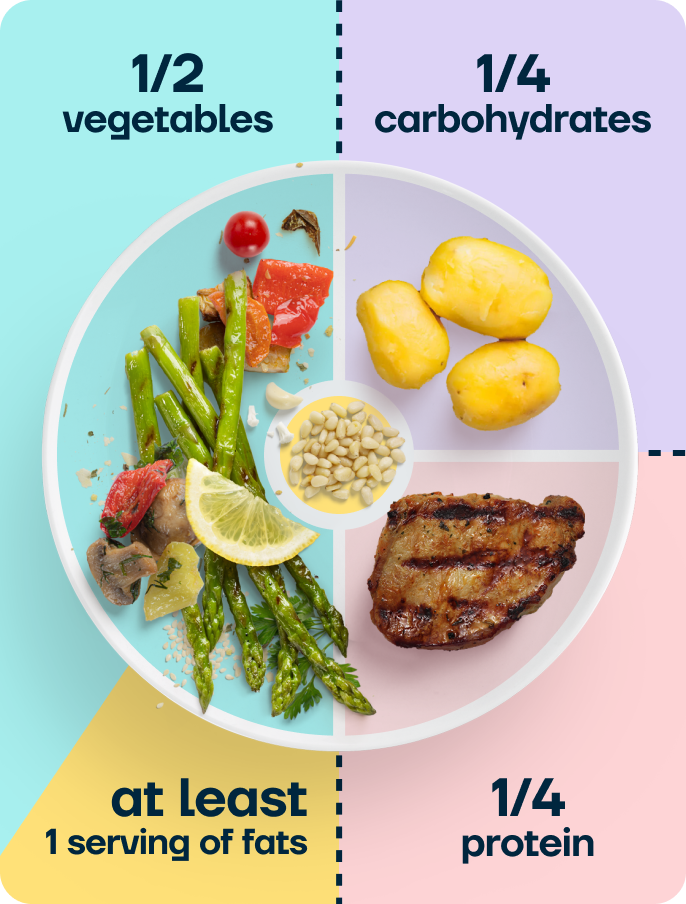
We recommend eating a diet based on whole foods that contains enough protein, fibre, fat, and complex carbohydrates and limits ultra-processed foods.
Whole foods help your body manage appetite more naturally. This becomes more important once you stop, when the medication is no longer reducing your hunger.
Get enough protein at each meal
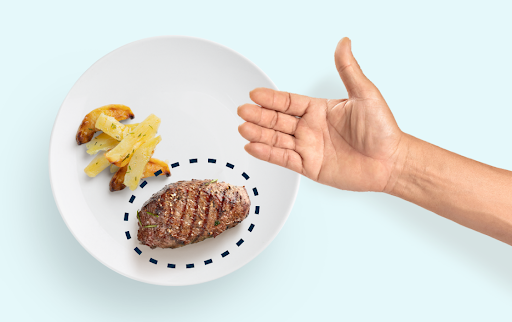
Protein is the most filling nutrient, so it helps manage the hunger that returns as Wegovy leaves your system.
Aim for a portion of protein roughly the size of your palm at each meal, about 30 to 40 grams.
Build movement into your week
Movement and exercise are among the most effective ways to maintain long-term weight loss, as they help improve the signals from our bodies to the brain that signal fullness.
A 10-minute walk after dinner is a realistic place to start, and you can do a little more as it feels manageable.
Strength training a couple of times a week helps you keep muscle, which supports your metabolism as you maintain your weight.
Address the underlying causes of overeating
Losing weight is as much about understanding why we eat as about what and how much we eat.
Emotional eating, environmental triggers, stress, and sometimes past experiences shape our relationship with food.
Working on these while you’re still on the medication gives you the best chance of keeping the weight off afterwards.
Come off slowly rather than suddenly
Tapering the dose gradually gives your appetite time to adjust, and lets you test your habits while you still have some support from the medication.
Tapering off medication is standard clinical practice. The weight regain research published so far is testing an extreme scenario where participants abruptly stopped the medication, in practice, this would rarely happen.
Our free Weight Regain Prevention Planner, below, generates a tapering schedule based on your current dose.
Use our free Weight Regain Prevention Planner
In research we presented in 2026, 59% of people who reduced their dose slowly while building healthy habits maintained their weight loss six months later.
Our free Weight Regain Prevention Planner assesses your habits across the eight areas that protect against regain: diet quality, protein, meal planning, aerobic exercise, strength training, emotional eating, sleep, and stress.
It shows you which habits are already in place and which still need work, then generates a personalised plan in around 3 minutes.
If you’re thinking about reducing or stopping Wegovy, the planner also generates a tapering schedule based on your current dose.
Do you need to stay on Wegovy forever?
At Second Nature, we don’t believe you have to stay on Wegovy for life to keep weight off.
We think about it, and other weight-loss injections like Mounjaro, in a similar way to antidepressants.
Antidepressants are rarely prescribed as a lifelong cure for depression.
They’re used to open a window to treatment, giving someone the space to engage with therapy and address the underlying causes of their condition.
We see these medications similarly. They calm the food noise so people can reduce the time they spend thinking about food, and by working on the brain’s appetite control centre, the hypothalamus, they open a window to treatment.
That window is the time to build the eating, movement, and behavioural habits that prevent weight regain if you come off the medication in the future.
Still, some people will need to stay on the medication for longer.
Obesity is a chronic condition, and for some people who may have a genetic adaptation that’s contributing to higher hunger and cravings, using the medication in the long term may be necessary.
Frequently asked questions
Will I regain all the weight if I stop Wegovy?
It’s not inevitable. In the STEP 1 trial extension, people who stopped suddenly regained about two-thirds of what they’d lost over the following year and stayed 5.6% below their starting weight on average.1
Building habits while you’re on the medication and tapering off slowly lowers the amount you’re likely to regain.
How much weight do people regain after stopping Wegovy?
In the STEP 1 trial extension, people regained about two-thirds of their lost weight in the year after stopping suddenly.1
In STEP 4, those who stopped regained most of their losses, while those who continued lost more.2
How much you regain depends largely on whether you’ve built habits to manage hunger without the medication.
How quickly do you put weight back on after stopping Wegovy?
Wegovy stays in your system for about five weeks after your last dose, so appetite usually returns gradually over the first month or so.3
Regain tends to be fastest in the early weeks, when hunger rebounds most strongly.
Does food noise come back after stopping Wegovy?
For many people, yes. As the effect of the medication fades, the food noise and cravings that quietened on it often return.
Habits around protein, whole foods, sleep, and stress make this easier to manage.
Can you stop Wegovy suddenly?
You can, but it isn’t the approach most likely to maintain your weight loss, nor is it considered clinical best practice.
Tapering the dose gradually gives your appetite time to adjust and lets you test your habits while you still have some support from the medication. Always discuss stopping with your prescriber.
Is a maintenance dose of Wegovy a good idea?
Some people stay on a lower-maintenance dose to lower their hunger while they cement their habits, which can be a reasonable option.
It’s a decision to make with your prescriber, based on your progress and how confident you feel managing hunger without full support.
How long do you need to stay on Wegovy?
On the NHS, NICE recommends Wegovy for up to two years, within a specialist weight management service.4
Privately, there’s no fixed time limit, and many people stay on for one to two years while they lose weight and build habits, then taper off, though some choose or need to stay on longer.
Do you have to be on Wegovy for life?
No. Obesity is a chronic condition, and some people do benefit from long-term medication, but many can come off once they’ve built the habits to maintain their weight.
The goal is to develop a healthier lifestyle that inherently supports a lower weight in the long term, not come off the medication as fast as possible.
Are weight-loss injections addictive?
Weight-loss injections aren’t inherently addictive.
However, because they reduce hunger and cravings, it can feel hard to come off them if you haven’t developed the habits to manage hunger naturally.
In that situation, some people feel dependent on the medication.
But obesity is a chronic condition, and many people may need to be on these medications for the long term to help manage their weight.
Take home message
Some weight regain is likely if you stop Wegovy suddenly without having built the habits to maintain your new weight, but regain isn’t inevitable, and it usually isn’t all of the weight you’ve lost.
In the STEP 1 trial extension, people who stopped suddenly regained about two-thirds of their loss and remained 5.6% below their starting weight, while in STEP 4, those who stayed on Wegovy kept losing.1
Those trials stopped the medication abruptly with no taper and no structured habit-building support, so you could argue that weight regain was inevitable in these conditions.
Emerging research is showing that if you come off the medication slowly and build healthy habits, you’re less likely to regain weight.
You don’t have to stay on Wegovy forever. Like antidepressants, it can open a window to treatment, giving you time to build the habits that keep weight off, though some people will choose or need to stay on longer.
Second Nature combines Wegovy with structured habit-change support from registered dietitians and nutritionists, built around a balanced plate of vegetables, protein, complex carbohydrates, and healthy fats.
A peer-reviewed study in JMIR Formative Research found that active subscribers on Second Nature’s medication-supported programme lost an average of 19.1% of their body weight at 12 months, with 77.7% achieving at least 10% weight loss.5
The research suggests you’re more likely to avoid weight regain when Wegovy is combined with structured habit-change support than when it’s prescribed on its own.
Second Nature's Mounjaro and Wegovy programmes
Second Nature provides Mounjaro or Wegovy as part of our Mounjaro and Wegovy weight-loss programmes.
Why choose Second Nature over other medication providers, assuming you're eligible?
Because peace of mind matters.
We've had the privilege of working with the NHS for over eight years, helping people across the UK take meaningful steps toward a healthier, happier life.
Our programmes are designed to meet people where they are, whether that means support with weight loss through compassionate one-to-one health coaching, or access to the latest weight-loss medications (like Mounjaro and Wegovy) delivered alongside expert care from a multidisciplinary team of doctors, psychologists, dietitians, and personal trainers.
At the heart of everything we do is a simple belief: real, lasting change comes from building better habits, not relying on quick fixes. We're here to support that change every step of the way.
With over a decade of experience, thousands of lives changed, and a long-standing record of delivering programmes used by the NHS, we believe we're the UK's most trusted weight-loss programme.
We hope to offer you something invaluable: peace of mind, and the support you need to take that first step.