


Jump to: Check if you’re eligible | NHS eligibility criteria | The reality of NHS access | How to apply, step by step | What to expect on NHS Wegovy | How well Wegovy works | Private alternatives | Frequently asked questions | Take home message
You can get Wegovy (semaglutide) on the NHS, but only through a specialist weight-management service, and only if you meet the criteria.1
NICE recommends Wegovy on the NHS for adults with a BMI of 35 or above and at least one weight-related condition, or in some cases a BMI of 30 to 34.9, and only within specialist (Tier 3) services.1
In practice, access varies a lot by area, because each Integrated Care Board decides how to fund and run these services, and waits can be long.
If you don’t qualify, or you’re facing a long wait, a private prescription is the main alternative.
Our free checker covers the eligibility criteria for Wegovy and Mounjaro, the two weight-loss injections licensed in the UK, and tells you whether you’re likely to qualify privately, through the NHS, or whether you fall outside the criteria.
Lose weight your way and keep it off
GLP-1 medication, expert support, and a programme that fits your life


NHS eligibility criteria
To get Wegovy on the NHS, you need to meet the criteria in NICE guidance (TA875) and be seen by a specialist weight-management service.1
- A BMI of 35 or above with at least one weight-related condition, or in some cases a BMI of 30 to 34.9 if you meet the criteria for referral to a specialist service
- A referral to a specialist NHS weight-management service, as GPs can’t prescribe Wegovy directly
- Evidence that you’ve already tried to lose weight through changes to diet and activity
- No medical reasons that make the medication unsuitable for you
For people from South Asian, Chinese, other Asian, Middle Eastern, Black African, or African-Caribbean backgrounds, the BMI thresholds are usually lowered by 2.5.1
Weight-related conditions that can qualify you at the lower BMI threshold include type 2 diabetes, high blood pressure, sleep apnoea (interrupted breathing during sleep), heart disease, polycystic ovary syndrome, and fatty liver disease.
Your GP will usually confirm these conditions before referring you on.
The reality of NHS access
NICE recommended Wegovy on the NHS in March 2023, but NHS access is still limited.1
It’s only available through specialist weight-management services, not from your GP directly, and the number of these services varies by area.
Each Integrated Care Board funds its own services and sets its own local priorities, so waiting times differ widely, often running from several months to well over a year.
NHS treatment is also funded for up to 2 years within these specialist services, rather than indefinitely.1
On the NHS, the maximum dose of Wegovy is 2.4 mg a week. The MHRA approved a higher 7.2 mg dose in January 2026, but it isn’t funded on the NHS yet.4
How to apply, step by step
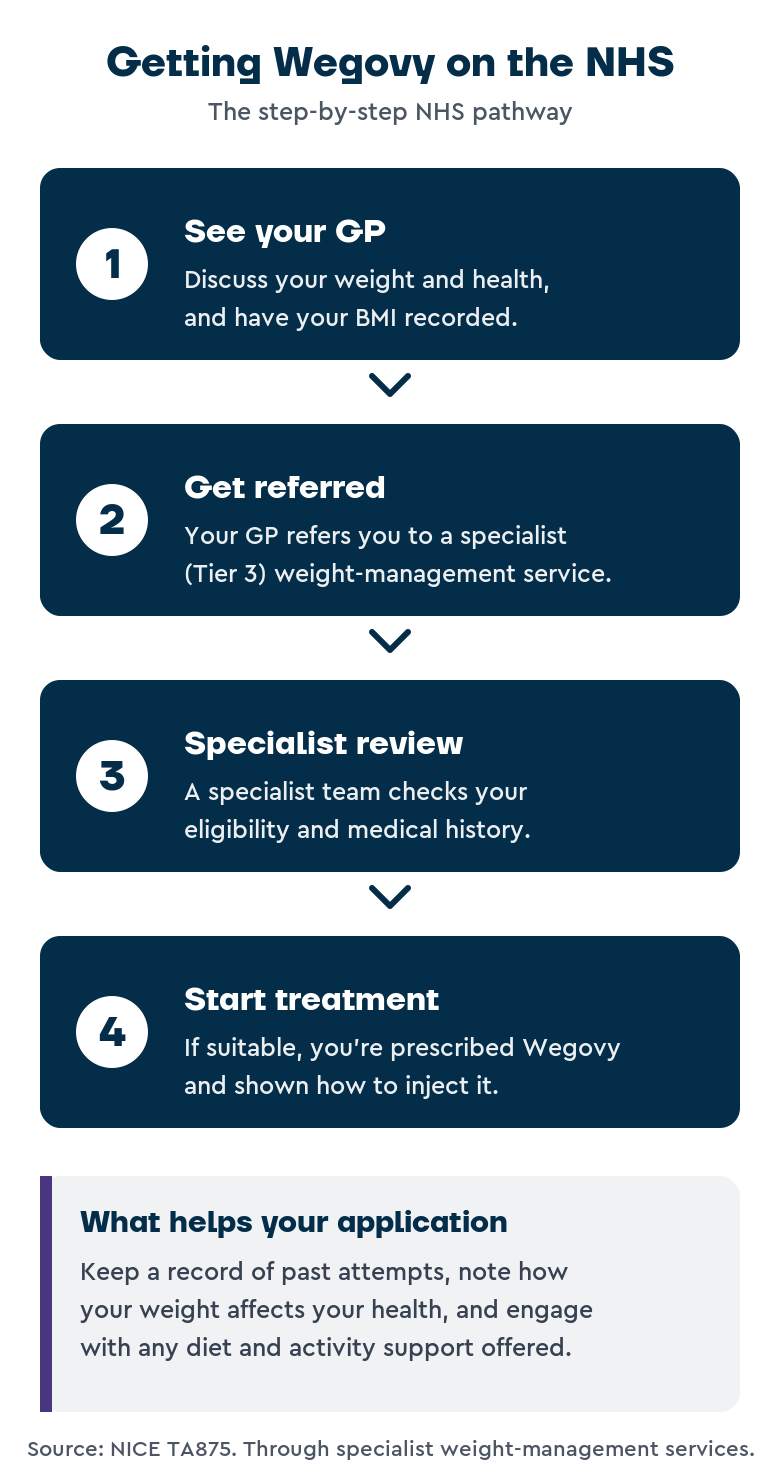
If you want to access Wegovy through the NHS, the pathway usually looks like this:
What to expect on NHS Wegovy
Wegovy is a once-a-week injection that you give yourself, usually in the stomach, thigh, or upper arm.2
You start on 0.25 mg a week, and the dose is increased gradually every 4 weeks up to the maintenance dose of 2.4 mg a week.2
Within specialist services, you can expect reviews every 1 to 3 months, with weight checks and support to manage any side effects, though how much dietetic support you get varies by area.
Treatment usually continues only if you’ve lost at least 5% of your starting weight after 6 months.1
The most common side effects are digestive, including nausea, diarrhoea, constipation, and vomiting, and they affect more than 1 in 10 people.2
These are usually mild to moderate, most likely while your dose is being increased, and tend to ease as your body adjusts.2
Wegovy can also make the contraceptive pill less effective, so if you take the pill, speak to your prescriber about using a barrier method such as condoms while you’re on it.2
Wegovy isn’t recommended in pregnancy or while breastfeeding.2
How well Wegovy works
In the STEP 1 trial, people taking Wegovy 2.4 mg lost an average of 14.9% of their body weight over 68 weeks, compared with around 2.4% on placebo.3
Around 70% of people lost at least 10% of their body weight, and about a third lost at least 20%.3
The higher 7.2 mg dose, approved by the MHRA in January 2026, produced an average weight loss of 20.7% in the STEP UP trial, though it isn’t available on the NHS yet.4
These results come from trials where the medication was combined with changes to diet and activity, which is how it’s designed to be used.
Private alternatives
If you don’t meet the NHS criteria, or you’re facing a long wait, a private prescription is the main alternative.
Private routes include online providers, private clinics, and some private GP services, with Wegovy typically costing around £150 to £300 a month depending on the dose.
Private services differ in how much support they include. Some offer the medication with a basic online screening, while others combine it with ongoing clinical care and structured support.
When you’re comparing providers, check that the service:
- Is registered with the Care Quality Commission, and dispenses through a pharmacy registered with the General Pharmaceutical Council
- Gives you a proper clinical assessment, not just a quick online form
- Provides ongoing monitoring and a named person to contact between prescriptions
- Offers support to help you maintain your weight loss and prevent weight regain in the future
Second Nature has worked with the NHS for over eight years, combining Wegovy or Mounjaro with one-to-one support from registered dietitians designed to help you keep the weight off.
Take our 3-minute eligibility quiz, and a clinician will review your answers.
Frequently asked questions
How long is the NHS waiting list for Wegovy?
Waiting times vary a lot by area, from several months to over a year.
The wait includes both getting into a specialist weight-management service and the assessment for medication once you’re there.
Can my GP prescribe Wegovy?
Not directly on the NHS. GPs can refer you to a specialist weight-management service, which assesses you and prescribes Wegovy if it’s suitable.1
A GP who also works privately may be able to prescribe it outside the NHS.
How do I qualify for weight-loss injections on the NHS?
For Wegovy, you generally need a BMI of 35 or above with a weight-related condition (or 30 to 34.9 in some cases), a referral to a specialist service, and evidence that diet and activity changes haven’t been enough on their own.1
You also need no medical reasons that make the medication unsuitable.
Is Wegovy available on the NHS for type 2 diabetes?
Wegovy is licensed for weight management, not as a type 2 diabetes treatment.
The semaglutide medication licensed for type 2 diabetes is Ozempic, which contains the same drug at lower doses.
How much does private Wegovy cost?
Privately, Wegovy typically costs around £150 to £300 a month, depending on the dose and the provider.
What’s the difference between Wegovy and Mounjaro?
In the SURMOUNT-5 head-to-head trial, Mounjaro produced an average weight loss of 20.2% compared with 13.7% for Wegovy at the 2.4 mg dose over 72 weeks.5
Mounjaro mimics two appetite hormones, GLP-1 and GIP, whereas Wegovy mimics only GLP-1, which is the likely reason its average weight loss was higher.
Wegovy’s higher 7.2 mg dose produced an average weight loss of 20.7% in a separate trial, though it hasn’t been compared with Mounjaro directly.4
Wegovy is also the only weight-loss injection with a heart-health benefit recognised on its UK label, based on the SELECT trial, which is relevant for people who already have heart disease.6
What are the side effects of Wegovy?
The most common are digestive, including nausea, diarrhoea, constipation, and vomiting, affecting more than 1 in 10 people.2
They’re usually mild to moderate, most likely while the dose is being increased, and tend to ease as your body adjusts.2
Will I regain weight after stopping Wegovy?
If you stop suddenly without having built the habits to manage hunger naturally, some weight regain is likely, because your appetite tends to return to where it was.
We recommend coming off the medication gradually and using your time on it to build habits that keep the weight off. Our free weight regain prevention planner walks you through this.
Are weight-loss injections addictive?
Weight-loss injections aren’t inherently addictive.
However, as they reduce hunger and quieten food noise, it may feel challenging to come off them in the future if you haven’t developed the habits to manage hunger naturally.
In that situation, some people may feel dependent on the medication to manage their weight.
But obesity is a chronic condition, and many people may need to be on these medications for the long term to help them manage it.
Take home message
Wegovy is available on the NHS, but access is limited by strict criteria, specialist capacity, and where you live, and the route runs through specialist weight-management services rather than your GP.
For people who qualify and can get into a service, Wegovy offers significant weight loss at no medication cost beyond the standard prescription charge, with regular monitoring.
For those who don’t qualify or face long waits, a private prescription offers faster access, at a monthly cost.
To optimise results and prevent weight regain after using Wegovy, we recommend eating a diet based on whole foods, that contains enough protein, fibre, fat, and complex carbohydrates, and limits ultra-processed foods.
The research suggests that you’re more likely to avoid weight regain when Wegovy is combined with structured habit-change support than when it’s prescribed on its own.
Second Nature combines Wegovy or Mounjaro with the balanced-plate approach and one-to-one support from registered dietitians.
In our published evaluation of a GLP-1-supported programme, members lost an average of 19.1% of their body weight at 12 months, with 77.7% losing at least 10%.7
Second Nature's Mounjaro and Wegovy programmes
Second Nature provides Mounjaro or Wegovy as part of our Mounjaro and Wegovy weight-loss programmes.
Why choose Second Nature over other medication providers, assuming you're eligible?
Because peace of mind matters.
We've had the privilege of working with the NHS for over eight years, helping people across the UK take meaningful steps toward a healthier, happier life.
Our programmes are designed to meet people where they are, whether that means support with weight loss through compassionate one-to-one health coaching, or access to the latest weight-loss medications (like Mounjaro and Wegovy) delivered alongside expert care from a multidisciplinary team of doctors, psychologists, dietitians, and personal trainers.
At the heart of everything we do is a simple belief: real, lasting change comes from building better habits, not relying on quick fixes. We're here to support that change every step of the way.
With over a decade of experience, thousands of lives changed, and a long-standing record of delivering programmes used by the NHS, we believe we're the UK's most trusted weight-loss programme.
We hope to offer you something invaluable: peace of mind, and the support you need to take that first step.
Lose weight your way and keep it off
GLP-1 medication, expert support, and a programme that fits your life
References
- National Institute for Health and Care Excellence. (2023). Semaglutide for managing overweight and obesity. Technology Appraisal TA875.
- Electronic Medicines Compendium. (2026). Wegovy: Summary of Product Characteristics.
- Wilding, J.P.H., Batterham, R.L., Calanna, S., et al. (2021). Once-weekly semaglutide in adults with overweight or obesity. New England Journal of Medicine, 384(11), 989-1002. (STEP 1 trial)
- Wharton, S., Freitas, P., Hjelmesæth, J., et al. (2025). Once-weekly semaglutide 7.2 mg in adults with obesity (STEP UP): a randomised, controlled, phase 3b trial. Lancet Diabetes & Endocrinology, 13(11), 949-963. (STEP UP trial)
- Aronne, L.J., et al. (2025). Tirzepatide as compared with semaglutide for the treatment of obesity. New England Journal of Medicine, 393(1), 26-36. (SURMOUNT-5 trial)
- Lincoff, A.M., Brown-Frandsen, K., Colhoun, H.M., et al. (2023). Semaglutide and cardiovascular outcomes in obesity without diabetes. New England Journal of Medicine, 389(24), 2221-2232. (SELECT trial)
- Richards, R., Whitman, M., Wren, G., et al. (2025). A remotely delivered GLP-1RA-supported specialist weight management program in adults living with obesity: retrospective service evaluation. JMIR Formative Research, 9(1), e72577.