What food noise actually is
Food noise happens in your mind, not in your stomach.1
You can experience it on a full stomach, after a large meal, or first thing in the morning, before you’re physically hungry.
The 2025 definition picks out a few features that separate food noise from the ordinary, passing thought of ‘that looks nice’.1
- It’s persistent: the thoughts keep coming back rather than passing
- It’s intrusive: it interrupts work, conversations, and concentration
- It’s unwanted: people describe it as distressing rather than pleasurable
- It carries a mental cost: the constant preoccupation takes up headspace and can lower quality of life
It’s also common. In one report cited by the 2025 panel, 57% of people living with obesity said they experienced food noise.1
Food noise isn’t a medical diagnosis, and it doesn’t appear in the manuals doctors use to diagnose conditions.1
Researchers are now working on measuring it. The panel behind the definition is developing a questionnaire that scores how much food noise someone experiences, which is the first step towards studying it properly.1
The term spread through patient communities years before researchers formally defined it.
Earlier work framed food noise as heightened ‘food cue reactivity’, meaning the brain over-responds to reminders of food, whether that’s an advert, a smell, or simply walking past the kitchen.2
Food noise isn’t the same as hunger
Food noise is often mistaken for hunger, but they’re different things.
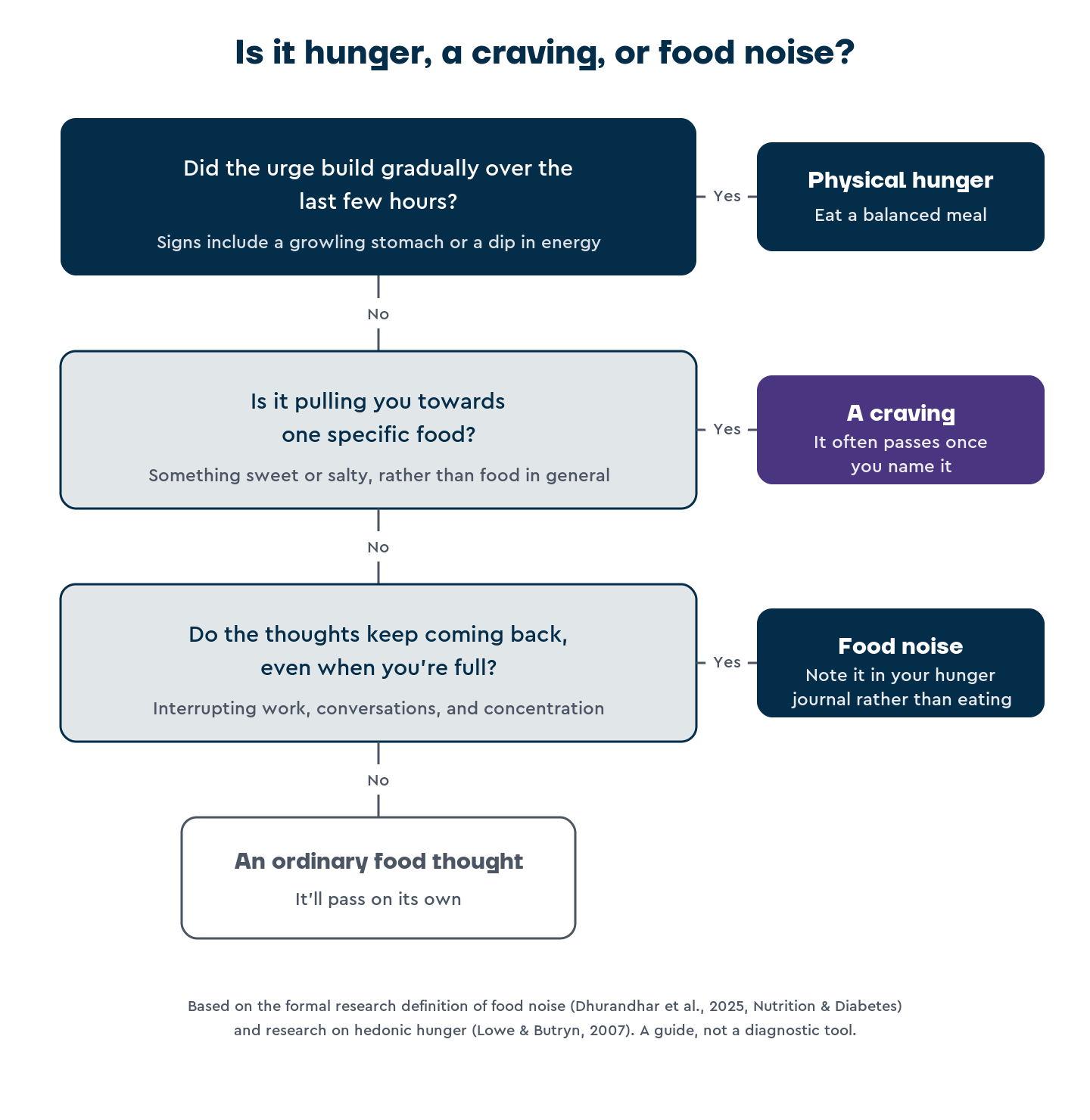
It helps to separate three experiences: physical hunger, hedonic hunger, and food noise.
Physical hunger is your body’s signal for nourishment from energy and nutrients. It builds gradually over 3 to 5 hours, often with a growling stomach or a dip in energy, and any balanced meal will leave us feeling full and satisfied afterwards.
Hedonic hunger is the desire to eat for pleasure rather than a physical requirement. Researchers described it back in 2007 as the pull of enjoyable food in the absence of any real need for calories or nutrients.3
It’s the desire for dessert when you’re already full, or the biscuit you reach for because it’s there, not because your body needs it.
Food noise is the cognitive layer that can sit atop both. It’s the thinking and the preoccupation, which can show up alongside physical hunger, alongside a craving, or on its own.1
Knowing which one you’re experiencing helps you decide how to respond in the moment.
Physical hunger will pass after a balanced meal rich in protein, fibre, fat, complex carbohydrates, and essential nutrients, and a craving driven by hedonic hunger will often fade after 10-15 minutes.
Food noise is more persistent. Noticing it for what it is won’t switch it off, but it does mean you’re less likely to answer every thought with food.
|
Physical hunger |
Hedonic hunger |
Food noise |
| What drives it |
An energy need |
The pleasure or reward of eating |
Intrusive thoughts about food |
| How it builds |
Gradually, over 3 to 5 hours |
Triggered by a cue: a sight, a smell, or an emotion |
Persistent, sometimes almost constant |
| What it focuses on |
Food in general |
A specific, usually enjoyable food |
Food as a topic, not always a meal |
| What settles it |
A balanced meal |
Eating the craved food, briefly |
Hard to settle by eating alone |
| On a GLP-1 medication |
Reduces it, so you feel fuller for longer |
Reduces cravings and the desire for sweet and savoury foods |
Turns down the volume on the thoughts |
How GLP-1 medications quiet food noise
Our body naturally produces a hormone called GLP-1 in the gut after we eat, which tells the brain we’ve had enough food.
Wegovy mimics that hormone over a longer period, helping us feel fuller for longer.
Mounjaro works in the same way but also mimics a second appetite hormone, GIP.
These drugs also interact with the brain’s appetite-control centre, which regulates feelings of food reward.
The net effect is that they reduce physical hunger and the non-physical desire to eat, as the reward we get from food is diminished.
The clearest evidence comes from a 20-week study of semaglutide, the drug in Wegovy.
On a validated eating questionnaire, people taking it reported better control of their eating, fewer and weaker food cravings, and a weaker desire for sweet and savoury foods, compared with placebo.4
Food noise quietens for the same reason. The medication reduces the hunger and reward signals that drive the thoughts in the first place.
The thoughts haven’t gone forever, though. The medication is turning down the volume rather than switching them off permanently.
That quieter period is what makes the medication so useful for building new eating habits while you’re taking it.
Second Nature has worked with the NHS since 2017, pairing medication with structured support to build new eating habits while food noise is low. Take our
3-minute eligibility quiz, and a clinician will review your answers.
Why food noise can come back
Because the medication quietens food noise rather than removing it, the noise can return.
People most often notice it at two points: while on the medication and after stopping it.
On the medication, some of the noise can creep back as the body settles into a dose.
In a 2025 case study published in Nature Medicine, brain recordings from one patient taking tirzepatide (the drug in Mounjaro) showed that the brain activity linked to her food preoccupation went quiet when she reached the full dose. About 5 months later, the activity returned, and so did the food noise.5
A single case can’t show how common this is, and the researchers have called for larger studies.5
If your food noise creeps back on a steady dose, it’s usually a prompt to review your dose and habits with your prescriber rather than a sign the medication has stopped working.
These results also suggest that the medication isn’t a magic pill for eliminating food noise forever, and it’s essential to develop healthy habits that help manage hunger and food noise naturally.
If you stop a weight-loss injection suddenly, without having built the habits needed to manage hunger on our own, our appetite can increase, and food noise often follow.
In a trial of people who had reached the full dose of semaglutide, those who switched to a placebo regained weight over the following months, while those who continued the treatment kept losing weight.6
This pattern of weight regain is consistent across trials examining what happens when people stop these medications abruptly, without healthy habits in place.
It isn’t inevitable, though. Our guide to whether your appetite returns after stopping Mounjaro covers what to expect and habits that help keep it manageable.
We recommend coming off the medication slowly, by gradually reducing the dose, and making sure you have habits in place to manage hunger naturally first.
Our free weight regain prevention planner walks through how to do that.
How to keep food noise quiet
The habits that keep food noise quiet are the same ones that help to keep us feeling fuller for longer, because steadier physical hunger means there’s less driving the noise.
We recommend a whole-food diet that provides enough protein, fibre, fat, and complex carbohydrates, and limits ultra-processed foods.
Protein, fibre, and fat are the most filling parts of a meal, so building each meal around them keeps you satisfied for longer.
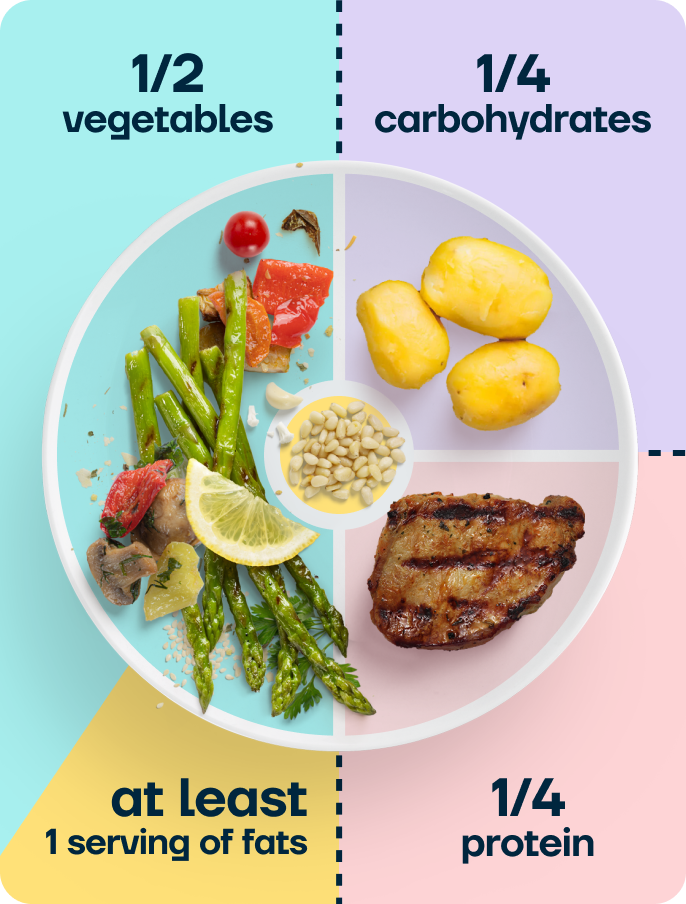
A simple way to picture it is Second Nature’s balanced plate: half vegetables, a quarter protein (roughly the size of the palm of your hand), a quarter complex carbohydrates such as brown rice, oats, or potatoes, plus a serving of fat.
Eating 3 balanced meals at roughly the same times each day helps too, because regular meals stop the long gaps that let hunger and food noise build.
A few other habits can also help to reduce food noise:
- Sleep: poor sleep increases our desire for energy-dense foods, so aim to go to bed at the same time each night and avoid screens at least 30 minutes before bed
- Stress and emotions: stress, boredom, and loneliness can all drive food thoughts, so it helps to notice when an urge is emotional rather than physical
- Your environment: having ultra-processed foods and snacks within easy reach can enhance our desire to eat them, so a designated eating space and keeping trigger foods out of sight both help
- Mindful eating: eating without the TV or your phone helps you notice fullness, which makes food noise easier to recognise when it shows up. Try taking 20 minutes to eat your meal, at a table, without distractions.
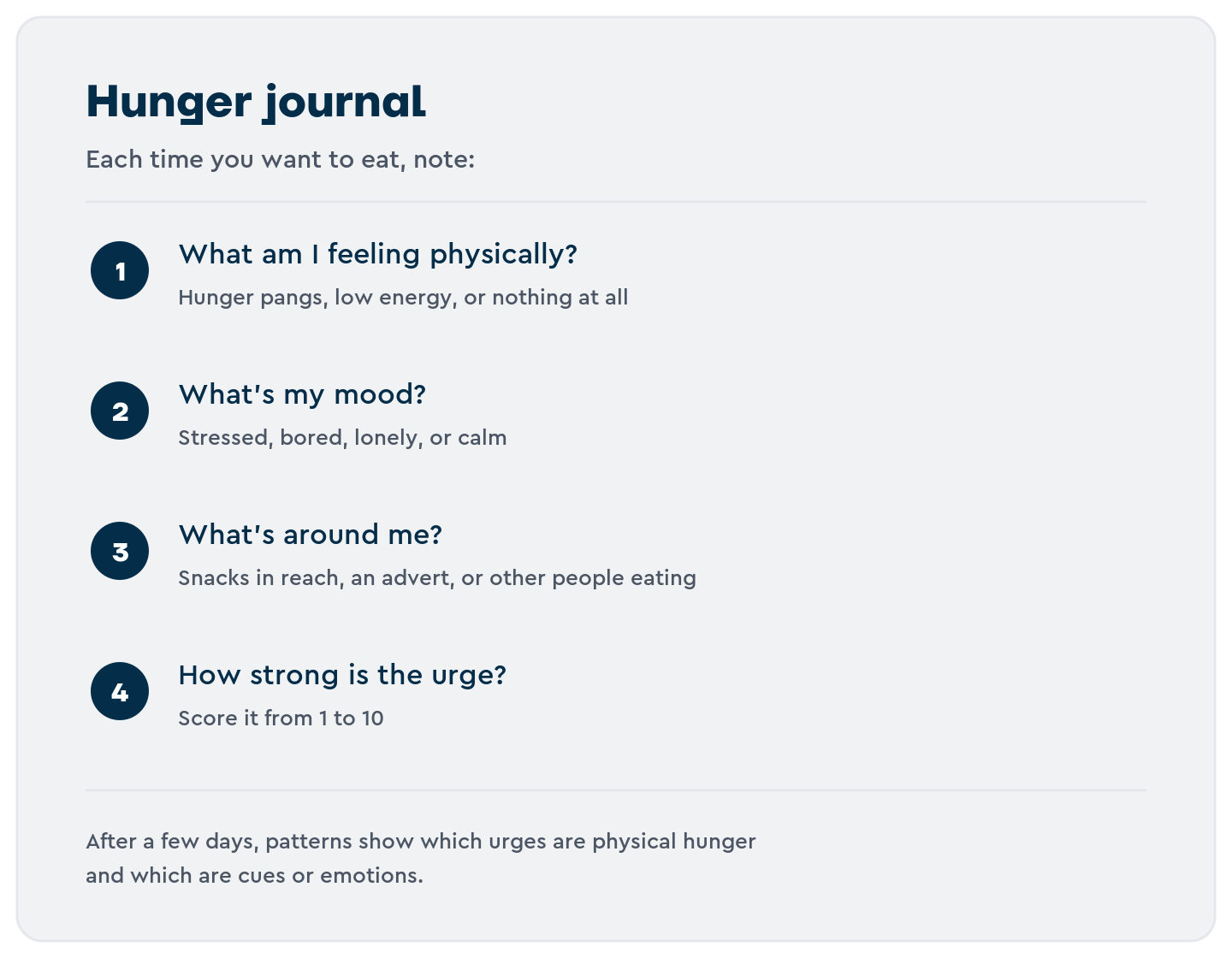
One practical exercise is to keep a short hunger journal for a few days.
Each time you want to eat, note what you’re physically feeling, your mood, what’s around you, and how strong the urge is from 1 to 10.
After a few days, you’ll start to see patterns in your day and which urges are physical hunger and which are cues or emotions rather than a need for food.
When food noise goes quiet, some people eat too little or skip meals because nothing prompts them to eat.
Eating too little will inherently increase our physical hunger and desire to eat because it makes it harder to get enough protein and nutrients and to maintain muscle mass while you lose weight.
If you’re eating smaller meals on the medication, we recommend prioritising protein, fibre, and fat, and opting for easier-to-digest meals, such as stews, casseroles, or soups with a source of protein.
The goal isn’t to eliminate hunger any more than you’d want to eliminate thirst. It’s about developing a healthier relationship with food and hunger so we can live a healthy, sustainable lifestyle over the long term.
It’s also worth noting that food noise is a relatively new concept, and its root causes aren’t fully understood.
So while there are healthy habits to reduce hunger and food noise, some individuals may need long-term medication support to manage it.
When to speak to a professional
Food noise on its own isn’t a problem to be fixed, and most of us experience some version of it.
It’s worth raising with a GP or dietitian when it starts to affect your quality of life.
That might mean feeling anxious around food, finding it hard to switch off thoughts even after regular meals, or struggling to concentrate because food keeps interrupting.
Persistent, distressing thoughts about food can also overlap with disordered eating, which the term ‘food noise’ doesn’t capture.1
If that sounds familiar, speaking to a professional is the right next step, whether or not you’re taking a GLP-1 medication.
Frequently asked questions
Is food noise a real medical condition?
No, food noise isn’t a medical diagnosis, and it doesn’t appear in the manuals doctors use to diagnose conditions.1
Still, the experience of food noise is becoming more widely accepted and researchers published a formal definition in 2025 and are developing a questionnaire to score it.1
Is food noise the same as hunger?
No. Physical hunger is your body’s natural desire for energy and nutrients and settles with a meal.
Food noise is intrusive thoughts about food that can persist even when you’re full.1
Why do I have so much food noise?
Food noise tends to be louder with long gaps between meals, too little protein and fibre, poor sleep, stress, and constant exposure to food cues like adverts.
For some people, the thoughts are simply stronger and more persistent than for others.
Do Mounjaro and Wegovy completely eliminate food noise?
For many people, the noise drops dramatically, sometimes for the first time in in their lives.
It’s more accurate to say the medication quiets the thoughts than erases them, because the brain systems that produce them remain active.5
Why has my food noise come back on Mounjaro?
Some noise can return as your body adjusts to a dose, or once you’ve been on a steady dose for a while.5
It’s usually a prompt to review your dose and your habits with your prescriber rather than a sign that the medication has stopped working.
Consider the time on the medication as an opportunity to develop a healthier relationship with hunger, rather than trying to eliminate it completely.
Will food noise return if I stop Mounjaro or Wegovy?
It can, especially if you stop suddenly without having built habits to manage hunger on your own.
In the STEP 4 trial, people who stopped semaglutide abruptly regained weight over the following months.6
Coming off slowly and putting those habits in place first makes a return to food noise much easier to handle.
Can you reduce food noise without medication?
Yes. Regular, balanced meals built around protein and fibre, good sleep, stress management, and keeping trigger foods out of easy reach all reduce food noise.
These habits help whether or not you’re taking a GLP-1 medication.
Still, food noise is a relatively new concept, and its root causes aren’t fully understood.
It’s possible that some individuals may need support from medication over the long term to help manage it.
Is food noise a sign of an eating disorder?
Not on its own, but persistent, distressing food thoughts can overlap with disordered eating.1
If the thoughts are affecting your quality of life or your relationship with food, it’s worth speaking to a GP or dietitian.
How long does it take for a GLP-1 medication to quiet food noise?
Many people notice a difference within the first few weeks of starting, as the dose builds up. The effect tends to be strongest once you reach a regular maintenance dose.
Our guides explain emotional eating, how to recognise it, and how to improve your relationship with food.
Take home message
Food noise is the persistent, intrusive thinking about food that runs separately from physical hunger, and as of 2025, it has a formal research definition rather than just a name patients gave it.1
Physical hunger is a natural desire of the body for calories and essential nutrients; hedonic hunger is the desire to eat for pleasure; and food noise is intrusive thinking that can be present alongside either or on its own.3
GLP-1 medications like Mounjaro and Wegovy quiet food noise by mimicking gut hormones that reduce both hunger and the reward we get from food, which is why people describe their food thoughts going quiet.4
Still, food noise can return as the body settles onto a dose,5 or when the medication stops suddenly before new habits are in place.6
The research suggests you’re more likely to keep food noise manageable and avoid weight regain when the medication is paired with everyday habits that help us feel fuller for longer: regular, balanced meals, enough protein and fibre, good sleep, and an environment with fewer food cues.
At Second Nature, we combine medication with structured support to build those habits, using the balanced plate model and guidance from registered dietitians.
In a 2025 service evaluation published in JMIR, our members achieved an average weight loss of 19.1% at 12 months, with 77.7% losing at least 10% of their body weight.7
Second Nature's Mounjaro and Wegovy programmes
Second Nature provides Mounjaro or Wegovy as part of our Mounjaro and Wegovy weight-loss programmes.
Why choose Second Nature over other medication providers, assuming you're eligible?
Because peace of mind matters.
We've had the privilege of working with the NHS for over eight years, helping people across the UK take meaningful steps toward a healthier, happier life.
Our programmes are designed to meet people where they are, whether that means support with weight loss through compassionate one-to-one health coaching, or access to the latest weight-loss medications (like Mounjaro and Wegovy) delivered alongside expert care from a multidisciplinary team of doctors, psychologists, dietitians, and personal trainers.
At the heart of everything we do is a simple belief: real, lasting change comes from building better habits, not relying on quick fixes. We're here to support that change every step of the way.
With over a decade of experience, thousands of lives changed, and a long-standing record of delivering programmes used by the NHS, we believe we're the UK's most trusted weight-loss programme.
We hope to offer you something invaluable: peace of mind, and the support you need to take that first step.