Jump to: Your week by week timeline | Understanding dose escalation | Mounjaro vs Wegovy | What the clinical trials show | Plateaus and weight fluctuations | Managing side effects | FAQs | Take home message
In clinical trials, people on Mounjaro lost an average of 22.5% of their body weight over 72 weeks, and those on Wegovy lost 20.7%1,2. But that weight loss isn’t evenly spread across those weeks.
Most of the weight loss happens between weeks 12 and 36, with very little in the first month for most people.
During the first weeks, progress can feel slow, side effects peak when the dose increases, and plateaus are more common from around month 3 as the body adapts to a lower set point.
Our interactive timeline is built on data from the SURMOUNT-1 and STEP UP clinical trials. Select your medication, and you’ll see a dose schedule, weight-loss chart, and practical tips for each phase.
Important safety information: Mounjaro (tirzepatide) and Wegovy (semaglutide) are prescription-only medications for managing obesity. This timeline provides estimates based on clinical trial averages and does not guarantee specific outcomes. Always consult your GP or prescribing clinician before starting or changing any treatment.
Your week-by-week timeline
Understanding dose increases
One of the most common frustrations people have in the first few weeks is feeling like the medication isn’t working. This is because the starting dose isn’t defined as a therapeutic dose for weight loss.
Both Mounjaro and Wegovy use a gradual dose-escalation schedule, designed to help the body adapt to the medication at lower doses before gradually increasing the dose to support more substantial weight loss.
You start on a low dose and increase every four weeks until you reach the dose that works for you.
Mounjaro dose schedule
Mounjaro starts at 2.5 mg and increases in 2.5 mg steps every four weeks: 2.5 mg, 5 mg, 7.5 mg, 10 mg, 12.5 mg, and 15 mg3.
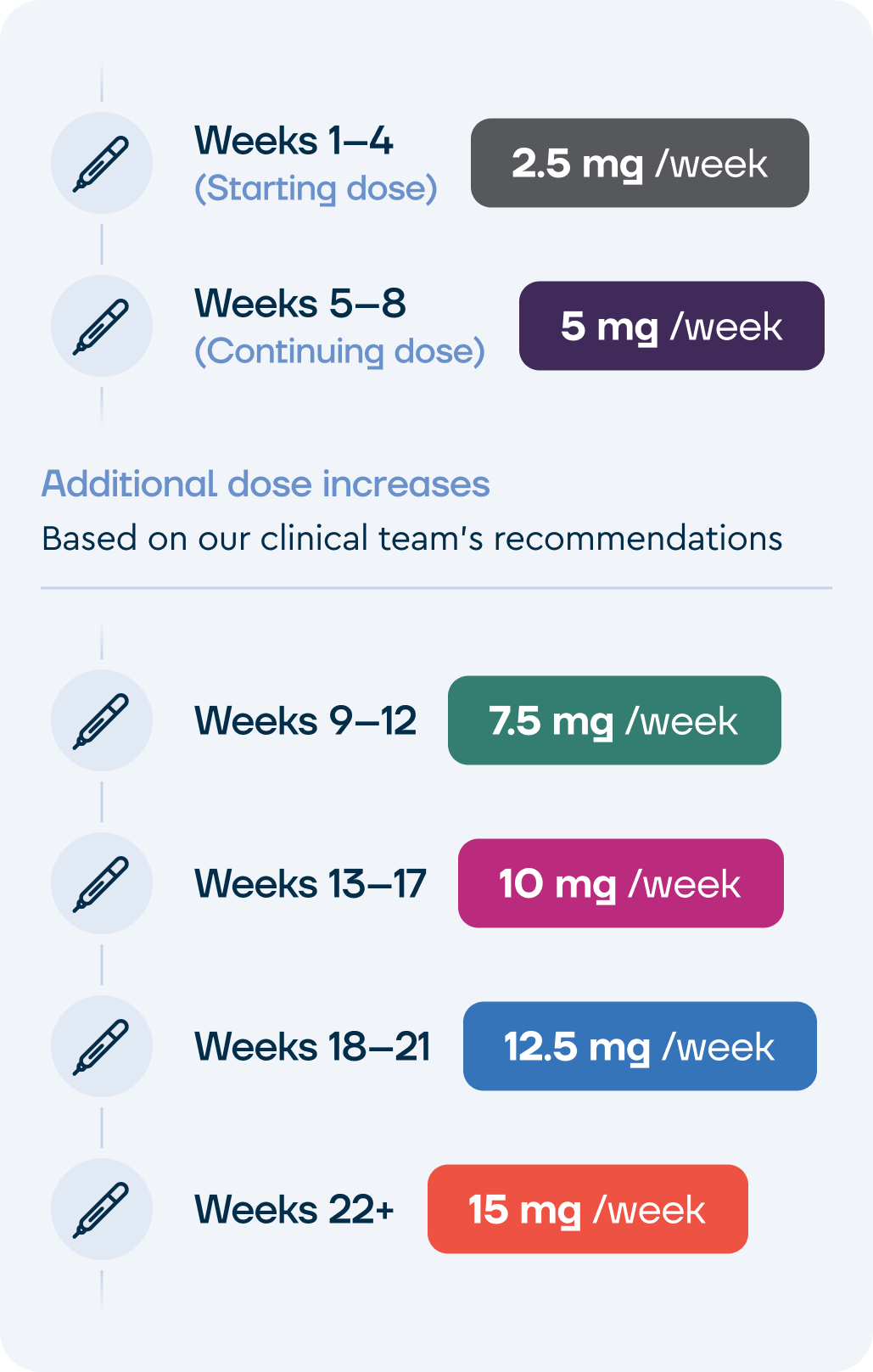
Not everyone needs to reach 15 mg. Some people lose weight steadily on 5 mg or 10 mg and stay on those doses. The right dose is the one that’s working for you and supports a sustainable weight-loss rate of around 1lb (0.5kg) per week.
Wegovy dose schedule
Wegovy starts at 0.25 mg and increases every four weeks through 0.5 mg, 1 mg, 1.7 mg, and 2.4 mg, before reaching the maximum dose of 7.2 mg4.
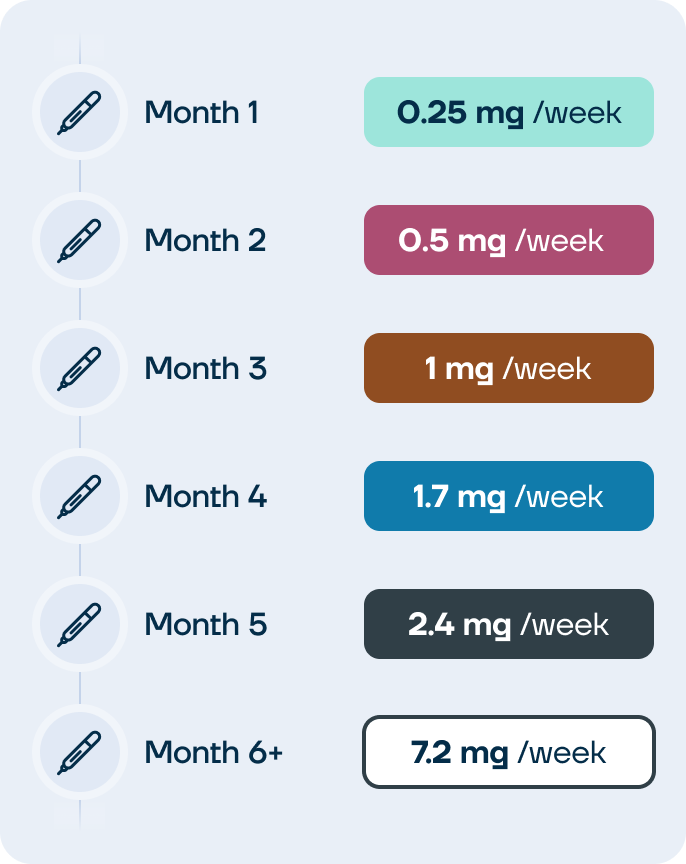
The jump from 2.4 mg to 7.2 mg is larger than previous increases. In STEP UP, the 7.2 mg dose led to 20.7% body weight loss at 72 weeks, compared to 13.7% on 2.4 mg2.
Weight loss is slower in the first 2 months
The purpose of starting at a low dose is to give your body time to adjust.
These medications mimic gut hormones (GLP-1 and GIP) that regulate appetite and blood sugar. Introducing them gradually reduces the severity of side effects3,4.
The first four to eight weeks aren’t representative of what the medication can do. If you’re not seeing much weight change early on, that’s expected.
Key things to know about dose escalation:
- Starting doses (2.5 mg Mounjaro, 0.25 mg Wegovy) aren’t therapeutic for weight loss
- Most noticeable weight loss begins from around week 8
- Side effects tend to peak during escalation and ease once you’re on a stable dose
- You can go at your own pace, and your prescriber will work with you to find the right dose
Mounjaro vs Wegovy at a glance
| Feature |
Mounjaro (tirzepatide) |
Wegovy (semaglutide) |
| Drug class |
Dual GIP and GLP-1 agonist |
GLP-1 agonist |
| Starting dose |
2.5 mg |
0.25 mg |
| Maximum dose |
15 mg |
7.2 mg |
| Weeks to reach max dose |
~20 weeks |
~28 weeks |
| Average weight loss (72 weeks) |
22.5%1 |
20.7%2 |
| Fastest weight loss phase |
Weeks 12 to 24 |
Weeks 12 to 28 |
| Landmark trial |
SURMOUNT-11 |
STEP UP2 |
| Injection frequency |
Once a week |
Once a week |
For a detailed comparison, see our guide on Wegovy vs Mounjaro: which is right for you?
What the clinical trials show
Mounjaro (SURMOUNT-1)
The SURMOUNT-1 trial followed 2,539 adults with obesity over 72 weeks. Participants on the highest dose (15 mg) lost an average of 22.5% of their body weight1.
Most of that weight loss happened in the first 24 weeks. By week 36, the rate of loss had slowed significantly as the body adapted to a lower set point.
Mounjaro mimics two gut hormones (GIP and GLP-1). This dual action is thought to explain its greater weight loss compared to semaglutide in head-to-head comparisons.
Wegovy (STEP UP)
The STEP UP trial followed 1,407 adults with obesity over 72 weeks. Participants on the highest dose (7.2 mg) lost an average of 20.7% of their body weight2.
The 7.2 mg dose was approved by the MHRA in January 2026 and represents a significant increase from the previous maximum of 2.4 mg.
Weight loss followed a pattern similar to Mounjaro, with the fastest rate between weeks 12 and 28, then gradually slowing down.
Here’s a summary of the weight loss trajectory across both medications:
- Weeks 1 to 4: 1 to 3% body weight loss (adjustment phase)
- Weeks 5 to 12: 5 to 8% (dose escalation, weight loss accelerating)
- Weeks 13 to 24: 10 to 17% (fastest weight loss period)
- Weeks 24 to 72: 17 to 22.5% (weight loss slowing, maintenance phase)
Plateaus and weight fluctuations
One of the most common concerns people have, especially from weeks 8 to 16, is that weight loss stalls. This is a normal part of the body’s response to sustained weight loss.
Weight loss on these medications follows a predictable curve: faster in the first few months, then gradually slows as the body adapts to a lower set point.
A plateau doesn’t mean the medication has stopped working. In both SURMOUNT-1 and STEP UP, participants continued to maintain their weight loss even after the rate of loss slowed1,2.
Daily weight fluctuations are also common and usually reflect changes in water retention, carbohydrate intake, and salt consumption, as well as hormonal changes over the month in women. Tracking the overall trend over weeks gives a much clearer picture than daily weigh-ins.
Managing side effects
Gut-related side effects (nausea, constipation, and fatigue) are the most commonly reported on both Mounjaro and Wegovy. They tend to be most pronounced during dose escalation and improve as the body adapts3,4.
Nausea
Nausea is the most common side effect and typically peaks in the first two to three days after each injection. It tends to improve as the week goes on and generally eases within the first eight to twelve weeks3,4.
Prioritise meals based on whole foods, as this tends to minimise side effects. If you experience nausea, easy-to-digest options like smoothies, soups, and scrambled eggs on toast are worth trying.
Constipation
Constipation is the second most common side effect and can become more noticeable as the dose increases. Including fibre-rich foods gradually and staying well hydrated (at least 2 litres of water a day) are the most effective steps.
Fatigue
Some people experience fatigue during dose escalation as they’re eating significantly less than before. Eating three balanced meals a day (even if you’re not hungry, prioritising protein at every meal, and maintaining regular movement can help with energy levels.
When to speak to your prescriber
If side effects are significantly impacting your quality of life, speak to your prescriber about adjusting your dose.
Lowering the dose or slowing the titration schedule is a common and clinically appropriate response. For more details, see our guides on Mounjaro side effects and Wegovy side effects.
Found this useful? Get more Second Nature guides in your Google results.
Frequently asked questions
How much weight can you lose on Mounjaro week by week?
Weight loss varies, but clinical trial averages give a useful guide. In SURMOUNT-1, participants on 15 mg lost around 2 to 3% in the first four weeks, 16% by week 24, and 22.5% by week 721.
How much weight can you lose in 4 weeks on Wegovy?
On average, participants in STEP UP lost around 1 to 2% of their body weight in the first four weeks on 0.25 mg2. This is the adjustment dose, so weight loss is minimal. Most noticeable changes begin from around week 8.
Can you lose weight on 2.5 mg of Mounjaro?
2.5 mg is the starting dose and isn’t considered therapeutic for weight loss. Some people do notice reduced hunger and modest changes, but the dose is primarily there to help your body adjust3.
What happens in week 3 of Mounjaro?
By week 3, you’re still on the 2.5 mg starting dose. You may notice reduced hunger for a few days after each injection, though this effect often wears off as the week progresses. Side effects are usually mild.
How long does it take to start losing weight on Wegovy?
Most people start to notice weight loss around week 8, once they’ve moved past the 0.25 mg starting dose. The fastest weight loss typically occurs between weeks 12 and 282.
Is it normal not to lose weight in the first month?
Yes. The first month on either medication is an adjustment phase. The starting doses (2.5 mg for Mounjaro, 0.25 mg for Wegovy) aren’t therapeutic for weight loss.
How long does it take to lose 3 stone on Mounjaro?
This depends on your starting weight. For someone weighing 100 kg, 3 stone (roughly 19 kg) would be approximately 19% of body weight. In SURMOUNT-1, participants on 15 mg reached that level at around week 28 to 32 on average1.
When is Wegovy the strongest?
Wegovy reaches its maximum dose at 7.2 mg. Weight loss tends to be fastest on the higher doses, typically between weeks 17 and 40. After that, weight loss naturally slows as the body adapts2.
What foods should you focus on while taking GLP-1 medications?
Prioritise whole foods built around the balanced plate: half vegetables, quarter protein, quarter complex carbohydrates, and a serving of healthy fat. Protein is particularly important for protecting muscle mass during weight loss.
If nausea is an issue, easy-to-digest options like smoothies, soups, and scrambled eggs on toast are better tolerated. For personalised ideas, try our free GLP-1 meal plan generator.
Is it better to inject Wegovy in the morning or at night?
There’s no clinical evidence that the time of day affects how well Wegovy works4. The most important thing is to inject on the same day each week. Some people prefer the evening so they can sleep through any initial nausea.
Has the medication stopped working if my weight plateaus?
No. Weight plateaus are a normal and necessary part of the process as the body adapts to a lower set point. In both SURMOUNT-1 and STEP UP, participants maintained their weight loss even after the rate of loss slowed1,2.
Take home message
Both Mounjaro and Wegovy follow a similar pattern: slower weight loss at lower doses, a period of faster weight loss at higher doses, followed by slower weight loss as the body adapts to a lower set point.
Understanding this pattern helps set realistic expectations. The first month isn’t representative of what the medication can do, and a plateau doesn’t mean it’s stopped working.
In a 12-month study published in JMIR Formative Research, Second Nature members on tirzepatide lost an average of 22.1% of their body weight, and those on semaglutide lost 17.1%5. Both figures exceeded clinical trial benchmarks.
Second Nature combines GLP-1 medication with personalised nutrition guidance from registered dietitians, a dedicated health coach, and a programme built around the balanced plate model and sustainable habit formation.
Second Nature's Mounjaro and Wegovy programmes
Second Nature provides Mounjaro or Wegovy as part of our Mounjaro and Wegovy weight-loss programmes.
Why choose Second Nature over other medication providers, assuming you're eligible?
Because peace of mind matters.
We've had the privilege of working with the NHS for over eight years, helping people across the UK take meaningful steps toward a healthier, happier life.
Our programmes are designed to meet people where they are, whether that means support with weight loss through compassionate one-to-one health coaching, or access to the latest weight-loss medications (like Mounjaro and Wegovy) delivered alongside expert care from a multidisciplinary team of doctors, psychologists, dietitians, and personal trainers.
At the heart of everything we do is a simple belief: real, lasting change comes from building better habits, not relying on quick fixes. We're here to support that change every step of the way.
With over a decade of experience, thousands of lives changed, and a long-standing record of delivering programmes used by the NHS, we believe we're the UK's most trusted weight-loss programme.
We hope to offer you something invaluable: peace of mind, and the support you need to take that first step.
References
- Jastreboff AM, Aronne LJ, Ahmad NN, et al. (2022). Tirzepatide Once Weekly for the Treatment of Obesity. New England Journal of Medicine, 387(3), 205-216.
- Wharton S, Freitas P, Hjelmesæth J, et al. (2025). Once-weekly semaglutide 7.2 mg in adults with obesity (STEP UP). Lancet Diabetes & Endocrinology, 13(11), 949-963.
- Eli Lilly. (2024). Mounjaro Summary of Product Characteristics. Electronic Medicines Compendium.
- Novo Nordisk. (2024). Wegovy Summary of Product Characteristics. Electronic Medicines Compendium.
- Richards R, Lunt W, Whitman M, Spaltro G, Hall R. (2025). Semaglutide and Tirzepatide in a Remote Weight Management Program: 12-Month Retrospective Observational Study. JMIR Formative Research, 9, e81912.