Jump to: What the UK licence says | Silent or symptomatic gallstones | What the trials found | Why weight loss can trigger gallstones | How to lower your risk | If symptoms start | Frequently asked questions | Take home message | References
Gallstones don’t automatically rule out taking Foundayo (orforglipron). They aren’t listed as a contraindication (a reason not to prescribe a medication) in Foundayo’s UK licence, and people with a history of gallbladder disease weren’t excluded from its main trials1,6.
Whether you’ll be prescribed Foundayo depends mainly on whether your gallstones cause symptoms.
Silent gallstones, the kind found by chance on a scan, don’t usually need any treatment on their own5.
Gallstones that cause pain usually need treating in their own right, and your prescriber may want that done first, because weight loss may cause more pain episodes3.
In the trials on Foundayo, gallstones formed in 1.3% of people taking it, compared with 0.6% on placebo1.
Most of that extra risk comes from the weight loss itself rather than the drug itself. In most people, eating a diet based on whole foods and losing weight slowly can help to lower the risk of gallstones.
Important safety information: Foundayo (orforglipron) is a prescription-only medication for weight management and type 2 diabetes. This article is for informational purposes only. Always consult with your healthcare provider before starting any new medication, particularly if you have gallstones or a history of gallbladder problems.
Gallstones aren’t listed as a reason not to prescribe Foundayo
Foundayo’s UK licence lists only one contraindication: a serious allergic reaction to orforglipron or any of the tablet’s other ingredients1. Gallstones and gallbladder disease aren’t listed.
Still, the licence does carry a warning. Acute gallbladder disease has been reported in people taking GLP-1 medications, including Foundayo, and the licence notes that these events “were associated with weight reduction”1.
Eli Lilly, the company that makes Foundayo, confirms that people with gallbladder disease weren’t excluded from the trials, but that this group hasn’t been analysed separately.
Lilly says it “cannot provide treatment recommendations” for people with a history of gallbladder disease6.
So, whether you’ll be prescribed Foundayo with a history of gallbladder disease will depend largely on your prescribing physician. They’ll consider whether your stones have ever caused symptoms, any previous complications such as an inflamed gallbladder or pancreatitis, and risk factors like your age, family history, and how quickly you’re likely to lose weight.
Some online providers respond to that evidence gap by declining anyone with diagnosed gallstones, while a prescriber who can review your full history can make an individual decision.
If one service declines you, that reflects its prescribing policy rather than a rule about the medication itself.
You can usually take Foundayo with silent gallstones, but painful gallstones may need treating first
Around 10 to 15% of adults in the UK have gallstones, and about 8 in 10 of them never get any symptoms5.
NICE, which sets treatment guidance for the NHS, recommends leaving silent gallstones found in an otherwise normal gallbladder alone unless symptoms develop5.
However, doctors treat gallstones that cause pain differently. The usual treatment is keyhole surgery to remove the gallbladder, because stones that have caused pain once are likely to cause it again5.
Whether you can start Foundayo depends on whether your gallstones have caused symptoms or complications:
| Situation |
Can you start Foundayo? |
| Silent gallstones, never any symptoms |
Usually no barrier, but tell your prescriber so you both know to watch for symptoms |
| Gallstones that have caused pain |
Discuss treating the gallstones first; your prescriber may want this resolved before significant weight loss |
| Previous complications (an inflamed gallbladder, gallstone pancreatitis) |
Specialist input before starting |
| Gallbladder already removed |
Gallstones can no longer form in the gallbladder, so this risk doesn’t apply |
Your prescriber will decide whether Foundayo is suitable after reviewing any previous gallstone pain, gallbladder inflammation, pancreatitis, or surgery.
How often gallbladder problems happened in the trials
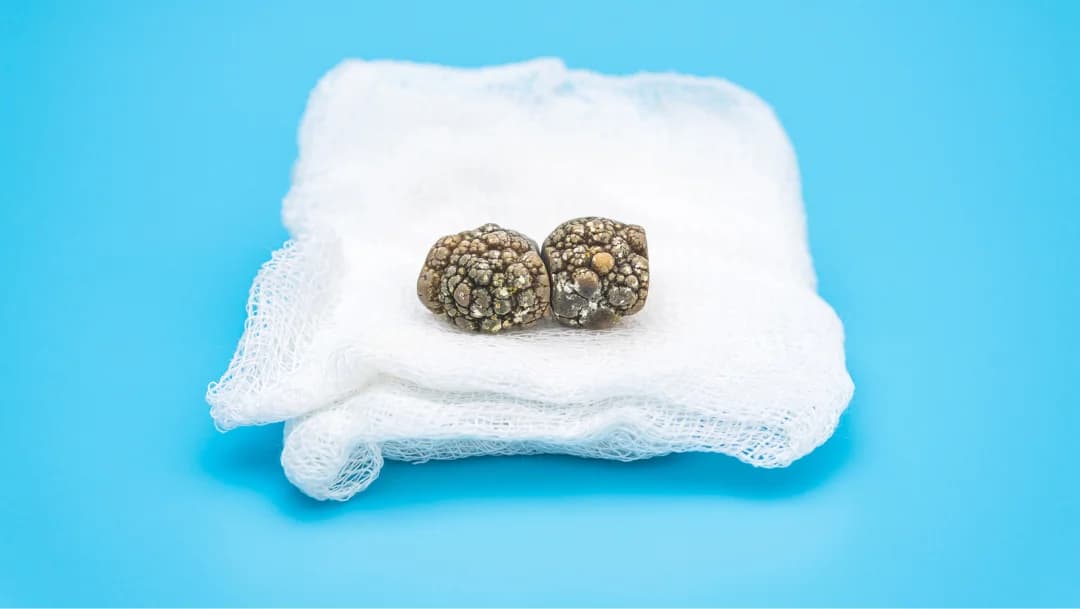
In trials of Foundayo, gallstones (the medical name is cholelithiasis) developed in 1.3% of people taking Foundayo, compared with 0.6% on placebo1.
In the licence’s classification, that makes gallstones a ‘common’ side effect, defined as affecting between 1 in 100 and 1 in 10 people1.
The main trial on Foundayo, ATTAIN-1, followed 3,127 adults for 72 weeks, so that 1.3% accumulated over almost a year and a half2.
People taking the drug’s highest dose lost an average of 11.2% of their body weight2.
When all of orforglipron’s phase 3 trials (large human trials with thousands of participants) are taken together, gallbladder and bile-duct problems affected 1.5% of people taking it and 1.1% of people taking a placebo or comparison medication4.
Gallstones accounted for almost all of the 0.4 percentage-point difference. An inflamed gallbladder (acute cholecystitis) occurred at similar rates in the orforglipron and comparator groups4.
The trials weren’t designed to count every gallstone. Nobody had their gallbladder scanned at the start of the studies or during them, so these figures reflect gallstones that caused symptoms and came to medical attention, not every gallstone that formed4.
The same increase appears across the GLP-1 class. A review of 76 trials of these medications found around 27 extra cases of gallbladder or bile-duct disease for every 10,000 people treated for a year3.
In that review, the risk was higher when the medications were used for weight loss, at higher doses, and for longer3.
Why losing weight can trigger gallstones
Most gallstones form when bile, the fluid our liver makes to help digest fat, carries more cholesterol than it can hold dissolved.
Research shows that when we lose weight quickly, the liver moves extra cholesterol out through the bile, and some of it can crystallise into stones3.
The gallbladder only empties when we eat, and it empties most strongly after meals that contain fat.
Foundayo reduces appetite, so people often eat less, feel full sooner, or sometimes skip meals (which we wouldn’t recommend).
Smaller meals or skipping meals entirely can make the gallbladder empty less often or less fully, leaving bile sitting there for longer and increasing the chance of stones forming.
GLP-1 medications are also thought to slow how strongly the gallbladder contracts, which adds to this effect3.
There’s no evidence that Foundayo’s tablet form lowers the risk of gallbladder problems. These problems have occurred with both oral and injected GLP-1 medications, and the risk increases with faster or greater weight loss, not the drug specifically3.
How to lower your risk while taking Foundayo
We recommend aiming to lose weight at a rate of around 0.5 – 1 lb per week. Losing weight slowly will mean that less cholesterol passes into the bile at once, reducing the risk of gallstones.
Foundayo is available in six doses: 0.8 mg, 2.5 mg, 5.5 mg, 9 mg, 14.5 mg, and 17.2 mg. You should stay on each dose for at least 30 days, and your prescriber will only increase it if the medication is working and the side effects are manageable1.
If you lose weight faster than recommended, speak to your prescriber about lowering your current dose and how to slow your weight loss naturally.
Eating regularly keeps the gallbladder emptying, because it only empties when we eat. In practice, this means:
- Aiming to eat 3 balanced meals a day based on whole foods, even if you’re not hungry
- Including some fat with each meal, around a portion the size of your thumb, from foods like extra virgin olive oil, nuts, avocado, or oily fish
- Don’t avoid fat or eat a very low-fat diet. Eating fat in our meals helps the gallbladder empty effectively.
- Avoiding long gaps without food, such as prolonged fasting
We recommend eating a diet based on whole foods that contains enough protein, fibre, fat, and complex carbohydrates, and limits ultra-processed foods.
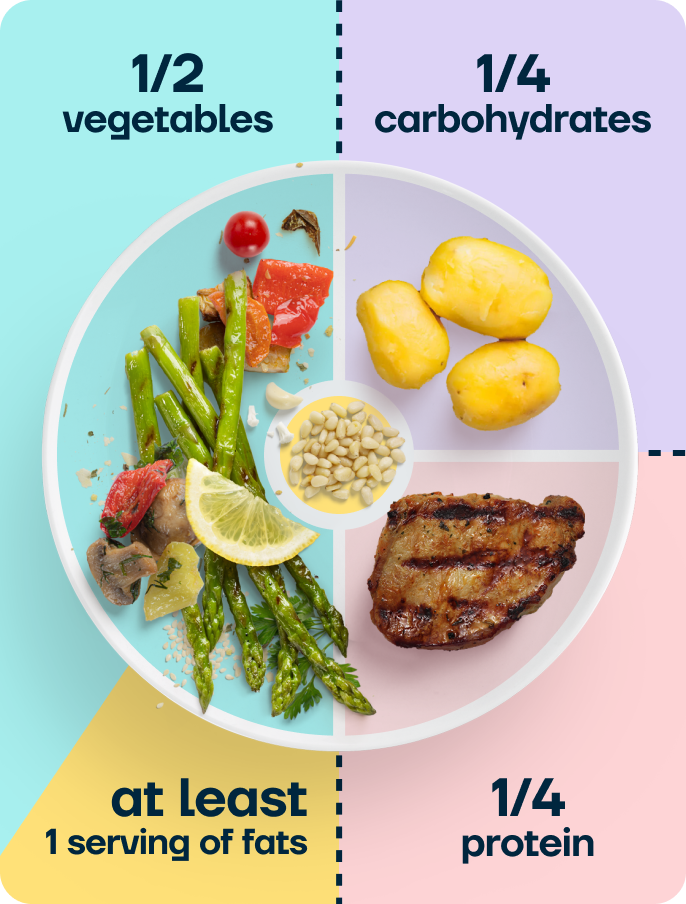
A useful guide for each meal is the Second Nature balanced plate: half vegetables, a quarter protein, a quarter complex carbohydrates such as wholegrain bread, rolled oats, brown rice, or potatoes, and a serving of fat.
Our guide on eating too little on Mounjaro examines the risk of losing weight too quickly while on GLP-1 medications.
Second Nature has worked with the NHS since 2017, combining GLP-1 medication with support from registered dietitians to help people lose weight slowly and sustainably. Take our 3-minute eligibility quiz, and a clinician will review your answers.
If you experience gallstone symptoms while you’re taking Foundayo
Gallstone pain (biliary colic) is a steady pain in the upper right side of the tummy, or in the centre just below the ribs. It often starts an hour or so after eating, can spread to the right shoulder blade or back, and typically lasts between 30 minutes and a few hours.
Contact your GP if you get this kind of pain, and tell them you’re taking Foundayo.
You should also inform your Foundayo provider. They may advise you to stop taking the drug while your gallbladder is investigated, and they’ll guide you on when it’s safe to restart.
Go to A&E or call 999 if you have:
- Pain that lasts more than a few hours or keeps getting worse
- A high temperature with tummy pain
- Yellowing of the skin or eyes (jaundice)
- Dark urine or pale stools
These can signal a blocked bile duct or an infected gallbladder, which need urgent treatment.
Developing symptoms doesn’t necessarily mean you need to come off Foundayo or stop trying to lose weight permanently.
Painful gallstones are usually treated by removing the gallbladder with keyhole surgery, most often as a day case5.
All being well, you should be able to restart Foundayo once your gallstones have been resolved.
Frequently asked questions
Can you take Foundayo if you’ve had your gallbladder removed?
Generally, yes. Without a gallbladder, gallstones can no longer form there, so this particular risk doesn’t apply.
People who’d had their gallbladder removed weren’t excluded from Foundayo’s trials, although they weren’t analysed separately either6.
Some people have looser stools after gallbladder removal, which can overlap with Foundayo’s digestive side effects early on, so mention the surgery to your prescriber.
Do you need a gallbladder scan before starting Foundayo?
No, there’s no routine scan before starting.
If your gallstones have caused symptoms before, or you’ve had complications such as an inflamed gallbladder or pancreatitis, your prescriber may want an ultrasound scan before you start.
Will Foundayo make my existing gallstones worse?
Foundayo doesn’t worsen gallstones on its own. The risk is that quick weight loss triggers symptoms from stones that were previously silent, which is why we recommend losing weight slowly and eating 3 balanced meals a day that include a source of fat.
Does Foundayo have a lower risk of gallstones because it’s a tablet?
There’s no evidence that oral GLP-1 medications have a different effect on gallstones to injections.
Foundayo activates the same GLP-1 receptor as the injectable medications, and across the class, gallbladder risk rises with the amount of weight lost3.
A tablet that produces the same weight loss as an injection would be expected to carry a similar gallbladder risk.
The rates reported in each medication’s trials can’t be compared directly, because the trials measured different groups of people over different lengths of time.
Why did an online pharmacy decline to prescribe me Foundayo because of gallstones?
Likely because there’s no trial data specific to people with gallbladder disease, each prescribing service sets its own policy, and some decline diagnosed gallstones as a precaution6.
A prescriber who can review your full history, such as your GP or a service with a clinician-led assessment, can make an individual decision.
Should I stop taking Foundayo if I get a gallstone attack?
Contact your prescriber or GP promptly rather than stopping on your own. They may advise pausing Foundayo while your gallbladder is investigated.
If you have severe pain lasting more than a few hours, a high temperature, or yellowing skin or eyes, go to A&E.
Can I take ursodeoxycholic acid to prevent gallstones while on Foundayo?
Ursodeoxycholic acid is sometimes prescribed to prevent gallstones during rapid weight loss, most commonly after weight-loss surgery.
It isn’t routinely recommended alongside weight-loss medications, but if you’re at high risk of gallstone complications, ask your prescriber whether it would help in your case.
Can gallstones cause pancreatitis while I’m taking Foundayo?
Yes. A gallstone that moves out of the gallbladder can block the duct draining the pancreas, causing gallstone pancreatitis.
Foundayo’s licence also carries its own separate warning about acute pancreatitis1. Severe upper tummy pain that spreads to your back and doesn’t settle, especially with vomiting, needs urgent medical attention.
Our guide on Mounjaro and pancreatitis explains the difference between medication-related and gallstone-related pancreatitis.
Our guides explain what Foundayo is and how it compares with Mounjaro. We also cover Wegovy with gallstones.
Take home message
Gallstones aren’t a contraindication (a reason not to prescribe) to Foundayo, and people with gallbladder disease weren’t excluded from its trials.
Whether you can take Foundayo depends mainly on whether your gallstones have caused symptoms or complications. Your prescriber will review this history before prescribing it.
Silent gallstones don’t usually need treatment. Gallstones that cause pain usually need surgery, and your prescriber may want to do that first.
In the Foundayo trials, gallstones formed in 1.3% of people taking Foundayo compared with 0.6% on placebo. This small increase in risk is linked to the rate of weight loss, not the drug itself.
To lower the risk of gallstones while taking Foundayo, lose weight at a steady pace and keep to regular meals that include some fat, so the gallbladder keeps emptying.
If gallstone pain does start, it’s usually treated by removing the gallbladder, and weight-loss treatment can often continue once you’ve recovered.
At Second Nature, we combine GLP-1 medication with structured habit support from registered dietitians, built around the balanced plate of half vegetables, a quarter protein, a quarter complex carbohydrates, plus a serving of fat.
A peer-reviewed study published in JMIR Formative Research found that active subscribers on Second Nature’s semaglutide-supported programme lost an average of 19.1% of their body weight at 12 months, with 77.7% achieving at least 10% weight loss7.
This support can help you manage both your weight loss and the steady eating pattern that lowers gallstone risk.
Second Nature's Mounjaro and Wegovy programmes
Second Nature provides Mounjaro or Wegovy as part of our Mounjaro and Wegovy weight-loss programmes.
Why choose Second Nature over other medication providers, assuming you're eligible?
Because peace of mind matters.
We've had the privilege of working with the NHS for over eight years, helping people across the UK take meaningful steps toward a healthier, happier life.
Our programmes are designed to meet people where they are, whether that means support with weight loss through compassionate one-to-one health coaching, or access to the latest weight-loss medications (like Mounjaro and Wegovy) delivered alongside expert care from a multidisciplinary team of doctors, psychologists, dietitians, and personal trainers.
At the heart of everything we do is a simple belief: real, lasting change comes from building better habits, not relying on quick fixes. We're here to support that change every step of the way.
With over a decade of experience, thousands of lives changed, and a long-standing record of delivering programmes used by the NHS, we believe we're the UK's most trusted weight-loss programme.
We hope to offer you something invaluable: peace of mind, and the support you need to take that first step.