How the Wegovy pill affects anticoagulant treatment
The Wegovy pill can affect how you take your anticoagulant because it must be taken before your other morning medicines, and it slows how quickly your stomach empties.1
Weight loss and changes to your eating habits can also impact your anticoagulant dose.4,5
Anticoagulants interrupt the process that forms blood clots. They’re often called blood thinners, although they don’t actually thin the blood.6
People take them when they’re at high risk of a blood clot, including people with atrial fibrillation (an irregular heartbeat), people who’ve had a blood clot before, and some people recovering from surgery.6
The dose has to be right, because too little anticoagulant can leave you at a higher risk of a blood clot, and too much can cause bleeding.7,8
There are two main types of anticoagulants: vitamin K antagonists, such as warfarin, and direct oral anticoagulants (DOACs), such as apixaban and rivaroxaban.
Warfarin works by blocking vitamin K, and your dose is determined by regular INR blood tests.
DOACs block specific clotting proteins directly, so they’re less affected by food and don’t need routine INR tests.7
Warfarin is the only anticoagulant that’s been tested with oral semaglutide, the drug in the Wegovy pill.3
Bækdal and colleagues published the study in Clinical Pharmacokinetics in 2019. They gave healthy volunteers a single 25 mg dose of warfarin on its own, then again after 7 weeks of daily oral semaglutide.3
After the volunteers took oral semaglutide, the total amount of S-warfarin (one of warfarin’s two forms) in their blood was 8% higher over time, and results for the other form were similar. Their highest INR reading was 2% lower.3
The 8% rise means slightly more warfarin reached the bloodstream, and the 2% fall in INR means warfarin’s effect on clotting barely changed.
Both fell within the range the researchers had set in advance for ‘no effect’, from 20% lower to 25% higher, so they concluded that oral semaglutide made no meaningful difference to warfarin levels or INR.3
Still, these results came from a single warfarin dose in healthy adults with a body mass index (BMI) below 30.
The study used 20 mg of oral semaglutide rather than the Wegovy pill’s 25 mg maintenance dose, and Novo Nordisk, which makes Wegovy, funded it.1,3
So, the study can’t show what happens when people take warfarin every day for a sustained period on the Wegovy pill, and you’ll still need extra INR checks when you start.1
How to take the Wegovy pill with anticoagulants
Take the Wegovy pill first, on its own, and take any morning anticoagulant dose at least 30 minutes later.1
We absorb the semaglutide in the Wegovy pill through our stomach, and food, large drinks, or other tablets reduce how much reaches our bloodstream. In one study, people absorbed 34% less semaglutide when they took it with five other tablets.1
To take the Wegovy pill:1
- Take it on an empty stomach after fasting for at least 8 hours, which is usually firs thing in the morning
- Swallow it whole with a sip of water, up to 120 mL (about half a glass)
- Wait at least 30 minutes before eating, drinking anything else (including tea or coffee), or taking any other medicine by mouth, including anticoagulant medications
No study has tested how well DOACs are absorbed when they’re taken 30 minutes after the Wegovy pill.
Semaglutide slows how quickly our stomach empties, which can change how other medicines are absorbed, so ask your pharmacist to check your full list of medicines.1
We recommend taking the Wegovy pill at least 30 minutes before your usual anticoagulant dose, so you can keep taking your anticoagulant at its usual time.
For example, if you normally take apixaban at 8am and 8pm, you could take the Wegovy pill at 7.30am and keep both apixaban doses at their usual times.
If you can’t take the pill 30 minutes before your usual anticoagulant time, ask your pharmacist to help you plan when to take each medicine.
Apixaban and dabigatran are usually taken twice a day, so moving one dose changes how long you wait before the next.7
Don’t skip an anticoagulant dose or move it to a new time unless your pharmacist or prescriber has agreed to it.
Apixaban and the Wegovy pill
Apixaban (Eliquis) is a DOAC taken twice a day. You can take it with or without food, even if you’re eating less on the Wegovy pill. Take any morning dose at least 30 minutes after the pill.1,9
For atrial fibrillation, apixaban is prescribed to prevent a stroke, and the usual dose is 5 mg twice a day.9 The lower dose of 2.5 mg twice a day is used when at least two of these apply:4
- You’re 80 or older
- You weigh 60 kg or less
- Your blood creatinine level (a waste product our kidneys remove) is 133 micromol/L or higher, which is a sign of reduced kidney function
Under these guidelines, reaching 60 kg on the Wegovy pill wouldn’t lower your dose on its own, but it could if you’re also 80 or older or have a high creatinine level.
For atrial fibrillation, apixaban 2.5 mg twice a day is also recommended if your creatinine clearance, an estimate of how well your kidneys are working, is 15 to 29 mL/min.9
These guidelines only apply to atrial fibrillation. If you take apixaban for a clot in the leg or lung, the usual dose is 5 mg twice a day after the first 7 days. After 6 months of treatment, it may be 2.5 mg twice a day to stop clots returning.9
In that case, ask the GP or clinic that prescribes it whether your dose needs reviewing as you lose weight.
If your weight is getting close to 60 kg, we recommend contacting the GP or clinic that prescribes your apixaban rather than waiting for your annual review.
Rivaroxaban and the Wegovy pill
Rivaroxaban (Xarelto) is a DOAC, and the dose you’re prescribed will depend on why you’re taking it. The usual doses are 10 mg to 20 mg once a day, or 15 mg twice a day for the first 3 weeks of treating a clot in the leg or lung.2
The 15 mg and 20 mg tablets must be taken with food, including both doses a day during those first 3 weeks.2 If you take them in the morning, take the Wegovy pill first, wait at least 30 minutes, then have your rivaroxaban with breakfast.1
On an empty stomach, we absorb about 66% of a 20 mg rivaroxaban dose. When people took it with food, the total amount in their blood over time was 39% higher, meaning they absorbed almost all of the dose.2,7
So, taking rivaroxaban 15 mg or 20 mg without food may leave you less protected against blood clots. Food made no difference to how much of a 10 mg dose was absorbed.2,7
The prescribing information doesn’t say how much you need to eat with rivaroxaban 15 mg or 20 mg for it to be fully absorbed, and we haven’t found a study that does, so we can’t give you a minimum amount of food.2
Rivaroxaban 15 mg and 20 mg need food to be fully absorbed, so take them with a meal.
We recommend eating 3 balanced meals a day while you take the Wegovy pill. If it’s reducing your hunger so much that you’re skipping meals, speak to your prescriber about lowering your Wegovy pill dose.
If nausea or other side effects prevent you from eating a meal with your rivaroxaban, ask your pharmacist or anticoagulant clinic what to do before your next dose is due.
If you already take rivaroxaban with your evening meal, you can usually keep doing so, as long as you finish eating at least 8 hours before the Wegovy pill.1
If you need to take rivaroxaban with a different meal, agree this with your pharmacist first, because it changes the time between doses.
Warfarin and the Wegovy pill
You can take warfarin with the Wegovy pill, but you’ll need more frequent INR checks when you start, as the prescribing information recommends.1
For atrial fibrillation or a clot in the leg or lung, the usual INR target is 2 to 3.7 Above your target, your blood is clotting too slowly, and your risk of bleeding is higher. Below it, you’re less protected against a clot.8
There’s no set schedule for INR checks on the Wegovy pill, so your anticoagulant clinic will decide how often you need them. We recommend telling them before you take your first pill.1
As a guide, the NHS Specialist Pharmacy Service advises an INR test 3 to 5 days after starting a medicine that may interact with warfarin, while people with a stable INR are usually tested every 12 weeks.5
Your Wegovy pill dose also goes up in steps, from 1.5 mg to 4 mg, 9 mg, and 25 mg, with at least a month at each dose.1 We recommend asking your clinic whether you need an INR check after each increase.
If you take warfarin in the evening, you won’t need to change when you take it. If you take it in the morning, take it at least 30 minutes after the Wegovy pill.1
A 2026 study by Gilbert and colleagues reviewed the health records of 1,021 people taking warfarin who started a GLP-1 medicine, including the Wegovy pill.
Their INR was in the target range 64.2% of the time in the 6 months before starting, and 62.1% of the time in the 6 months after.8
Average INR didn’t change, but readings varied a little more, so your INR could move up or down after you start the pill, even if it’s been stable.8
However, the study didn’t test the Wegovy pill specifically, and 82.6% of the people in it had diabetes. The researchers also didn’t know what people ate, so they couldn’t show why INR control changed.8
The prescribing information also reports cases of lower INR readings in people taking semaglutide with acenocoumarol, a medicine related to warfarin.1
Our eating habits can also affect INR. Our body uses vitamin K to make proteins that help blood clot, and warfarin blocks this process.10 So, foods rich in vitamin K, such as leafy green vegetables, can interfere with how warfarin works.11
If we significantly change how many green vegetables we eat, this can also affect our INR because of their vitamin K content.5 Studies on this are small and conflicting, so we can’t predict how much your INR would change.12
Losing weight may also mean you need a lower warfarin dose.10 The NHS Specialist Pharmacy Service lists weight changes among the things to look into when an INR result is out of range.5
We haven’t found a study that measured warfarin doses as people lost weight on a GLP-1 medicine, so we can’t say how much your dose might change.
We recommend keeping your vitamin K intake consistent. Tell your clinic if you’re eating much less than usual, if you’ve been unwell, or if your weight has fallen, so they can adjust your INR checks and dose.
Our guide to Wegovy with warfarin covers INR monitoring on the weekly injection in more detail.
Edoxaban, dabigatran, and the Wegovy pill
Edoxaban (Lixiana) is a DOAC taken once a day, and dabigatran (Pradaxa) is a DOAC usually taken twice a day. You can take both with or without food. Take any morning dose at least 30 minutes after the Wegovy pill.1,13,14
The usual edoxaban dose of 60 mg once a day is lowered to 30 mg if any one of these applies:13
- You weigh 60 kg or less
- Your creatinine clearance is 15 to 50 mL/min, which means your kidney function is moderately or severely reduced
- You take ciclosporin, dronedarone, erythromycin, or ketoconazole, which raise the amount of edoxaban in your blood
So, unlike apixaban, reaching 60 kg is enough on its own to lower your edoxaban dose. We recommend telling your prescriber as your weight approaches 60 kg, so they can review your dose before you reach it.13
For atrial fibrillation or a clot in the leg or lung, the usual dabigatran dose is 150 mg twice a day. It’s lowered to 110 mg twice a day if you’re 80 or older or take verapamil (a heart medicine), because verapamil raises the amount of dabigatran in your blood.14
Your prescriber may also consider the lower dose if you’re aged 75 to 80, your kidney function is moderately reduced, or you have reflux or inflammation of your stomach or food pipe. Dabigatran isn’t used if your creatinine clearance is below 30 mL/min.14
Dabigatran can cause indigestion, which may be worse when you take it on an empty stomach.7 If you take it in the morning, having it with breakfast may be easier.
Monitoring your treatment
If you take warfarin, your INR results determine the dose you’ll be prescribed.15 With a DOAC, you’ll need regular blood tests and medication reviews, although routine INR or clotting tests aren’t needed.4
The NHS Specialist Pharmacy Service recommends a DOAC review 1 month after you start a DOAC or change dose.
Once your treatment is stable, it recommends a full blood count, liver and kidney blood tests, and a review at least once a year.4
At a DOAC review, you should be asked whether you’re taking your doses as prescribed, checked for signs of bleeding, anaemia, a stroke, or a clot in the lung, and asked about your other medicines, including anything you buy over the counter.4 Tell them you’ve started the Wegovy pill.
You may need more frequent checks if you have reduced kidney function, if an illness or new medicine affects your kidneys or liver. For people over 75 or frail, experts suggest a check every 4 months. 4
Kidney function affects DOAC doses because our kidneys help clear these medicines from the body. If less is cleared, more stays in your blood, which increases your risk of bleeding.7
Clinicians use your body weight and a blood creatinine result to estimate how well your kidneys are working, known as creatinine clearance. Some DOAC doses will be determined by that estimate, including edoxaban and dabigatran.4
So, if you’ve lost weight on the Wegovy pill, tell your GP or anticoagulant clinic your current weight and ask whether you need your DOAC review earlier than planned.
Vomiting and diarrhoea are common on the Wegovy pill, particularly when your dose goes up. Rarely, the dehydration they cause can make your kidneys work less well.1 Tell your prescriber if these side effects continue, because your DOAC dose may depend on how well your kidneys are working.4
Check with your pharmacist before taking anything for side effects or pain. Ibuprofen and aspirin can affect how well anticoagulants work, so the NHS suggests paracetamol if you need pain relief, and herbal remedies such as St John’s wort can also interfere.11
Before you start the Wegovy pill, we recommend agreeing the following with your prescriber and your GP or anticoagulant clinic:
- When you’ll take the pill and each anticoagulant dose
- Whether you’re due a blood test, INR check, or DOAC review
- Who to contact if you’re eating much less than usual, and at what weight they’d like to review your dose
- What to do if vomiting makes it hard to keep your medicines down
If your Wegovy prescriber isn’t the GP or clinic that manages your anticoagulant, make sure both have your full list of medicines.
If managing several medicines is causing ongoing worry or low mood, tell your GP so they can arrange support.
Eating well on both medications
We recommend eating 3 balanced meals a day, plus protein-rich snacks in between if needed.
The Wegovy pill reduces hunger and can quieten food noise, so we recommend planning meals at set times rather than waiting until you feel hungry, as your usual hunger cues won’t be there to cue you to eat.
We recommend eating a diet based on whole foods, that contains enough protein, fibre, fat, and complex carbohydrates, and limits ultra-processed foods.
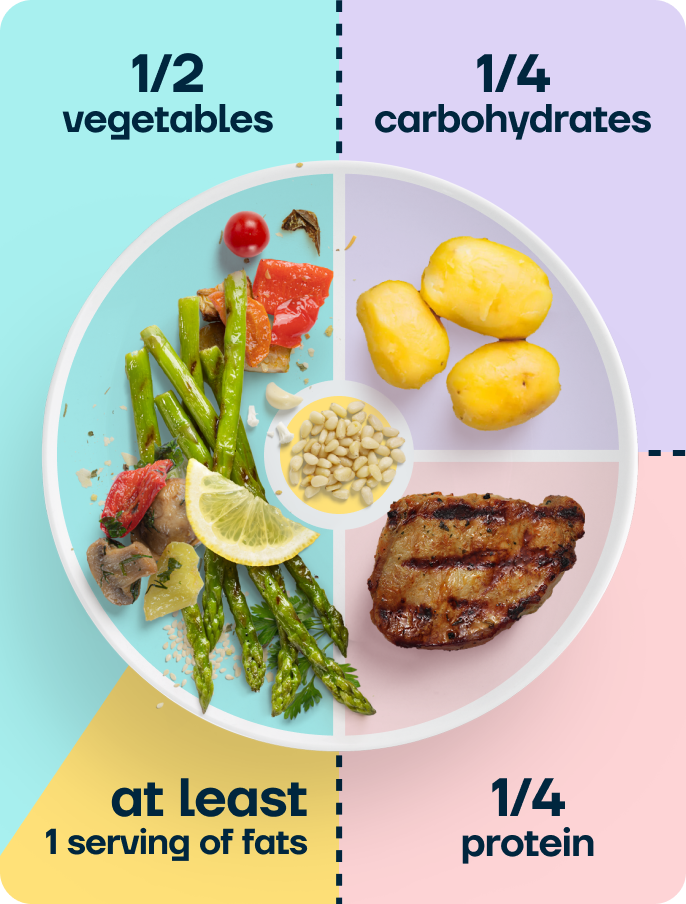
To follow the Second Nature balanced plate, fill half your plate with vegetables, a quarter with protein, and a quarter with complex carbohydrates, plus a serving of fat. For example, you could have chicken or tofu with brown rice and broccoli, dressed with olive oil.
If you’re struggling to eat enough protein at your main meals, we recommend trying easier-to-digest protein sources, like scrambled eggs, minced meat, tofu, and white fish.
To maintain muscle and bone while losing weight on the Wegovy pill, we recommend eating enough protein and calcium and doing regular strength exercise.
We also recommend aiming to lose around 1 lb a week, as losing weight quickly can increase the risk of losing excess muscle and bone mass.16
Losing muscle can also increase fall risk.16 Clinicians check for falls at DOAC reviews because a fall can cause bleeding.4
Research on adults losing weight suggests aiming for 1.2 to 1.6 grams of protein per kg of body weight per day.16
For someone weighing 90 kg, that’s around 110 to 145 grams a day. A portion about the size of the palm of your hand at each meal, such as fish, chicken, eggs, tofu, beans, or lentils, is a practical guide, with protein-rich snacks if meals alone don’t provide enough.

If you take warfarin, keep a consistent intake of green vegetables in your main meals so your vitamin K levels don’t drop.
For calcium, include milk, yoghurt, or calcium-fortified plant drinks in your meals.
If you have kidney disease, ask your kidney team or GP how much protein is right for you.
You don’t need to avoid green vegetables on warfarin
You can keep eating green vegetables on warfarin. We recommend eating similar amounts week to week.11,12
Warfarin reduces clotting by stopping our liver from recycling vitamin K, which it needs to make clotting proteins.
Eating a lot of vitamin K gives the liver a fresh supply, so it can make more clotting proteins and warfarin has less effect. For this reason, people starting warfarin were told for many years to avoid vitamin K-rich foods, such as leafy greens.10,12
However, your warfarin dose is set using your INR results, so it’s already matched to the amount of vitamin K you usually eat.
People who eat more vitamin K tend to need a higher warfarin dose, and the NHS says your anticoagulant clinic will adjust your dose to suit your diet, as long as you keep it consistent.11,12
The evidence that food has a large effect on INR is also weaker than the old advice suggests.
A 2016 review of 11 studies found that restricting vitamin K doesn’t seem to improve how well warfarin controls blood clotting.
The studies that did find an effect of food only saw it at high intakes of over 150 micrograms of vitamin K a day, roughly 30 g of cooked spinach or 106 g of cooked broccoli.12
One reason is that we absorb vitamin K from vegetables much less well than from a supplement. In one study in the review, 553 people with atrial fibrillation were followed for about 30 months, and eating a diet high in vegetables made no difference to how stable their INR was.12
Your INR is more likely to change if you suddenly start eating far more or far fewer green vegetables than usual, because your warfarin dose was set for the amount you normally eat. Tell your anticoagulant clinic if your diet changes a lot.
Foods rich in vitamin K include spinach, kale, broccoli, Brussels sprouts, chickpeas, and liver. The advice on vitamin K doesn’t usually apply if you take a DOAC.11,12
Don’t drink cranberry or grapefruit juice while you’re taking warfarin, as they can increase its effect. Warfarin is also affected by alcohol, so don’t drink more than 1 or 2 alcoholic drinks a day, and never binge drink.11
Don’t take vitamin K supplements while you’re taking warfarin, unless your anticoagulant clinic has told you to.11,17
Staying active safely
At Second Nature, we don’t judge exercise by how much weight it helps us lose. Regular movement supports our heart health, mood, and muscle strength on the Wegovy pill.
If you take an anticoagulant, we recommend choosing activities where falls and collisions are unlikely, such as walking, swimming, an exercise bike, yoga, or Pilates, because you’re more prone to bleeding if you’re injured.11
Strength exercise helps us maintain muscle while we lose weight.16 Start with movements you can control, such as standing up from a chair, wall press-ups, or resistance bands, before moving on to light weights.
Your GP or anticoagulant clinic may advise you to avoid contact sports, such as boxing or rugby, because of the risk of excessive bleeding.11
We’d recommend asking them before taking up activities where you’re more likely to fall, such as climbing or mountain biking.
Bleeding warning signs and when to get help
Call 999 if you have signs of bleeding in the brain, such as a sudden bad headache with confusion, sensitivity to light, slurred speech, difficulty moving your arms or legs, or feeling or being sick.18
The Wegovy pill isn’t an anticoagulant, and bleeding isn’t listed among its side effects. Headache, nausea, and vomiting are, so don’t put these signs down to the pill.1
Call 999 or go to A&E if you can’t stop any bleeding.15,19
Call 999 if you’ve hit your head and you’ve been knocked out, can’t stay awake, have had a fit, or have new problems with your vision, hearing, walking, balance, or speech.20
After any other head injury, call NHS 111 straight away, even if you feel well, because you take an anticoagulant. If you’re told to go to A&E, don’t drive yourself there.20
Get immediate medical attention if you’ve been in a major accident.15
Signs of excessive bleeding on an anticoagulant include:15
- Blood in your urine
- Blood when you poo, or black poo
- Severe bruising
- Nosebleeds lasting longer than 10 minutes
- Vomiting or coughing up blood
- Sudden severe back pain
- Difficulty breathing or chest pain
- Heavy or increased bleeding during periods, or any other bleeding from your vagina
If you notice any of these signs, call NHS 111.17,18
If you have severe or repeated bleeding, call 111 or go to A&E immediately.15
If repeated vomiting means you can’t keep medicines or fluids down, contact your prescriber or pharmacist the same day, or NHS 111 if they’re closed.21
Tell them which anticoagulant you take, the dose, when you took it, and when you were sick. If you take rivaroxaban, tell them exactly how long after your dose you were sick, as this affects whether you need to take another dose.22
We recommend not taking a replacement dose until they’ve advised you, because too little anticoagulant can leave you less protected against a clot, and too much can increase your risk of bleeding.7,21
Dental treatment, surgery, and other procedures
Tell your dentist, surgeon, and anaesthetist that you take both an anticoagulant and the Wegovy pill as soon as your procedure is booked.11
You may be able to keep taking your anticoagulant for dental treatment, such as having a tooth removed, although you might need a blood test first.11
You may be advised to stop it before surgery or other invasive procedures, including an endoscopy, because of the risk of heavy bleeding. Only stop or change it on the advice of the team treating you.11
The Wegovy pill slows how quickly our stomach empties, so food can stay there for longer.
There have been reports of people taking GLP-1 medicines inhaling food or fluid into their lungs during general anaesthesia or deep sedation, so your anaesthetic team will decide whether anything needs to change before your procedure.1
Anticoagulants and the Wegovy pill at a glance
| Anticoagulant |
How it’s usually taken |
What to check when starting the Wegovy pill |
| Apixaban (Eliquis) |
Twice a day, with or without food9 |
Ask for a review as your weight gets close to 60 kg; for atrial fibrillation, the lower dose usually needs two of: age 80 or older, weight 60 kg or less, or creatinine of 133 micromol/L or higher4 |
| Rivaroxaban (Xarelto) |
Depends on the reason you take it; 15 mg and 20 mg with food2 |
Agree which meal to take it with; tell your pharmacist if you’re finding it hard to eat |
| Edoxaban (Lixiana) |
Once a day, with or without food13 |
Ask for a review as your weight gets close to 60 kg, because the dose is lowered at 60 kg or less13 |
| Dabigatran (Pradaxa) |
Usually twice a day, with or without food14 |
Your dose depends on kidney function, age, and whether you take verapamil; report vomiting or diarrhoea that doesn’t settle14 |
| Warfarin |
Keep vitamin K intake consistent12 |
More frequent INR checks when you start the pill; tell your clinic if your appetite, meals, or weight change1 |
Take home message
You can take the Wegovy pill with an anticoagulant, but not at the same time. Take the pill first, on its own, then wait at least 30 minutes before any morning anticoagulant dose.
Research on oral semaglutide is limited to warfarin, so your treatment needs reviewing as your appetite, eating habits, and weight change. We recommend agreeing on your medication routine with your prescriber and your GP or anticoagulant clinic before you start.
If you take warfarin, you’ll need extra INR checks when you start. If you take a DOAC, ask for a review as your weight falls, particularly if you take edoxaban and are close to 60 kg.
Tell your prescriber if you’re finding it hard to eat or you keep vomiting.
If you notice signs of bleeding, call NHS 111, or go to A&E if it’s severe or you can’t stop it. Call 999 if you have signs of bleeding in the brain, such as a sudden bad headache with confusion.15,18
Second Nature’s programme combines GLP-1 medication, including the Wegovy pill, with support from our registered dietitians and nutritionists, who help members plan regular meals using the balanced plate and fit them around the pill’s morning routine.
A study of our programme alongside weekly semaglutide injections, published in JMIR Formative Research, found an average weight loss of 19.1% at 12 months among active subscribers.23
Of all members with recorded 12-month weights, 77.7% lost at least 10% of their starting weight.23
Second Nature's Mounjaro and Wegovy programmes
Second Nature provides Mounjaro or Wegovy as part of our Mounjaro and Wegovy weight-loss programmes.
Why choose Second Nature over other medication providers, assuming you're eligible?
Because peace of mind matters.
We've had the privilege of working with the NHS for over eight years, helping people across the UK take meaningful steps toward a healthier, happier life.
Our programmes are designed to meet people where they are, whether that means support with weight loss through compassionate one-to-one health coaching, or access to the latest weight-loss medications (like Mounjaro and Wegovy) delivered alongside expert care from a multidisciplinary team of doctors, psychologists, dietitians, and personal trainers.
At the heart of everything we do is a simple belief: real, lasting change comes from building better habits, not relying on quick fixes. We're here to support that change every step of the way.
With over a decade of experience, thousands of lives changed, and a long-standing record of delivering programmes used by the NHS, we believe we're the UK's most trusted weight-loss programme.
We hope to offer you something invaluable: peace of mind, and the support you need to take that first step.