When the Wegovy pill may be considered after breast cancer
You may consider the Wegovy pill once you’ve recovered from surgery, chemotherapy, or radiotherapy and are eating well. You may also be able to take it alongside long-term hormone treatment, such as tamoxifen or an aromatase inhibitor.
The UK prescribing information sets no fixed waiting period after cancer treatment, so when you can start the Wegovy pill depends on the treatment you’re having and how well you’ve recovered.1
It’s best to wait until you’ve recovered because the Wegovy pill can cause nausea and vomiting, which chemotherapy can also cause.1,5 Starting the pill during chemotherapy could make these side effects harder to manage.
In OASIS 4, the main trial of the Wegovy pill, 74.0% of people taking it reported digestive side effects such as nausea, compared with 42.2% on placebo.4
If nausea makes it hard to eat, the pill could make it harder to get enough protein, energy, and essential nutrients as it reduces appetite.6
So, during chemotherapy, radiotherapy, or recovery from surgery, eating enough to recover usually takes priority over trying to lose weight.
Remission is defined as the point when tests and scans show the cancer has shrunk or can no longer be found. Many people still take hormone treatment for years afterwards.
Your oncologist and prescriber will need to check how well this treatment aligns with the Wegovy pill, which has to be taken on an empty stomach, at least 30 minutes before taking other medicines by mouth.1
Oestrogen is a hormone that can make some types of breast cancer grow. Tamoxifen stops it acting on cancer cells, while aromatase inhibitors, such as letrozole, anastrozole, or exemestane, lower how much oestrogen the body makes.5
Tamoxifen and aromatase inhibitors both reduce the chance of hormone-sensitive breast cancer returning. If longer treatment may be suitable for you, NICE recommends that your cancer team discusses the benefits and risks of taking them for more than five years.5
In the UK, the Wegovy pill is licensed for adults with a body mass index (BMI) of 30 or higher, or 27 or higher with at least one weight-related health condition.1
Your prescriber will also review your cancer history, ongoing treatment, and recovery before deciding whether the pill is suitable, and providers may have additional eligibility requirements.
Does the Wegovy pill affect breast cancer risk?
There’s no evidence that GLP-1 medicines, including the Wegovy pill, increase the risk of developing breast cancer.2
Still, it’s not clear whether they change the risk of breast cancer returning for patients in remission, as no randomised trials have published results on this yet.3
Developing breast cancer
A 2026 review of 48 randomised trials, involving 94,245 participants, found that GLP-1 medicines probably have little or no effect on the risk of developing breast cancer compared with placebo.2
The review couldn’t give an exact figure on risk, so it gave a likely range. For every 10,000 people treated, there could be up to 10 fewer or up to 12 more cases of breast cancer.2
Even at either end of that range, the difference is about 1 person in every 1,000. Because the range also includes no difference, the review concluded that GLP-1 medicines probably make little or no difference to breast cancer risk.2
The trials weren’t designed to study cancer and followed people for a short time, so longer-term studies are still needed.2
Breast cancer returning
The Wegovy pill hasn’t been shown to prevent breast cancer returning, or to make it more likely to return.
A 2026 U.S. study by Tatum and colleagues looked at the health records of women with breast cancer who were also living with obesity or type 2 diabetes.3
Women who took a GLP-1 medicine were less likely to have their cancer return in another part of the body than similar women who took no GLP-1 medicine, or who took insulin or metformin.3
However, the study’s main analysis found no clear difference compared with women taking SGLT2 inhibitors, another type of diabetes medicine, so whether GLP-1 medicines looked beneficial depended on which group they were compared with.3
Because doctors chose each woman’s treatment rather than assigning it at random, the study can’t show that GLP-1 medicines caused the difference. It also didn’t test the Wegovy pill specifically.
The researchers didn’t have each woman’s weight change, so they couldn’t tell whether weight loss explained the difference.3
| Question |
Evidence available |
What it can tell us |
| Do GLP-1 medicines increase the risk of developing breast cancer? |
A 2026 review of 48 randomised trials |
No clear increase compared with placebo, but the trials were short and weren’t designed to study cancer |
| Do they stop breast cancer returning? |
A 2026 U.S. health-records study of women with breast cancer |
Cancer returned less often in some comparisons, but the study can’t show that the medicines caused the difference |
| Does losing weight explain any difference in cancer returning? |
The same health-records study |
The researchers didn’t have each woman’s weight change, so the study can’t answer this |
How the Wegovy pill works
The Wegovy pill mimics GLP-1, a hormone our gut naturally releases after eating. It reduces hunger by communicating with the brain’s appetite centres and slowing digestion.1
Less hunger and less food noise can make it easier to eat less to support weight loss.
In OASIS 4, adults without diabetes taking the Wegovy pill at 25 mg had an average weight loss of 13.6% after 64 weeks, compared with 2.2% on placebo. Both groups received lifestyle support to improve eating and activity habits.4
The 13.6% average weight loss figure includes everyone assigned to the pill, including those who stopped taking it. The trial wasn’t designed to study people after breast cancer, so we can’t use this outcome to predict how people will respond to the drug after breast cancer.
Our Wegovy pill and injection comparison explains the dosing routine and trial results for each version.
Taking the Wegovy pill alongside tamoxifen or aromatase inhibitors
You may be able to take the Wegovy pill alongside tamoxifen or an aromatase inhibitor, as the UK prescribing information doesn’t list an interaction with either.1
No study has directly tested taking the pill with these medicines, so ask your oncologist, prescriber, or pharmacist to check them before you start.
Unlike the weekly Wegovy injection, the pill is taken every day, so you’ll need to plan when you take it around your other medicines.
To take the pill:1
- Take it on an empty stomach, after fasting for at least eight hours (in the morning, for example)
- Swallow the tablet whole with a sip of water, up to 120 mL (about half a glass)
- Wait at least 30 minutes before eating, drinking, or taking any other oral medicines
The Wegovy pill must be taken on its own on an empty stomach; otherwise, it won’t be as effective. When semaglutide tablets were taken at the same time as five other tablets, the amount of semaglutide absorbed fell by 34%.1
Still, we don’t know how well tamoxifen or other cancer tablets are absorbed when they’re taken 30 minutes after the Wegovy pill.
Semaglutide also slows how quickly our stomach empties, which can change how other tablets are absorbed, so ask your pharmacist to check all the medicines you take.1
If you take a cancer medicine with breakfast, we’d recommend asking your pharmacist to write out a daily schedule before you start the Wegovy pill, including any calcium, vitamin D, or other supplements you take.
Some bisphosphonate tablets (bone-strengthening medicines), such as alendronic acid, also need to be taken on an empty stomach, at least 30 minutes before breakfast or other medicines.7
These tablets and the Wegovy pill both need to be taken before any other medicine, so ask your pharmacist how to take them on the days you need both.
Don’t skip or change your cancer medicine to fit around the Wegovy pill.
If you can’t find a routine that works for all your medicines, your prescriber may consider a different weight-management treatment, such as a weekly injection, which you can take with or without food.
Our guide to Wegovy after breast cancer discusses taking the Wegovy injection after breast cancer in more detail.
How to prevent muscle and bone loss
To maintain muscle and bone while losing weight on the Wegovy pill, we recommend eating enough protein and calcium, losing weight slowly (around 1 lb per week), and doing regular strength exercise.6
Some breast cancer treatments can lead to muscle and bone loss, and weight loss can also increase the risk of muscle and bone loss.5,6,8
In one study of 347 women, lean body mass (muscle and other non-fat tissue) fell by 3.1% after 18 months on an aromatase inhibitor, although other studies of breast cancer treatment have found no clear change.8
NICE recommends a bone density scan (DEXA) for women starting an aromatase inhibitor, unless they’re already having bisphosphonates as part of their cancer treatment. It doesn’t recommend a scan for people taking tamoxifen alone.5
We recommend aiming to lose around 1lb a week, as losing weight quickly can increase the risk of losing lean tissue alongside fat.6
We also recommend staying on the lowest effective dose for as long as possible. Many of our members stay on lower doses of Wegovy and Mounjaro and achieve significant weight loss without losing excess muscle.
We recommend eating a diet based on whole foods, that contains enough protein, fibre, fat, and complex carbohydrates, and limits ultra-processed foods.
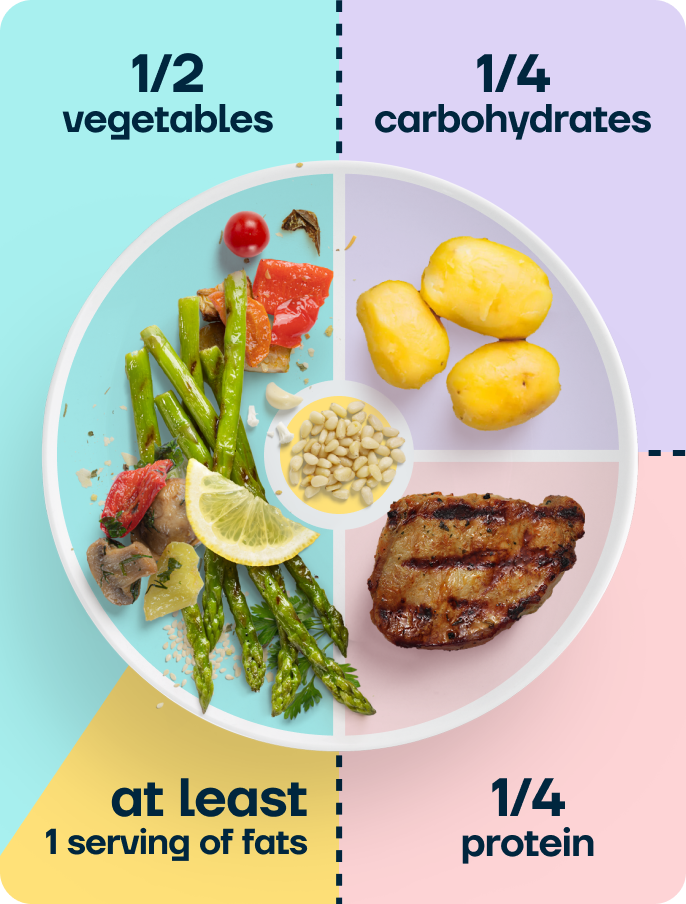
Use Second Nature’s balanced plate to plan each meal:
- Fill half the plate with vegetables, such as broccoli, carrots, peppers, or green beans, for fibre and a range of vitamins and minerals
- Fill a quarter with protein, such as chicken, fish, eggs, Greek yoghurt, tofu, beans, or lentils, using a portion about the size of the palm of your hand
- Fill the remaining quarter with complex carbohydrates, such as brown rice, potatoes, or wholemeal pasta, which add fibre to support regular bowel movements
- Add a serving of fat, such as olive oil, nuts, or avocado
Research on adults losing weight points to 1.2 to 1.6 grams of protein per kg of body weight per day.6
For someone weighing 90 kg, that’s around 110 to 145 grams a day, or a serving the size of the palm of your hand at each meal.
Some protein sources are more filling than others, and it can be challenging to eat enough protein when your hunger is lower because you’re on GLP-1 medications.
We recommend easier-to-digest protein sources like minced meat, yoghurt, scrambled eggs, fish, tofu, or slow-cooked meat. If you’re still struggling to eat protein each day, you could add protein powder to smoothies or soups.
For calcium, include milk, yoghurt, or calcium-fortified plant drinks in your meals. Ask your cancer team whether you need calcium or vitamin D supplements alongside any bone-strengthening treatment you already take.6
Aim for 3 balanced meals a day, with protein-rich snacks in between if needed.
Tell your prescriber and cancer team if you keep finding it hard to eat, you’re losing weight faster than planned, or you feel weaker than usual.
Building a movement routine after breast cancer treatment
At Second Nature, we don’t judge exercise by how much weight it helps us lose. After breast cancer, walking and strength exercise can reduce fatigue, ease joint pain from aromatase inhibitors, and help maintain muscle and bone.6,9,10
A 2026 review of 116 randomised trials, involving 9,206 women with breast cancer, found that strength exercise reduced fatigue and improved how well women could carry out physical tasks, compared with women who didn’t do these programmes.9
If fatigue is limiting what you can do, start small and build up gradually. For example, a 10-minute walk after lunch and add a few minutes each week.
Strength exercises help maintain the muscles we use to stand up, climb stairs, and carry shopping, and regular sessions also help maintain bone.6
Start with 2 short sessions a week of leg exercises, such as standing up from a chair or step-ups, which don’t put weight through your chest or shoulder.
Ask your cancer team when you can add resistance bands for your arms.
Aromatase inhibitors can cause joint and muscle pain.5 A year-long trial followed 121 previously inactive women with this joint pain.
Those who did 150 minutes of aerobic exercise a week and supervised strength training twice a week saw their worst joint pain score fall by 29%. In women who had usual care, it rose by 3%.10
After surgery or radiotherapy, keep doing the arm and shoulder exercises your cancer team gave you.
If you still can’t move your arm or shoulder as easily as before, ask for a referral to physiotherapy, as NICE recommends.5
Lymphoedema is swelling, usually in the arm, caused by fluid building up after lymph nodes are removed or treated.
NICE says there’s no indication that physical activity, including arm exercise, causes lymphoedema or makes it worse, and that it may improve quality of life.5
Ask a physiotherapist or your cancer team to adapt exercises if you have lymphoedema, thinning bones, or ongoing pain.
Support for fear of cancer recurrence and body image
Fear of cancer returning is common after breast cancer. Speak to your breast care nurse or GP if this fear, or changes in how your body looks, are affecting your eating, sleep, or daily life.
In an analysis of 3,612 people who’d had breast cancer, about 6 in 10 had at least a moderate fear of it returning, and about 1 in 5 had a level of fear that needs specialist support.11
This fear doesn’t always fade with time. Across all cancers, about 1 in 5 people had this higher level of fear, whether they were diagnosed in the past year or more than 10 years ago.11
For some people, starting the Wegovy pill can bring these worries back. Fear of recurrence often includes watching our body closely for symptoms, so a side effect such as nausea could feel like a sign that the cancer has returned.11
Tell your cancer team about any new symptoms so they can check them.
Psychological support can also help. A review of 23 controlled trials found a small reduction in fear of recurrence that largely lasted at follow-up.12
Newer forms of cognitive behavioural therapy (CBT, a talking therapy), which focus on how we respond to worrying thoughts, had a larger effect than traditional CBT.12
NICE recommends that everyone with breast cancer has prompt access to specialist psychological support, so ask your breast care nurse or GP for a referral.5
Breast cancer treatment can also change how we feel about our bodies. A 2026 review of 41 studies found that body image scores fell during treatment and were lower after mastectomy than after treatment where the breast wasn’t removed.13
If you’ve had surgery or reconstruction, ask your breast care team how weight loss might change the way your breasts look before you start the Wegovy pill.
What to agree with your cancer team before starting
Before starting, ask your oncologist and prescriber whether weight loss is appropriate at this stage of recovery, and agree how they’ll monitor it. Bring a list of every medicine and supplement you take, including anything you take only occasionally.
Ask your team:
- Have I recovered enough, and am I eating well enough, to start a medicine that reduces appetite?
- How should the pill fit around my cancer medicines, bone medicines, and supplements?
- Do I need a bone density review because of my hormone treatment?
- Who should I contact if side effects stop me eating or taking my other medicines?
Contact your prescriber promptly if vomiting means you can’t keep cancer medicines or fluids down.
Seek urgent help for severe stomach pain that doesn’t go away, because it can be a sign of pancreatitis (inflammation of the pancreas).1
Keep attending your planned cancer follow-up appointments and mammograms. Tell your cancer team about new breast, chest-wall, or underarm changes, or any other new symptoms, rather than assuming they’re side effects of the Wegovy pill.
Take home message
You may be able to take the Wegovy pill after breast cancer once you’ve recovered from surgery, chemotherapy, or radiotherapy and are eating well. You may also be able to take it alongside long-term tamoxifen or an aromatase inhibitor.
Your oncologist and prescriber need to review your treatment, recovery, and medicines before you start.
There’s no evidence that GLP-1 medicines, including the Wegovy pill, increase the risk of developing breast cancer.
Still, it’s not clear whether they change the risk of breast cancer returning for patients in remission, as no randomised trials have published results on this yet.
The pill has to be taken on an empty stomach, at least 30 minutes before other medicines by mouth, so ask your pharmacist for a written schedule for your tablets.
To maintain muscle and bone while you lose weight, eat enough protein and calcium, lose weight slowly (around 1 lb per week), and do regular strength exercise.
Fear of cancer returning is common after breast cancer. Speak to your breast care nurse or GP if it’s affecting your eating, sleep, or daily life.
Second Nature combines medication with personalised support from registered dietitians and nutritionists, including help planning protein-rich meals when appetite is low.
Our advice is built around the balanced plate of half vegetables, a quarter protein, a quarter complex carbohydrates, and a serving of fat.
A peer-reviewed study of our programme alongside semaglutide injections found an average weight loss of 19.1% at 12 months among members who were still subscribed.14
Of all members with recorded 12-month weights, 77.7% lost at least 10% of their starting weight.14
Second Nature's Mounjaro and Wegovy programmes
Second Nature provides Mounjaro or Wegovy as part of our Mounjaro and Wegovy weight-loss programmes.
Why choose Second Nature over other medication providers, assuming you're eligible?
Because peace of mind matters.
We've had the privilege of working with the NHS for over eight years, helping people across the UK take meaningful steps toward a healthier, happier life.
Our programmes are designed to meet people where they are, whether that means support with weight loss through compassionate one-to-one health coaching, or access to the latest weight-loss medications (like Mounjaro and Wegovy) delivered alongside expert care from a multidisciplinary team of doctors, psychologists, dietitians, and personal trainers.
At the heart of everything we do is a simple belief: real, lasting change comes from building better habits, not relying on quick fixes. We're here to support that change every step of the way.
With over a decade of experience, thousands of lives changed, and a long-standing record of delivering programmes used by the NHS, we believe we're the UK's most trusted weight-loss programme.
We hope to offer you something invaluable: peace of mind, and the support you need to take that first step.
Frequently asked questions
Can I take the Wegovy pill while taking tamoxifen?
You may be able to take the Wegovy pill with tamoxifen, as the UK prescribing information doesn’t list an interaction between them.1
No study has directly tested taking them together, so ask your oncologist and prescriber to check this before you start.
Can I take the Wegovy pill with anastrozole or letrozole?
You may be able to take the Wegovy pill with anastrozole or letrozole, as the UK prescribing information doesn’t list an interaction with either.1
Both medicines can reduce bone density, so ask your oncologist and prescriber to check your bone health and calcium intake before you start.5
How long after chemotherapy can I start the Wegovy pill?
The UK prescribing information doesn’t set a fixed waiting period after chemotherapy, so when you can start depends on how well you’ve recovered and if weight loss is appropriate for you.1
It’s best to wait until you’ve recovered, because the pill can cause nausea and vomiting, which chemotherapy can also cause, and this can make it harder to eat enough.1,5
Does the Wegovy pill cause breast cancer?
There’s no evidence that GLP-1 medicines, including the Wegovy pill, increase the risk of developing breast cancer.
A review of 48 randomised trials found that they probably make little or no difference to breast cancer risk compared with placebo.2
The trials were short and weren’t designed to study cancer, so longer-term studies are still needed.2
Can oral semaglutide reduce breast cancer recurrence?
Oral semaglutide, the drug in the Wegovy pill, hasn’t been shown to reduce the risk of breast cancer returning.
In a 2026 health-records study, cancer returned less often in women taking GLP-1 medicines in some comparisons, but the study couldn’t show that the medicines caused the difference, and it didn’t test the Wegovy pill.3
Will I lose the same amount of weight as people in Wegovy pill trials?
Your weight loss may be different, because OASIS 4, the main trial of the Wegovy pill, wasn’t designed to study people after breast cancer.
In the trial, people assigned to the Wegovy pill had an average weight loss of 13.6% after 64 weeks, compared with 2.2% on placebo.4
Can I take the Wegovy pill if I’m worried about bone loss?
You may be able to take the Wegovy pill if you’re worried about bone loss, but ask your oncologist and prescriber to check your bone health first, particularly if you take an aromatase inhibitor, which can reduce bone density.5
To maintain bone while you lose weight, eat enough calcium and do regular strength exercise, and ask whether you need a bone density scan before you start.5,6
Does meeting the BMI criteria mean I’m eligible for treatment?
Meeting the BMI criteria in the UK licence doesn’t mean you’ll be prescribed the Wegovy pill.1
Your prescriber will also review your cancer history, ongoing treatment, recovery, and other health conditions before deciding whether the pill is suitable, and providers may have additional eligibility requirements.