How Mounjaro affects anticoagulant therapy
A 2024 systematic review published in Drug Safety examined pharmacokinetic studies of GLP-1 receptor agonists taken alongside oral medications.1
For warfarin specifically, overall drug exposure (measured as area under the curve) stayed within the standard limits used to assess clinically meaningful interactions.
The authors concluded that dose adjustments are probably not required for most oral medications taken with GLP-1 receptor agonists, but advised caution with drugs where the difference between an effective dose and one that causes side effects is small. Anticoagulants fall into this category.
The relevant indirect mechanisms are:
1. Weight loss: as you lose weight on Mounjaro, dosing requirements may need reassessing, particularly for warfarin, where INR varies with body composition changes.
2. Reduced food intake: appetite reduction affects rivaroxaban absorption (which must be taken with food at higher doses) and can lower vitamin K intake on warfarin.
3. Delayed gastric emptying: Mounjaro slows digestion, which delays the time to peak concentration of oral anticoagulants but doesn’t usually change overall exposure.
4. Vomiting: persistent vomiting from Mounjaro side effects can prevent absorption of oral anticoagulants entirely, leaving you with less protection against clots.
NICE doesn’t specifically contraindicate combining GLP-1 medications with anticoagulants. Standard practice is to inform your anticoagulation service before starting Mounjaro.
The main types of anticoagulants
Direct oral anticoagulants (DOACs) like apixaban (Eliquis), rivaroxaban (Xarelto), edoxaban (Lixiana), and dabigatran (Pradaxa) are the most commonly prescribed anticoagulants in the UK for atrial fibrillation and venous thromboembolism.
They have fewer food and drug interactions than warfarin and don’t require routine blood monitoring.
Vitamin K antagonists (mainly warfarin) require regular INR monitoring and are sensitive to changes in vitamin K intake from green vegetables.
Injectable anticoagulants like enoxaparin (Clexane) are usually used short-term for hospital prophylaxis or pregnancy and are less affected by Mounjaro.
Apixaban and Mounjaro
Apixaban (Eliquis) is one of the most commonly prescribed DOACs in the UK. Its absorption is largely unaffected by food, so Mounjaro’s effects on appetite and meal timing don’t usually change how well it works.2
The standard apixaban dose for atrial fibrillation is 5 mg twice daily. The lower 2.5 mg twice-daily dose is used only when at least two of the following three criteria are met: age 80 years or older, body weight 60 kg or less, or serum creatinine 133 micromol/L or higher (indicating reduced kidney function).2
This is a common point of confusion worth clarifying. Crossing 60 kg below as you lose weight on Mounjaro doesn’t automatically trigger a dose reduction on its own. The dose is only reduced if you also meet one of the other two criteria.
If you’re approaching the 60 kg threshold and you’re also over 80 or have reduced kidney function, your GP or anticoagulation service may reassess your dose.
Tell them about significant weight loss (more than 5-10% of your starting weight) so they can review your prescription against the criteria.
Rivaroxaban and Mounjaro
Rivaroxaban (Xarelto) is taken once a day. The 15 mg and 20 mg doses must be taken with food to achieve full absorption.3 This is the most relevant interaction with Mounjaro to be aware of.
Without food, the bioavailability of the 20 mg dose is approximately 66%. Taking it with food increases drug exposure (AUC) by 39%, bringing absorption close to complete.3
Mounjaro reduces appetite, particularly when first started and after each dose increase. If you don’t feel like a full meal at your usual rivaroxaban time, something small like a slice of toast with peanut butter, a handful of nuts with some cheese, or a yoghurt with seeds is enough to improve its absorption.
If reduced appetite means you’re regularly skipping meals or struggling to eat at your rivaroxaban time, contact your GP or anticoagulation service.
Taking rivaroxaban without food can leave you at a higher risk of stroke or recurrent clot.
The standard dose for atrial fibrillation is 20 mg once daily, with a lower 15 mg dose for moderate kidney impairment.
Warfarin and Mounjaro
Warfarin requires more careful management with Mounjaro than DOACs because it’s highly sensitive to vitamin K intake from green vegetables.
The pharmacokinetic studies in the Calvarysky review found that warfarin’s overall exposure remains within standard limits when taken with GLP-1 receptor agonists, but indirect dietary effects matter.1
If Mounjaro reduces your appetite and you eat fewer green vegetables than usual, your vitamin K intake drops, your INR rises, and your bleeding risk increases. The opposite happens on days you eat more vegetables than usual.
The principle for warfarin patients on Mounjaro is consistency rather than avoidance. Eat similar amounts of vitamin K-containing foods each day. If your appetite drops significantly, tell your anticoagulation service so they can check your INR and adjust your dose.
Your anticoagulation service will likely recommend more frequent INR checks in the first few months of Mounjaro treatment.
Bleeding warning signs and when to seek help
Because anticoagulants slow your blood’s ability to clot, some extra bleeding is expected and usually not a concern.
Small bruises, a bit of gum bleeding when brushing your teeth, or a nosebleed that takes slightly longer to stop are all common and rarely need attention.
Signs requiring immediate medical attention (call 999 or go to A&E)
- Vomiting blood, or vomit that looks like coffee grounds (a sign of upper gastrointestinal bleeding)
- Black, tarry stools (a sign of bleeding in the stomach or upper bowel)
- Bright red blood in stools or large amounts of red urine
- Sudden severe headache, especially with drowsiness, confusion, weakness, or vision changes
- Any head injury, even if you feel fine immediately afterwards (anticoagulants increase the risk of delayed intracranial bleeding)4
- Bleeding from a wound that doesn’t stop after 10 to 15 minutes of firm pressure
- Sudden severe abdominal or back pain with no obvious cause
Signs to contact your GP or anticoagulation service the same day
- Blood in urine that you can see (pink or red urine)
- Heavier or longer menstrual bleeding than usual
- Frequent unexplained bruising
- Persistent nosebleeds lasting more than 10 minutes despite pressure
Mounjaro-specific risks
Two interactions between Mounjaro side effects and anticoagulants warrant particular attention.
First, persistent vomiting on Mounjaro combined with anticoagulants increases the risk of an upper gastrointestinal bleed.
If you’re vomiting and you see blood or coffee-ground material, treat this as an emergency.
Second, Mounjaro can cause dehydration and dizziness in the early weeks, particularly if nausea reduces fluid intake.
Dehydration increases fall risk, and any fall with head impact while on anticoagulants needs urgent medical assessment, even if you feel fine afterwards.4
Reversal agents
The effects of apixaban, rivaroxaban, and dabigatran can be reversed quickly in emergency settings using specific reversal agents (andexanet alfa for apixaban and rivaroxaban; idarucizumab for dabigatran).
Warfarin can be reversed with vitamin K and prothrombin complex concentrate. Reversal isn’t routine, but it’s available when needed.4
Dental treatment, surgery, and other procedures
For most routine dental procedures, including simple extractions, current UK dental guidance advises continuing your anticoagulant rather than stopping it.
The thrombotic risk of stopping anticoagulation usually outweighs the bleeding risk from dental treatment.5
Higher-bleeding-risk dental procedures
For procedures with greater bleeding risk (multiple extractions, complex surgical extractions, periodontal surgery), guidance recommends:5
- For apixaban or dabigatran (twice daily): skip the morning dose on the day of treatment
- For rivaroxaban or edoxaban taken in the morning: delay the morning dose until at least 4 hours after bleeding has stopped
- For rivaroxaban or edoxaban taken in the evening: no change needed
- For warfarin: check INR within 24 hours of treatment, and proceed if it’s below 4
Surgery and other invasive procedures
For elective surgery or invasive procedures (endoscopy, colonoscopy, joint replacement, cataract surgery), discuss anticoagulation timing with your surgical team and your GP at least 1 to 2 weeks in advance.
The decision to pause or continue depends on the procedure’s bleeding risk and your underlying clotting risk.
Always tell your dentist, surgeon, and anaesthetist that you take both an anticoagulant and Mounjaro.
Tirzepatide can affect anaesthesia planning because of delayed gastric emptying, and your team may want to plan around this separately from the anticoagulant.
Carry a medical ID indicating you take both medications.
Monitoring your treatment
The monitoring approach depends on which anticoagulant you take.
For warfarin, your anticoagulation service will likely recommend more frequent INR checks (often weekly initially) when you start Mounjaro and after each dose increase, returning to your usual schedule once readings stabilise.
For DOACs (apixaban, rivaroxaban, edoxaban, dabigatran), routine blood monitoring isn’t required.
Your GP may recommend checking kidney function (eGFR) and weight every 3 to 6 months while you’re on Mounjaro, since significant changes in either may affect dosing decisions.
Before starting Mounjaro
Your GP or anticoagulation service should be aware of:
- Your current weight, for future comparison
- Your most recent eGFR and serum creatinine
- Your current INR if you’re on warfarin
- All other medications you take
Report any unusual bleeding, persistent vomiting, falls, or significant changes in appetite to your prescriber. Side effects from any medication can also be reported to the MHRA Yellow Card Scheme at yellowcard.mhra.gov.uk.
Eating well on both medications
Even with reduced appetite on Mounjaro, eating three balanced meals a day helps to ensure that you’re medications are working effectively.
For rivaroxaban, it keeps absorption steady. For warfarin, it keeps your vitamin K intake from green vegetables consistent, which stabilises your INR.
Staying fed and hydrated also reduces fall risk, which becomes more significant when you’re on an anticoagulant.
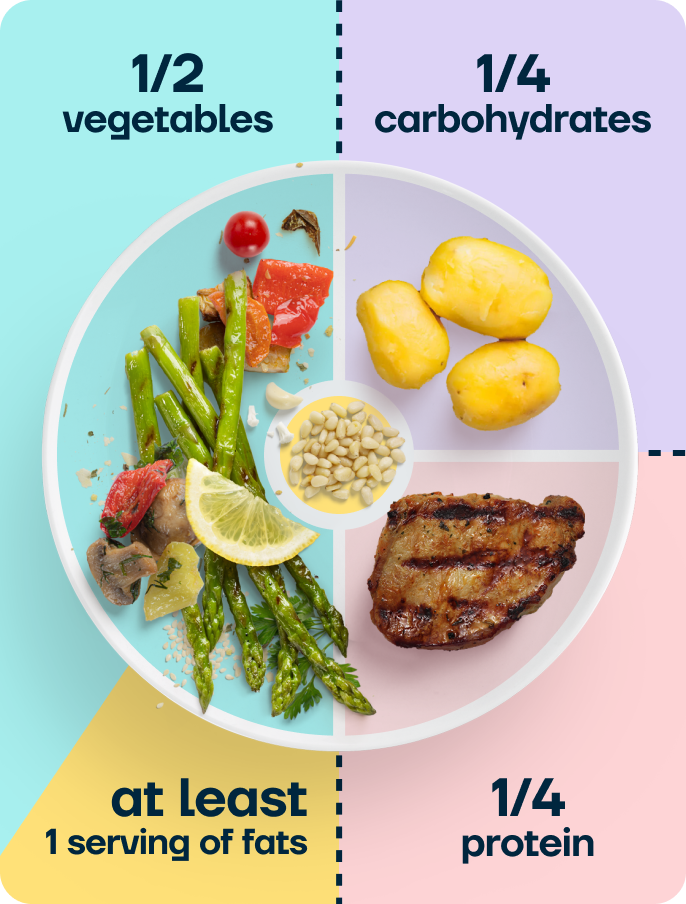
The Second Nature balanced plate model is a useful starting framework: half the plate vegetables, a quarter protein, a quarter complex carbohydrates, plus a serving of fat.
Protein at every meal
Protein helps preserve muscle mass during weight loss, reducing the risk of falls. Good sources include chicken, fish, eggs, Greek yoghurt, beans, lentils, and tofu. Aim for a portion at each meal.
Complex carbohydrates for steady energy
Fibre-rich carbohydrates digest slowly and help avoid energy dips. Choose wholegrain or sourdough bread, rolled oats, brown rice, potato, sweet potato, quinoa, beans and lentils, and wholemeal pasta.
Healthy fats from whole foods
Whole-food fats support brain function and helps our body absorb oral medications. Extra virgin live oil, avocado, nuts, seeds, oily fish, full-fat dairy, and eggs all work well.
For rivaroxaban specifically, including some fat at each meal helps absorption.
Vitamin K intake for warfarin patients
If you’re on warfarin, its recommend to maintain a consistent intake of vitamin K. Eat similar amounts of green vegetables each day rather than large amounts on some days and none on others.
Good sources include broccoli, spinach, kale, Brussels sprouts, and green beans. Pick the ones you enjoy and include similar portions regularly.
If Mounjaro reduces your appetite enough that you’re eating fewer vegetables than usual, tell your anticoagulation nurse so they can monitor your INR and adjust your warfarin dose if needed.
Staying active safely
Regular movement supports weight loss, cardiovascular health, and muscle preservation while you’re taking Mounjaro. For people on anticoagulants, the main consideration is reducing the risk of falls.
Research on habit formation suggests it takes an average of 66 days for a new behaviour to become automatic, though this varies considerably between individuals.6
Starting with something small enough to do on a bad day, attached to an existing routine, gives the habit the best chance of sticking. A 10-minute walk after dinner, or some gentle stretching before bed, are reasonable starting points.
Activities that work well
Walking, swimming, stationary cycling, cycling on quiet routes, yoga, Pilates, light resistance training, and group exercise classes all suit people taking anticoagulants.
Resistance training is particularly useful for preserving muscle during weight loss on Mounjaro.
Activities to approach with care
Contact sports (rugby, boxing, martial arts) and high-impact activities (downhill skiing, mountain biking on technical trails) carry a higher injury risk on anticoagulants. A bleed from a collision or fall takes longer to stop and can be more serious.
Cycling on busy roads, climbing, and gymnastics on apparatus where falls are possible warrant the same caution.
The NHS recommends 150 minutes of moderate activity per week as a long-term target. Build up gradually rather than starting at that level.
Anticoagulants and Mounjaro at a glance
| Anticoagulant |
Food requirement |
Routine monitoring |
Key consideration with Mounjaro |
| Apixaban (Eliquis) |
No food requirement |
No routine blood tests; check kidney function and weight every 3 to 6 months |
Dose only reduced to 2.5 mg twice daily if at least 2 of: age ≥80, weight ≤60 kg, creatinine ≥133 micromol/L |
| Rivaroxaban (Xarelto) |
15 mg and 20 mg doses must be taken with food |
No routine blood tests; check kidney function and weight every 3 to 6 months |
If reduced appetite means missing meals at your rivaroxaban time, contact your prescriber |
| Edoxaban (Lixiana) |
No food requirement |
No routine blood tests; check kidney function and weight every 3 to 6 months |
Dose adjusted for kidney function, weight ≤60 kg, or certain interacting medications |
| Dabigatran (Pradaxa) |
No food requirement |
No routine blood tests; check kidney function regularly |
More dependent on kidney function than other DOACs |
| Warfarin |
Consistent vitamin K intake (green vegetables) matters more than specific food timing |
Regular INR checks; more frequent during Mounjaro initiation and dose increases |
Reduced appetite can lower vitamin K intake and raise INR; aim for daily consistency |
Frequently asked questions
Does Mounjaro directly interact with anticoagulants?
No. There are no known direct chemical interactions between tirzepatide and common anticoagulants like apixaban, rivaroxaban, edoxaban, or warfarin.1
The considerations are indirect: weight loss, reduced food intake, and the effect of side effects like vomiting on absorption.
Will I need to change my anticoagulant dose on Mounjaro?
Possibly, but not everyone does. For DOACs, dose changes are usually only needed if specific criteria are met (for apixaban, two of three: age ≥80, weight ≤60 kg, creatinine ≥133 micromol/L).
For warfarin, dose changes are guided by INR readings rather than by weight directly.
I’m losing weight on Mounjaro and might drop below 60 kg. Will my apixaban dose change automatically?
Not on its own. The lower 2.5 mg twice-daily dose is used only if at least two of the three criteria are met (age 80 or older, weight 60 kg or less, serum creatinine 133 micromol/L or higher). If you only meet one criterion, the standard 5 mg twice daily dose is correct.2
Which anticoagulant is best with Mounjaro?
Research hasn’t directly compared anticoagulants in people taking Mounjaro.
In general, DOACs require fewer adjustments than warfarin as eating patterns change, and apixaban and edoxaban don’t depend on food for absorption.
Rivaroxaban must be taken with food at higher doses, which matters more on Mounjaro. Your GP or haematologist can advise on your specific situation.
What should I do if I’m vomiting on Mounjaro and on anticoagulants?
Contact your GP or anticoagulation service the same day. Persistent vomiting can prevent the absorption of oral anticoagulants, leaving you under-anticoagulated.
If you see blood in vomit, or vomit that looks like coffee grounds, call 999 or go to A&E. This can be a sign of upper gastrointestinal bleeding.
What should I do if I have a fall or head injury while on anticoagulants?
Seek immediate medical assessment, even if you feel fine. Anticoagulants increase the risk of delayed bleeding inside the skull after a head impact, which may not be obvious for hours after the injury.4
Can I have dental work or surgery while on both medications?
Yes. For most routine dental work, including simple extractions, you continue your anticoagulant.
For higher-bleeding-risk procedures, your dentist may advise adjusting the timing of your DOAC dose for that day.5
For elective surgery, discuss timing with your surgical team at least 1 to 2 weeks in advance. Always tell your dentist, surgeon, and anaesthetist about both medications.
Do I need to avoid any foods on both medications?
If you’re on a DOAC, no specific foods are off-limits. For rivaroxaban, take it with a meal or substantial snack containing some fat.
If you’re on warfarin, the principle is consistency with green vegetables rather than avoidance, so eat similar amounts each day.
What exercise is safe while taking anticoagulants and Mounjaro?
Most exercise is safe and encouraged. Walking, swimming, cycling, yoga, pilates, and resistance training all work well.
Avoid contact sports and high-impact activities where falls or collisions are likely. Speak to your GP if you’re unsure about a specific activity.
Could Mounjaro affect my mood while I’m managing multiple medications?
The most common Mounjaro side effects are gastrointestinal rather than mood-related.
Managing several long-term medications can feel overwhelming for some people, particularly during the early weeks of a new prescription. If you notice persistent low mood, anxiety, or difficulty coping, mention it to your GP.
Take home message
You can take Mounjaro alongside anticoagulants such as apixaban, rivaroxaban, edoxaban, or warfarin, but the combination requires coordinated monitoring by your GP, anticoagulation service, and Mounjaro prescriber.
The main considerations aren’t direct drug interactions. They’re the indirect effects of weight loss on dosing, reduced appetite on absorption (particularly for rivaroxaban and warfarin), and Mounjaro side effects, such as vomiting and dehydration, on bleeding risk.
For apixaban, the lower 2.5 mg twice daily dose applies only if at least 2 of the 3 criteria are met (age ≥80, weight ≤60 kg, creatinine ≥133 micromol/L). Crossing below 60 kg alone doesn’t trigger a dose change.
For rivaroxaban, take the 15 mg and 20 mg doses with food (even a substantial snack works) to maintain proper absorption.
For warfarin, consistency in vitamin K intake matters more than avoidance, and your INR will need closer monitoring during Mounjaro initiation.
Recognise the bleeding warning signs that need urgent attention: vomiting blood or coffee-ground material, black tarry stools, sudden severe headache, any head injury, or bleeding that doesn’t stop with pressure.
Second Nature’s Mounjaro programme combines medication with support from registered dietitians and a structured habit-change programme, built around the balanced plate model and focused on sustainable changes.
In a 2025 study published in JMIR Formative Research, active subscribers on Second Nature’s GLP-1 supported programme lost an average of 19.1% of their body weight at 12 months, with 77.7% achieving at least 10% weight loss.7
Second Nature's Mounjaro and Wegovy programmes
Second Nature provides Mounjaro or Wegovy as part of our Mounjaro and Wegovy weight-loss programmes.
Why choose Second Nature over other medication providers, assuming you're eligible?
Because peace of mind matters.
We've had the privilege of working with the NHS for over eight years, helping people across the UK take meaningful steps toward a healthier, happier life.
Our programmes are designed to meet people where they are, whether that means support with weight loss through compassionate one-to-one health coaching, or access to the latest weight-loss medications (like Mounjaro and Wegovy) delivered alongside expert care from a multidisciplinary team of doctors, psychologists, dietitians, and personal trainers.
At the heart of everything we do is a simple belief: real, lasting change comes from building better habits, not relying on quick fixes. We're here to support that change every step of the way.
With over a decade of experience, thousands of lives changed, and a long-standing record of delivering programmes used by the NHS, we believe we're the UK's most trusted weight-loss programme.
We hope to offer you something invaluable: peace of mind, and the support you need to take that first step.
References
- Calvarysky, B. et al. (2024). Drug-drug interactions between glucagon-like peptide 1 receptor agonists and oral medications: a systematic review. Drug Safety, 47(5), 439-451.
- Electronic Medicines Compendium. (2025). Eliquis 2.5 mg film-coated tablets – Summary of Product Characteristics.
- Electronic Medicines Compendium. (2025). Xarelto 20 mg film-coated tablets – Summary of Product Characteristics.
- British Heart Foundation. (2025). Direct oral anticoagulants (DOACs): how do they work?.
- Scottish Dental Clinical Effectiveness Programme. (2022). Management of dental patients taking anticoagulants or antiplatelet drugs: quick reference guide (2nd edition).
- Lally, P. et al. (2010). How are habits formed: modelling habit formation in the real world. European Journal of Social Psychology, 40(6), 998-1009.
- Richards, R. et al. (2025). A remotely delivered GLP-1RA-supported specialist weight management program in adults living with obesity: retrospective service evaluation. JMIR Formative Research, 9(1), e72577.