Evidence from clinical trials
The clearest evidence on Wegovy doses comes from STEP UP, a trial that compared two doses against each other and against placebo in the same group of people.1
STEP UP enrolled 1,407 adults with obesity and without type 2 diabetes, and treated them for 72 weeks.1
| Wegovy dose |
Average weight loss (72 weeks) |
| 7.2 mg |
20.7% |
| 2.4 mg |
17.5% |
| Placebo |
2.4% |
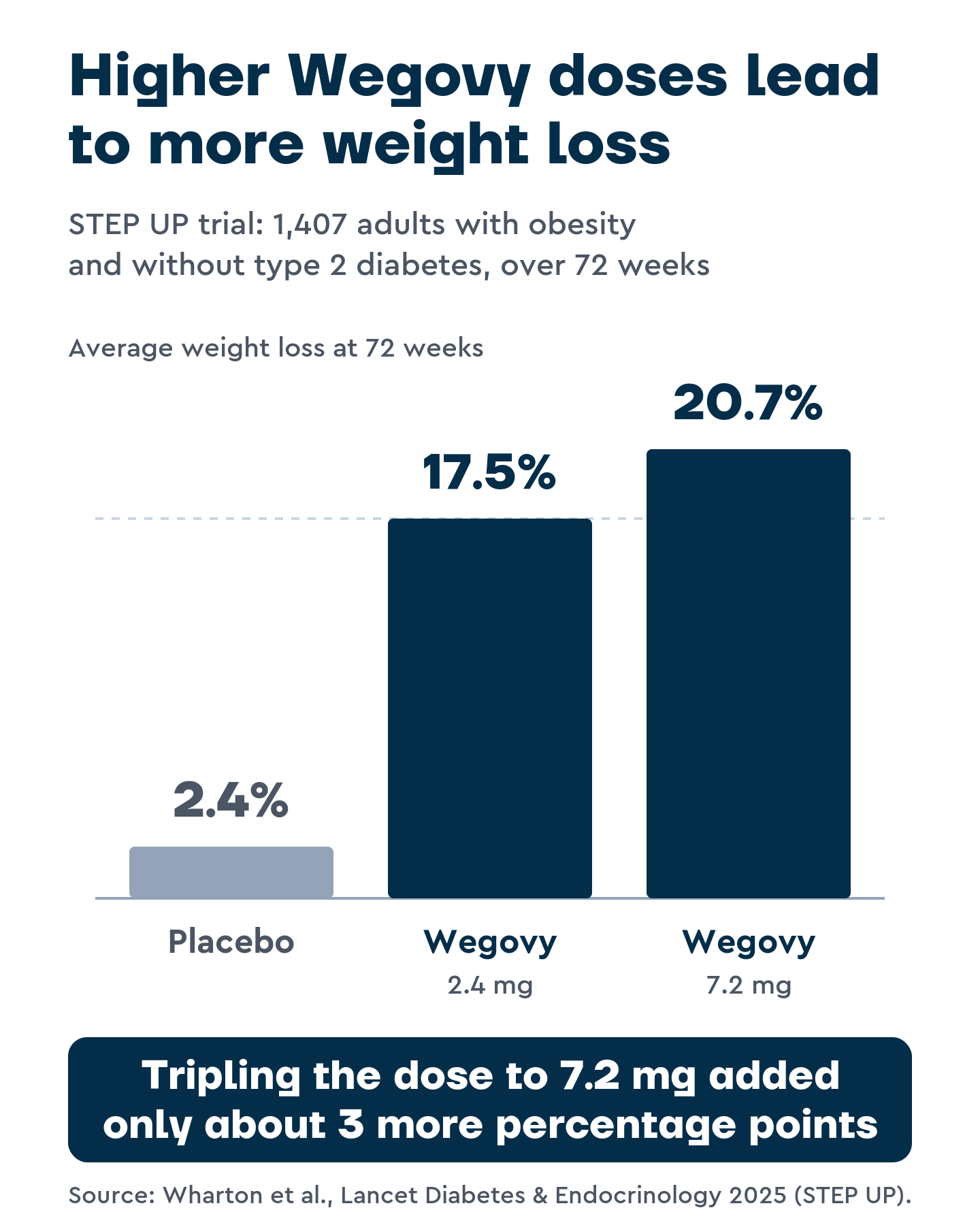
Among people who stayed on treatment and reached their target dose, the average at 7.2 mg rose to 20.7%, a figure often used when Wegovy is directly compared with Mounjaro.1
Nearly half of the people taking 7.2 mg lost at least 20% of their body weight.1
The older STEP 1 trial studied the 2.4 mg dose on its own in 1,961 adults without diabetes, and found an average weight loss of 14.9% over 68 weeks, compared with 2.4% on placebo.2
Lower doses, such as 0.25 mg, 0.5 mg, and 1 mg, are designed as dose increases to help people reach 2.4 mg, not maintenance doses for weight management.6
Still, many people will find they can lose weight at a sustainable rate on lower doses and maintain them for as long as they find them effective.
Those lower doses have been studied as maintenance doses mainly in type 2 diabetes, where semaglutide is sold as Ozempic, and weight loss tends to be smaller.4
In STEP 2, which compared doses in adults with obesity and type 2 diabetes, the 2.4 mg dose produced an average weight loss of 9.6% over 68 weeks, compared with 3.4% on placebo.4
Key points:
- Higher doses of Wegovy consistently produce greater average weight loss
- In STEP UP, 7.2 mg produced an average weight loss of 20.7%, compared with 17.5% on 2.4 mg
- Nearly half of the people on 7.2 mg lost at least 20% of their body weight
- Doses below 2.4 mg are generally considered titration steps, but many people can achieve significant weight loss on them, particularly if they’re combined with healthy lifestyle changes
- Going from no medication to 2.4 mg adds far more weight loss than going from 2.4 mg to 7.2 mg
How weight loss changes with dose
The science behind a higher dose
Semaglutide mimics GLP-1, a hormone that communicates with the appetite centres in the brain and slows how quickly the stomach empties.6
A higher dose means more of the medication is interacting with those appetite centres, which tends to reduce hunger and further quieten food noise. This is why average weight loss rises as the dose rises.1
Why the benefit gets smaller at each dose increase
The increase in weight loss is not constant. An early dose-ranging trial tested five increasing doses of semaglutide and found that each dose increase led to greater weight loss, but two of the middle doses produced nearly the same result (11.6% and 11.2%), an early sign that going higher doesn’t always yield a greater effect.3
Going from no medication to 2.4 mg added about 11.7 percentage points of weight loss in STEP UP, whereas tripling the dose to 7.2 mg added only about 3 more.1 This is why some people do well on 2.4 mg and don’t need to go higher.
Key points:
- A higher dose means more of the medication communicates with the appetite centres in the brain
- Average weight loss rises with the dose, but by a smaller amount at each step
- The 2.4 mg dose delivers most of the available weight loss for many people
- The right dose is the one that balances results against side effects and cost
Second Nature has worked with the NHS since 2017, and we prescribe the lowest effective dose for as long as it’s working rather than moving you up the doses each month by default.
Take our 3-minute eligibility quiz, and a clinician will review your answers.
Individual factors affecting results
Starting weight and BMI
Your starting weight affects both how much weight you lose in total and the percentage you lose.
People with higher starting weights often lose more total weight in kilograms, while those starting at a lower body weight may lose fewer kilograms but a similar percentage.
There’s also wide variation between individuals, and some people respond more strongly to a given dose than others.1
Taking it consistently
Missing doses can reduce its effectiveness, regardless of which dose you’re on.
A consistent weekly injection at a lower dose will support greater long-term weight loss than occasional higher doses.
The importance of habits
On the Second Nature programme, we recommend a few habits that help our members lose weight sustainably while preventing muscle loss on GLP-1 medications.
Rapid weight loss can increase the risk of muscle and bone loss, so we recommend aiming for a sustainable rate of about 1 lb per week and staying on the lowest effective dose as long as it’s working.
Many of our members remain on lower doses of Wegovy and achieve significant weight loss without losing excess muscle mass.
Research on adults losing weight points to 1.2 to 1.6 grams of protein per kg of body weight per day, which, for someone weighing 90 kg, is around 110 to 145 grams, or a serving the size of the palm of your hand at each meal.
Wegovy reduces appetite, so many people struggle to eat enough protein in their meals before they feel full.
We recommend prioritising protein at every meal, and aiming for easier-to-digest meals like stews, casseroles, bolognese, chilli, soup (with a protein source), and smoothies.
Great protein sources that are also easy to digest include yoghurt, eggs, tofu, minced meat, and cottage cheese.
We recommend eating a diet based on whole foods that contains enough protein, fibre, fat, and complex carbohydrates and limits ultra-processed foods.
Regular movement, including resistance training such as bodyweight exercises, resistance bands, or weights, a couple of times a week, helps you maintain muscle mass while you lose weight.
Key points:
- Your starting weight affects both the total and the percentage of weight you lose
- Taking the medication consistently is more important than focusing on reaching the highest dose
- Staying on the lowest effective dose and losing weight at around 1 lb a week helps protect muscle
- Eating enough protein through a diet based on whole foods, and doing some resistance training will protect against muscle and bone loss during weight loss
Side effects at different doses
Side effects tend to become more common at higher doses.1 The most common side effects are gastrointestinal: nausea, diarrhoea, vomiting, and constipation.6
In STEP UP, gastrointestinal side effects became more common as the dose rose.1
| Group |
People reporting gastrointestinal side effects |
| 7.2 mg |
70.8% |
| 2.4 mg |
61.2% |
| Placebo |
42.8% |
These side effects are usually mild to moderate, tend to be worse in the days just after a dose increase, and often settle within a few weeks as your body adjusts.2
The 7.2 mg dose also led to more reports of altered skin sensations, such as tingling or numbness, known as dysaesthesia.1 This affected 22.9% of people on 7.2 mg, compared with 6.0% on 2.4 mg and 0.5% on placebo.1
Still, tolerability varies a lot between people. Some have few side effects even on the highest dose, while others find a lower dose more comfortable for the long term.
When weighing up a higher dose, it helps to ask whether the additional weight loss is worth the increased risk of side effects, and whether those side effects would affect your daily life.
Key points:
- Gastrointestinal side effects became more common as the dose rose in STEP UP, from 42.8% on placebo to 61.2% on 2.4 mg and 70.8% on 7.2 mg
- Altered skin sensations, such as tingling, were also more common on 7.2 mg (22.9%) than on 2.4 mg (6.0%)
- Nausea, diarrhoea, vomiting, and constipation are the most common side effects
- Side effects are usually worst just after a dose increase and often settle within a few weeks
- It’s worth considering whether increasing the dose is worth the risk of increased side effects. If the lower doses are working for you, there’s no reason to increase.
How to find your ideal Wegovy dose
When a higher dose makes sense
Moving up to 7.2 mg may be worth discussing with your prescriber if:
- You’ve reached and tolerated 2.4 mg, but haven’t reached your weight or health goals
- You’ve not experienced side effects, or any that have impacted your daily life
- Your weight loss has stalled at 2.4 mg
- You have weight-related health conditions that would benefit from further weight loss
When staying on a lower dose makes sense
Staying on 2.4 mg, or a maintenance dose below it, may suit you better if:
- You’re losing weight at a steady, sustainable rate
- Side effects are affecting your day-to-day life
- You’re close to your goal weight
- Cost is a concern
- You’re planning for the long term
NHS and licensing context
The MHRA licence for the 7.2 mg dose applies to private prescribing.8
On the NHS, Wegovy is prescribed at 2.4 mg through specialist weight-management services, and the 7.2 mg dose isn’t funded yet.
Wherever you’re prescribed it, the dose is a decision to make with your healthcare provider, who can weigh up your results, side effects, and health history.
Our guide to getting Wegovy on the NHS covers the eligibility criteria and how to apply.
Frequently asked questions
Will I stop losing weight if I don’t increase my dose?
No, most people keep losing weight on 2.4 mg without moving to 7.2 mg.
The rate may be slower than on a higher dose, but many people reach their goals on 2.4 mg.
Consistency with the injection and your eating and activity habits is more important than trying to reach the maximum dose.
Is 2.4 mg still the maximum Wegovy dose?
No. The MHRA approved a higher 7.2 mg dose on 12th January 2026.8
It’s for people who have already reached and tolerated 2.4 mg, and it’s currently available privately rather than on the NHS.
How is the 7.2 mg dose given?
Like the lower doses, the 7.2 mg dose is administered as a once-weekly injection.6
Depending on the provider, it may come as a single higher-strength pen or as lower-strength pens that together make up the dose, so check how yours is supplied when you collect it.
How much more weight will I lose on 7.2 mg than 2.4 mg?
In STEP UP, the 7.2 mg dose produced an average weight loss of 20.7% over 72 weeks, compared with 17.5% on 2.4 mg, a difference of about 3 percentage points.1 That’s an average, so some people will gain more from the higher dose and some less.
Can I start on a higher dose to lose weight faster?
No, starting higher isn’t recommended.
The licenced dosing schedule, starting at 0.25 mg and increasing every 4 weeks, is designed to reduce side effects and let your body adjust.6
People who follow the schedule are more likely to stay on the medication and get better results overall.
Do side effects always get worse at higher doses?
On average, side effects become more common at higher doses, but this isn’t the same for everyone.1
Some people experience a few extra side effects at higher doses, while others find them harder to manage. They’re usually worse just after a dose increase and often settle within a few weeks.
Can I move to a lower dose for maintenance once I reach my goal?
Many prescribers support a lower maintenance dose once you’ve reached your goal weight, particularly if you’ve built habits that help you manage hunger.
You might notice a little more hunger at first.
Always make dose changes under medical supervision.
What happens if I stop Wegovy?
If you stop Wegovy suddenly without having built the habits needed to maintain your new weight, some weight regain is likely.
In the STEP 4 trial, people who switched to placebo after reaching 2.4 mg regained about 7% of their body weight over the following 48 weeks, while those who continued lost a little more.5
This pattern of regain is consistent across the trials that examined what happens when people stop the medication suddenly.
We recommend coming off the medication slowly by gradually reducing the dose, and making sure you have habits in place to manage hunger naturally.
Our free weight regain prevention planner can help you plan this.
Are weight-loss injections addictive?
Weight-loss injections aren’t inherently addictive.
However, as they reduce hunger and cravings, it may feel challenging to come off them in future if you haven’t developed the healthy habits to manage hunger naturally.
In this scenario, some people may feel dependent on the medication to manage hunger.
But obesity is a chronic condition, and many people may need to be on these medications for the long term to help them manage their weight.
How do I know if I’m on the right dose for me?
The right dose is the one that gives you meaningful weight loss with side effects you can live with.
Signs you’re on the right dose include steady weight loss, reduced hunger and food noise, and side effects that don’t significantly affect your daily life.
This may or may not be the 2.4 mg or 7.2 mg dose.
Take home message
Higher doses of Wegovy lead to greater average weight loss, but the increase gets smaller at each dose increase.
In STEP UP, the 7.2 mg dose produced an average weight loss of 20.7% over 72 weeks, compared with 17.5% on 2.4 mg, while going from no medication to 2.4 mg added far more than that.1
Your weight-loss results also depend on your starting weight, how consistently you take the medication, your side effects, and your eating and activity habits.
For many people, the 2.4 mg maintenance dose will support sufficient weight loss alongside healthy lifestyle changes.
The research suggests you’re more likely to avoid weight regain when medication is combined with structured habit-change support than when it’s used on its own.
Second Nature combines weight-loss medication with structured support from registered dietitians, built around the balanced plate of half vegetables, a quarter protein, and a quarter complex carbohydrates, plus a serving of fat.
In our published research, members lost an average of 19.1% of their body weight at 12 months, and 77.7% lost at least 10%.7
Second Nature's Mounjaro and Wegovy programmes
Second Nature provides Mounjaro or Wegovy as part of our Mounjaro and Wegovy weight-loss programmes.
Why choose Second Nature over other medication providers, assuming you're eligible?
Because peace of mind matters.
We've had the privilege of working with the NHS for over eight years, helping people across the UK take meaningful steps toward a healthier, happier life.
Our programmes are designed to meet people where they are, whether that means support with weight loss through compassionate one-to-one health coaching, or access to the latest weight-loss medications (like Mounjaro and Wegovy) delivered alongside expert care from a multidisciplinary team of doctors, psychologists, dietitians, and personal trainers.
At the heart of everything we do is a simple belief: real, lasting change comes from building better habits, not relying on quick fixes. We're here to support that change every step of the way.
With over a decade of experience, thousands of lives changed, and a long-standing record of delivering programmes used by the NHS, we believe we're the UK's most trusted weight-loss programme.
We hope to offer you something invaluable: peace of mind, and the support you need to take that first step.