Check your progress
How much weight loss is normal, and when
Appetite will typically reduce in the first week or two on GLP-1 medications, but fat loss takes longer.
Initial weight loss in the first few weeks can be attributed to water loss, glycogen (stored carbohydrate in the muscles and the liver), and salt. From then, the body will start to ‘burn’ through existing fat stores.
The first four weeks on weight-loss medication are spent on a starting dose.
That dose isn’t necessarily designed to support weight loss; it’s more to help the body adapt to the medication before increasing up to the higher doses.8
The dose then rises no more often than every four weeks, so it takes several months to reach the highest one.8
Additionally, it can take 4-8 weeks for the medication to reach its steady state in the blood.
This steady state is the level at which the drug no longer rises and falls but is maintained at a higher level, and hunger levels will be more consistently lower.
Once we reach this steady state, it’s recommended to aim for a weight-loss rate of around 0.5-1 lb per week to reduce the risk of muscle and bone loss, hair loss, and nutrient deficiencies.
Here’s the average weight loss reported at the end of each medication’s main trial.
| Medication and dose |
Trial |
Time |
Average loss |
| Mounjaro 15 mg |
SURMOUNT-1 |
72 weeks |
20.9% |
| Mounjaro 10 mg |
SURMOUNT-1 |
72 weeks |
19.5% |
| Wegovy injection 7.2 mg |
STEP UP |
72 weeks |
18.7% |
| Wegovy injection 2.4 mg |
STEP 1 |
68 weeks |
14.9% |
| Wegovy pill 25 mg |
OASIS 4 |
64 weeks |
13.6% |
These are average results based on outcomes of thousands of individuals, and individual results vary widely.
In all four trials, the medication was taken alongside recommendations and support to change diet and introduce more physical activity, so the outcomes reflect that combination, not necessarily the drug on its own.1,2,3,4
Each figure is also the average across everyone who started the trial, including those who stopped early, rather than only the people who adhered to the drug and completed the entire trial.
If you’ve seen higher weight-loss results advertised for these medications, it’s likely the ‘completers’ figure, which is more of a ‘best-case scenario’ outcome.
Still, most eligible people respond well to GLP-1 medications.
In these trials, around 9 in 10 people on Mounjaro and around 6 in 7 on Wegovy lost at least 5% of their body weight.
Losing 5% of our body weight is considered the benchmark for clinical benefits where we’re likely to see health improvements such as lower blood sugar levels and blood pressure.1,2,15
OASIS 4, the main trial of the Wegovy pill, was much smaller, with 307 participants compared with 2,539 in the SURMOUNT-1 trial.1,3
If you’re taking the Wegovy pill, take it as soon as you wake up, on an empty stomach, with no more than half a glass of water, and swallow it whole. Then wait at least 30 minutes before eating, drinking, or taking anything else.9
Taken with food, or too soon before a meal, far less of the drug is absorbed, and you’ll lose less weight as a result.9
The Wegovy injection now has a higher 7.2 mg dose, approved by the MHRA on 6th January 2026, with a single-dose 7.2 mg pen following on 14th April 2026.9 It’s only for people with a BMI of 30 or above, and only after at least four weeks on 2.4 mg.8,9
Still, most people are on 2.4 mg, which is the dose that the checker will compare your progress with.
Measuring progress beyond the scale
Our weight loss is only one measure of progress, but our health is much more than our weight.
Measuring our weight as our only marker of progress is a bit like assessing our quality of life solely by our job salary.
Sure, our salary will influence many aspects of our lives, but it can’t determine our happiness, sense of purpose, or whether we’re living in alignment with our values.
Our health is much the same. Our weight is one way to measure our health, but it’s one of many, and not necessarily the most important.
Here are other ways of measuring progress beyond the numbers on the scale:
- Body measurements – like waist circumference – and how your clothes fit. Our waist can reduce in size as our body redistributes fat away from our internal organs, which can have profound health benefits.
- Energy levels, and how well you can perform activities of daily living, such as climbing the stairs, standing up from a chair, shopping, and walking.
- Food noise. Thinking about food less and feeling more in control around it can significantly improve life satisfaction, as we have more headspace for other areas of our lives.
- Other physical health markers. A weight loss of around 5% is enough to lower blood pressure, improve blood sugar, and reduce your risk of many chronic diseases.15,16
- Mood and psychological wellbeing. How we feel day to day often has a bigger impact on our lives than how we look. If we’re seeing improvements in our daily mood and our optimism for the future, that’s significant progress that we should engage with.
All of these improvements will make us more likely to avoid weight regain in the future as we move away from a weight-centred approach to our lives.
If we focus on our overall health and psychological well-being, rather than making weight the epicentre of our lives, we’re more likely to live a more meaningful and purposeful life, which will inherently lead to maintaining a healthier weight.
Why weight loss isn’t linear
Weight loss is rarely a straight line to the bottom. There are hundreds of factors that influence our weight and can lead to weight fluctuations, even when we’re on weight-loss medications.
The expectation that we should be losing weight at the same rate every day, every week, often derails our progress.
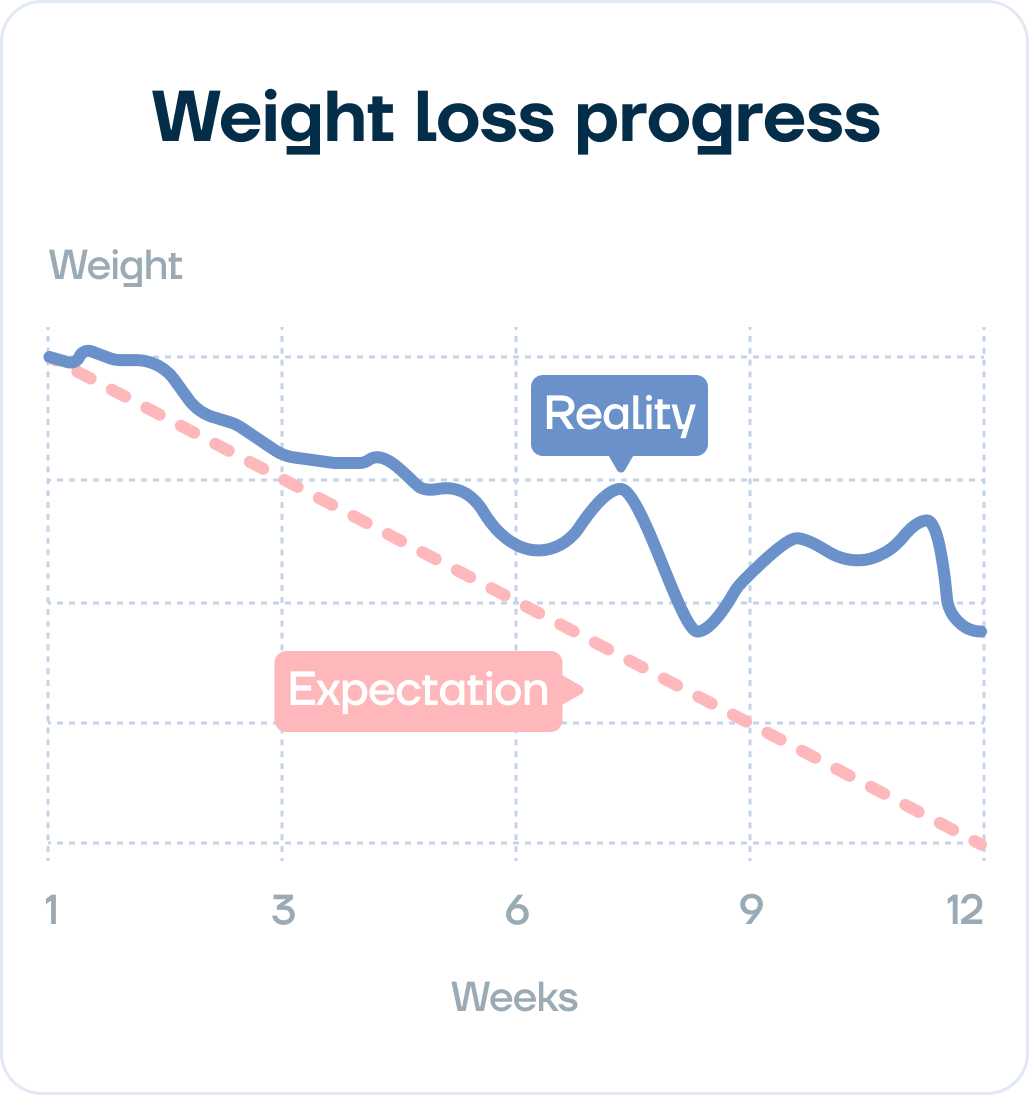
Experiencing weight fluctuations and weight-loss plateaus is a normal and necessary part of the weight-loss process.
Our brain has something known as our set point, which is the level of body fat it is used to us having.
When we lose weight, our brain will initially respond by slowing our metabolism (the energy we burn) and increasing hunger levels to return us to its expected set point.
However, our set point can change, but we need to give our brain time to adjust to our new level of body fat. This means that experiencing a weight-loss plateau is simply the time it takes for our brain to accept this new level of body fat as our new normal.
When our brains accept this new set point, we can start losing body fat again, and the process can continue.
Plus, our daily weight is likely to fluctuate by 0.5 kg to 2-4 kg due to changes in water levels, carbohydrate intake, salt intake, undigested food, and hormones.
So, we shouldn’t become obsessed with the micro changes we might see on the scales each day, as they’re unlikely to tell us whether we’ve lost body fat.
All of this is why we recommend weighing yourself consistently at the same time, for example in the morning, with minimal clothing, before you’ve had a drink or eaten anything, and focus on the overall trend over 6-8 weeks, rather than focusing on the daily numbers.
Am I losing weight too quickly?
Faster weight loss isn’t necessarily better weight loss.
In a review of studies in which people lost more than 10 kg, those who lost weight more quickly by adopting more drastic dieting approaches lost a greater percentage of their total weight loss from lean tissues such as muscle and bone.10
The NHS suggests aiming for 1 to 2 lb (0.5 to 1 kg) a week.11
At Second Nature, we recommend our members lose around 0.5-1 lb a week once you’re settled on the medication, as this slow rate of weight loss will reduce the risk of muscle and bone loss and support weight loss without compromising other areas of your health.
Losing weight very quickly also raises the risk of gallstones.8
Contact your prescriber if you’re regularly losing more than 2 lb a week after the first month, particularly if accompanied by exhaustion, feeling cold, weakness, or hair loss. Never adjust your dose yourself.
There are four things you can do to protect muscle mass while you lose weight.
- Stay on the lowest effective dose for as long as possible. Increasing your dose each month to lose weight faster increases the risk of losing muscle and bone mass.
- Eat enough protein. Around 1.2 to 1.6 g per kg of body weight a day protects muscle mass during weight loss, which is roughly 110 to 145 g for someone of 90 kg, or a portion the size of your palm at each meal.12
- Do some resistance training. Bodyweight exercises, resistance bands, or weights twice a week is a good target to aim for, but starting with simple exercise snacks, like doing calf raises while the kettle boils, is a good way to develop the habit to behin with.
- Don’t restrict your calories too much. Base your meals on whole foods with protein, fibre, healthy fat, and complex carbohydrates, and minimise the intake of ultra-processed foods.
Our guide to losing weight too quickly on Mounjaro covers this in more detail.
Why weight loss is slower in the first 3 months
Not experiencing much weight loss in the first three months is quite normal, and doesn’t mean the medication isn’t working.
Researchers analysed data from the SURMOUNT-1 trial to examine people whose weight loss was slow early on.
At week 12, 82% of those taking Mounjaro had already lost at least 5% of their body weight. Of the 18% who hadn’t, 70% reached 5% weight loss by week 24, and 90% by week 72.5
| Point in treatment |
Group |
Lost 5% or more |
| Week 12 |
Everyone taking Mounjaro |
82% |
| Week 24 |
The slower group |
70% |
| Week 72 |
The slower group |
90% |
The slower group took just under 25 weeks, on average, to reach 5% weight loss. They also tended to start at a higher weight, at around 110 kg against 104 kg, with a higher BMI, and were more likely to be men.5
Around one in ten of the participants still hadn’t lost 5% by week 72, though. If you reach 6 months on the medication and haven’t lost 5% of your body weight, speak with your GP or prescriber about your options.5
When to consider a dose increase
The dose can rise no sooner than every four weeks, which gives the body time to adjust and keeps side effects manageable.8
Mounjaro is available in 2.5 mg, 5 mg, 7.5 mg, 10 mg, 12.5 mg, and 15 mg.
The Wegovy injection is available in 0.25 mg, 0.5 mg, 1 mg, 1.7 mg, 2.4 mg, and 7.2 mg, with 7.2 mg required for a BMI of 30 or above.
The Wegovy pill’s dosing schedule is 1.5 mg, 4 mg, 9 mg, then 25 mg.8,9
Higher doses do produce more weight loss on average.
In SURMOUNT-1, people on 15 mg lost 20.9%, against 19.5% on 10 mg and 15.0% on 5 mg.1 But the difference between the two highest doses is small, and side effects grow more common as the dose increases.
At Second Nature we recommend our members remain on the lowest effective dose for as long as possible, rather than raising it every month by default.
We’d usually recommend increasing the dose if weight loss has stalled for 4-8 weeks or more, despite maintaining healthy habits, and side effects remain minimal.
A higher dose won’t necessarily increase weight loss again if the real problem is too little protein, too little sleep, or too little food overall. Our guide to the higher doses of Mounjaro explains how medication dose relates to weight loss.
Second Nature has worked with the NHS since 2017, pairing the medication with structured habit support and daily access to a registered dietitian or nutritionist.
We adjust the dose to how you’re responding rather than raising it on a fixed schedule. Take our 3-minute eligibility quiz, and a clinician will review your answers.
What happens if you stop
Our appetite and food noise is likely to return when we stop taking the medication if we haven’t developed the healthy habits that are needed to maintain a lower weight naturally.
In the STEP 1 trial extension, people who came off semaglutide regained around two-thirds of the weight they’d lost within a year.6
In SURMOUNT-4, those switched from tirzepatide to a placebo regained 14.0% of their body weight over the following year, while those who stayed on it lost a further 5.5%.7
In both trials, the medication was simply withdrawn, with no continued support.
We support all of our members to come off the medication slowly with a gradual reduction of the doses over many months until they feel ready.
Still, if the healthy habits aren’t in place to maintain a lower weight naturally, we wouldn’t recommend coming off the medication until they are.
Our free weight-regain prevention planner can help provide a personalised plan to prevent weight regain when coming off of weight-loss medications.
Frequently asked questions
How long does it take to see results on a GLP-1 medication?
Most people will start to see weight loss in the first few weeks, but this is mainly water and glycogen (stored carbohydrate).
Losing body fat will take more time, and by week 12 in SURMOUNT-1, 82% of people on Mounjaro had lost at least 5% of their body weight.5
What’s the best way to track progress on a GLP-1 medication?
Weigh yourself once a week, at the same time and in the same clothes, and follow the four-to-six-week trend rather than any single reading.
Alongside the scales, try body measurements, how you’re sleeping, energy levels, and psychological wellbeing.
Is there a free app to track GLP-1 progress?
The checker at the top of this page is free, and compares your weight loss with the clinical trial average for your medication at the same point in treatment.
It’s worth tracking your measurements and how your clothes fit alongside them, since those can change despite our overall weight remaining the same.
How much weight should I have lost after one month on Mounjaro?
Not much, and that’s expected. The first month is spent on a starting dose meant to let the body adjust rather than drive weight loss.8
Losing very little in month one says nothing about how well the medication will work for youover the long term.
How much weight can you lose in three months?
That depends on your dose and starting weight, and weight loss is slower early on as you gradually increase your dose and introduce healthy habits. The majority of weight loss on GLP-1 medications occurs after month 3.
The checker above compares your loss so far with the trial average for your medication at the same week.
Should you count calories on a GLP-1 medication?
We don’t recommend it. The medication already reduces how much you eat by lowering appetite and quietening food noise, so the more useful focus is the quality of what’s on the plate: whole foods, enough protein, and fewer ultra-processed foods.
How do I make a GLP-1 medication work faster?
You can’t, and it isn’t safe to try. The dose rises only every four weeks so the body can adjust, and most of the weight loss is observed at the higher doses over several months.
A higher dose won’t make up for too little protein, too little sleep, or a poor diet, so those are the things to focus on alongside the medication.
Is losing 2 lb a week on semaglutide too fast?
The NHS suggests 1 to 2 lb (0.5 to 1 kg) a week, so 2 lb is at the top of that range.11 At Second Nature, we aim for around 0.5-1 lb a week to reduce the risk of muscle and bone loss.
Speak to your prescriber if you’re regularly losing more than 2 lb a week beyond the first month.
Should you fast on a GLP-1 medication?
Only the Wegovy pill needs to be taken on an empty stomach: take it on waking, with a little water, and wait 30 minutes before eating.
The injections don’t need fasting at all. Skipping meals to speed things up tends to backfire, because eating too little means more of what you lose comes from muscle rather than fat.
Why have I stopped losing weight on Mounjaro?
Two flat weeks is normal; four weeks or more without any loss is a genuine plateau. Usually it’s because appetite has drifted back up as the body settles on the dose.
Check your protein, whether you’re eating enough overall, and your sleep before assuming you need a higher dose.
Does a slow start mean the medication won’t work for me?
Usually not. Among the people in SURMOUNT-1 who had lost less than 5% by week 12, 90% went on to reach at least 5% by week 72, taking an average of just under 25 weeks to get there.5
How do I know when to go up a dose on a GLP-1 medication?
The dose can rise no sooner than every four weeks.8 The usual sign is appetite coming back and staying back for a couple of weeks.
Your prescriber makes that call, and you should never increase the dose yourself.
How long can you stay on a GLP-1 medication?
Obesity is a long-term condition, and many people stay on these medications for years, often at the lowest dose that keeps working.
There’s no fixed cut-off, and how long you stay on is a decision to make with your prescriber.
What happens if you stop taking it?
Appetite returns, and some weight regain is common if haven’t developed healthy habits while you were on the medication.
In the STEP 1 extension, people regained around two-thirds of their lost weight within a year of stopping semaglutide.6
Coming off gradually, with habits already in place, gives you the best chance of preventing future weight regain.
Are weight-loss medications addictive?
Weight-loss medications aren’t inherently addictive.
But because they lower hunger and cravings, coming off them can feel hard if you haven’t built the habits to manage hunger without them, and some people feel reliant on the medication as a result.
Obesity is a chronic condition, though, and many people need treatment for years to manage it.
Take home message
How much you lose comes down to your medication, your dose, and how long you’ve been on it, so no single figure can tell you whether you’re on track.
Plus, the number on the scale is only one part of the picture. What’s more important is what weight loss and a healthier lifestyle can lead to: more energy, increased movement, better health, a reduced risk of chronic disease, and improved psychological wellbeing.
Our tracker not only gives you an idea of how you’re progressing with your weight loss but also your habits, as those habits will help you maintain a healthier weight in the long term if you come off the medication in the future.
Second Nature's Mounjaro and Wegovy programmes
Second Nature provides Mounjaro or Wegovy as part of our Mounjaro and Wegovy weight-loss programmes.
Why choose Second Nature over other medication providers, assuming you're eligible?
Because peace of mind matters.
We've had the privilege of working with the NHS for over eight years, helping people across the UK take meaningful steps toward a healthier, happier life.
Our programmes are designed to meet people where they are, whether that means support with weight loss through compassionate one-to-one health coaching, or access to the latest weight-loss medications (like Mounjaro and Wegovy) delivered alongside expert care from a multidisciplinary team of doctors, psychologists, dietitians, and personal trainers.
At the heart of everything we do is a simple belief: real, lasting change comes from building better habits, not relying on quick fixes. We're here to support that change every step of the way.
With over a decade of experience, thousands of lives changed, and a long-standing record of delivering programmes used by the NHS, we believe we're the UK's most trusted weight-loss programme.
We hope to offer you something invaluable: peace of mind, and the support you need to take that first step.