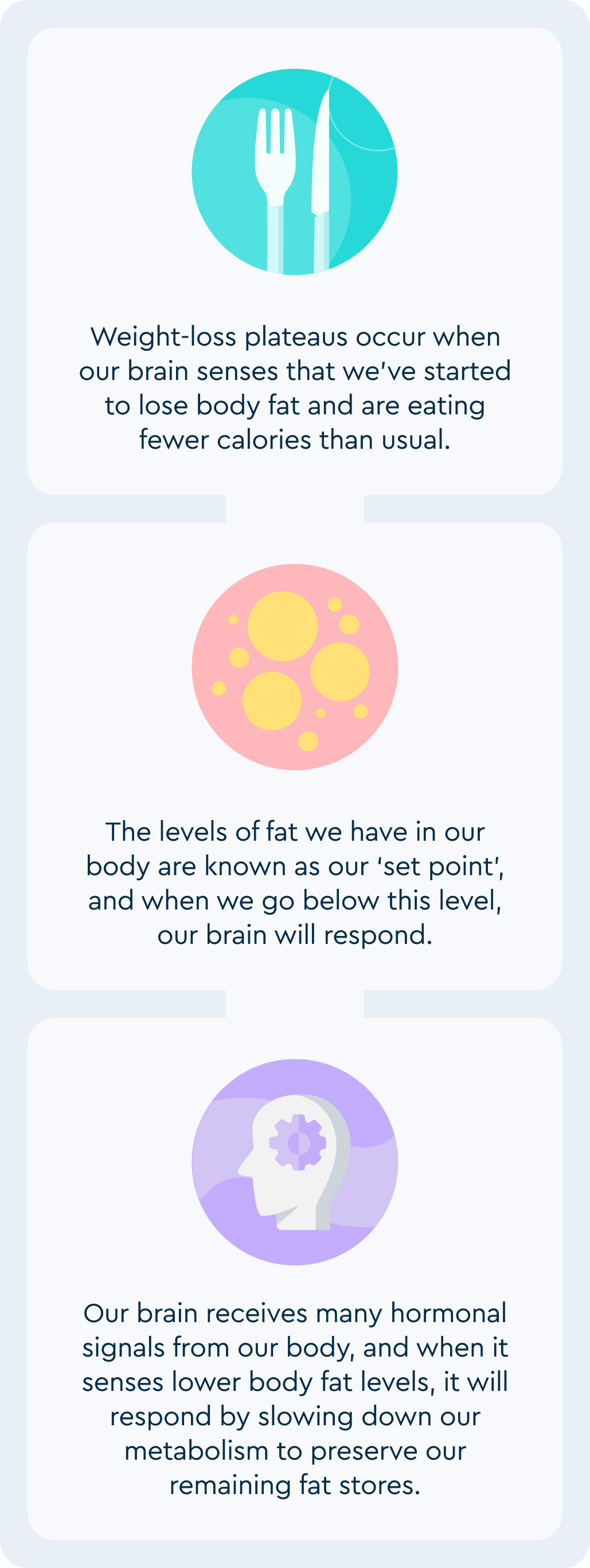
Weight-loss plateaus occur when our brain senses that we’ve started to lose body fat and are eating fewer calories than usual.
The fat levels in our body are known as our ‘set point’, and when we go below this level, our brain will respond.
Our brain receives many hormonal signals from our body, and when it senses lower body fat levels, it will respond by slowing down our metabolism to preserve our remaining fat stores.
This response from our brain is a protective evolutionary mechanism. It’s designed to prevent us from dying of starvation and survive a famine.
Having a weight-loss plateau is an absolute certainty if you’re currently on your weight-loss journey. You’ll probably have many plateaus.
However, it’s important to internalise that this is a normal and expected part of losing weight over the long term.
That said, it can be very easy to start second-guessing yourself and question whether you’re still doing the right things – particularly when the weight doesn’t seem to move for 4+ weeks.
Our experience at Second Nature is that weight-loss plateaus can last as long as eight to twelve weeks.
This is an incredibly long time, which is why we often find it helpful to have additional support and reassurance during this time – otherwise, it’s very easy to give up.
It’s common, frustrating, and demotivating
It’s common for those on a weight loss journey to notice that their weight loss has slowed down or stopped, even if they’re still eating fewer calories.
For those of us building healthy habits sustainably around diet, physical activity, exercise, strength training, sleep, and stress, it can be confusing to see our weight going down steadily for some time and then remaining the same or slightly increasing.
This is known as a weight-loss plateau and can be incredibly demotivating. It’s essential to understand the science behind why this happens and how we can get past a weight-loss plateau so that we can reach our health goals.
What is a weight loss plateau?
If you’ve had many unsuccessful weight loss efforts in the past, you know how hard it is to continue losing weight and keep it off in the long run. Fat loss is often a short-term experience associated with eventual weight regain.
The ideal weight loss journey will be phased with periods of losing body fat and weight maintenance until we reach our goal weight.
Let’s recap the dieting journey many of us have taken in the past: significant initial weight loss after lowering your calorie intake or cutting the carbs, then progress stalls, then progress continues to plateau, and finally, we get disillusioned and quit.
Yet, the stalling part, or the ‘plateau’, is essential – the scales aren’t moving because our body is adjusting to change.
We tend to lose weight quickly in the first few weeks after making lifestyle changes. However, after a few weeks, we might notice the scales come to a complete standstill, or the numbers start to creep back up.
Often when we embark on a weight-loss journey, we assume it will be linear. We think we can keep losing weight at the same rate as when we first started. But this isn’t the case.
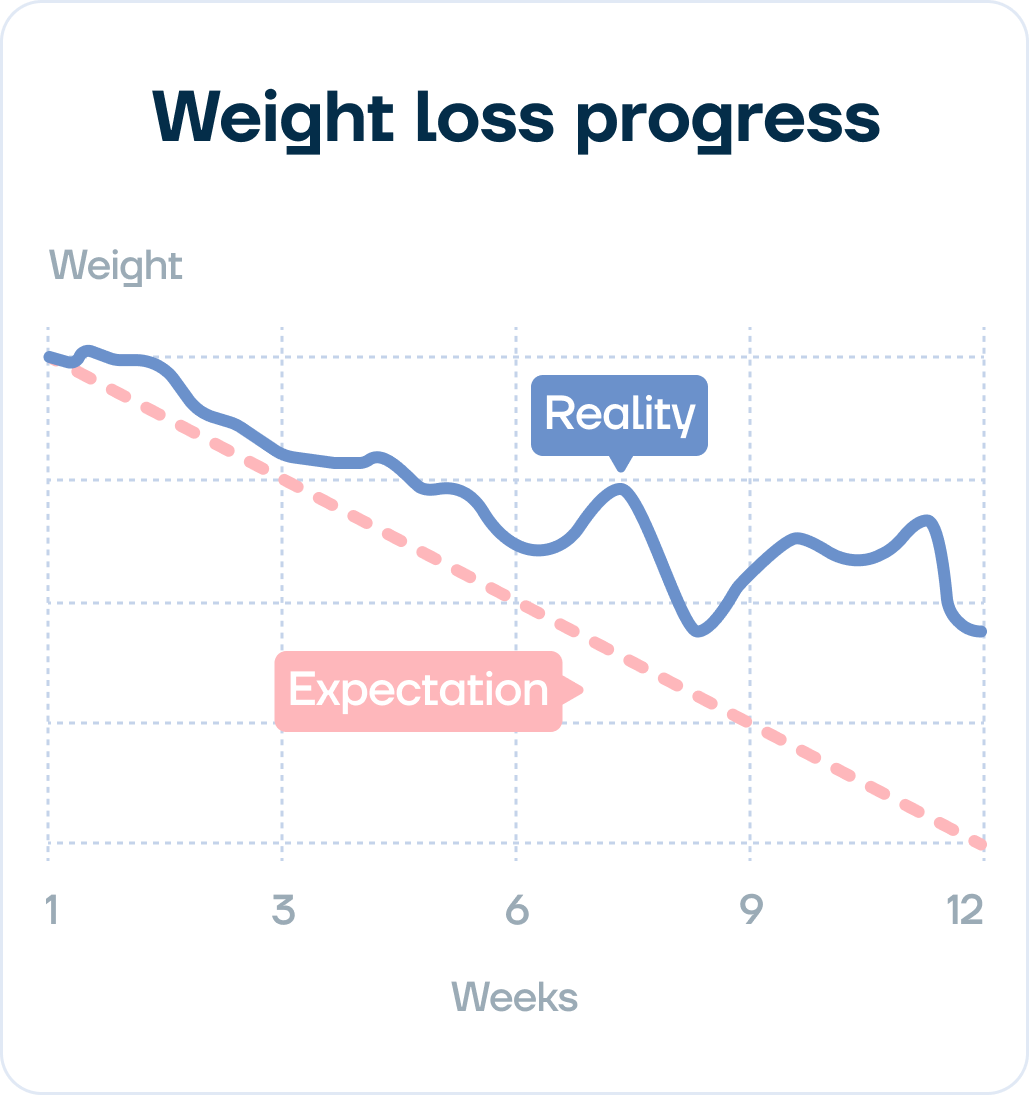
Below we can see a graph representing our ‘expectations’ vs the ‘reality’ of a typical weight loss journey. In the graph on the right, we can see intermittent periods of weight loss and weight plateaus.
Although this might not look ideal, the journey on the right represents a more sustainable way to lose weight. It’s worth noting that our weight is still trending downward overall, but we experience fluctuations and plateaus along the way.
Key points:
A weight-loss plateau is a period of ‘stalling’ or even weight gain on our weight loss journey
No healthy, sustainable weight loss journey is linear and the plateaus are important for long-term weight loss.
Why does our weight plateau?
The weight-loss plateaus are essential to allow time for our body to ‘reset’ before we can continue losing weight again. This is explained through a theory called the ‘set-point theory’.
To better explain ‘set-point theory’, here’s a helpful analogy: consider it our core body temperature.
Our body’s average temperature is 37 degrees. If we go above or below that, the body will do everything in its power to get us back to that normal temperature – it’ll sweat to cool down or shiver to keep warm.
‘Homeostasis’ is how our body maintains itself in a stable condition, whether temperature or weight.
Everyone has a natural ‘set point’, the weight our body hovers at when we eat healthily. Our DNA and the environment around us determine our set point.
Slow, gradual weight gain over many years can trick our body into thinking its set point is higher than it should be, which causes our body to resettle at a new, higher weight.
Scientists estimate that the average person will have a set-point range of 5-10% of their body weight, which means that at any given time, our body can lose or gain between that amount without much resistance.
For example, if your current ‘set point’ is 12 stone (76kg), your body could lose or gain between ~8-17lbs (4-8kg) without too much resistance.
However, going below this range would be highly challenging. Our body is programmed to function optimally within our set-point range and will do everything to maintain it.
It’s important to remember that everyone is unique, so some people might have a different set-point range, meaning their body allows a much smaller or more significant weight loss before meeting resistance.
Key points:
‘Set-point theory’ explains why it’s important to allow time for our body to ‘reset’ before we can continue losing weight again
Everyone has a unique set-point weight and going below this weight is extremely challenging.
What this means for weight loss
The set-point theory explains why some people reach a ‘stalemate’ situation when losing weight naturally, despite continually practising healthy habits around diet, exercise, sleep, and stress.
Our natural set point might not be what we want it to be or even what society thinks it should be. Some of us will naturally have a higher weight set point, and others will have a lower one.
It’s essential to take this into account when making lifestyle changes. If our goal is unrealistic, it can be demotivating when it’s not realised quickly enough, resulting in us giving up and returning to unhealthy habits.
Key points:
Set-point theory explains why some people reach a ‘stalemate’ situation when losing weight naturally, despite continually practising healthy habits
Some of us will naturally have a higher weight set point, and some of us will have a lower one.
Why weight-loss plateaus are very important
A weight-loss plateau doesn’t mean our healthy lifestyle changes aren’t working. If they’re a result of reaching our set-point weight, it’s a necessary part of our body’s process to readjust and reset.
Research shows that two-thirds of people regain all the weight they lost, and then some follow a strict diet, so we need to remember that maintaining the weight we’ve already lost is a significant achievement.
The weight maintenance phase, or weight loss plateau, is essential to allow our body time to adapt. If we ignore this maintenance phase, continuing to lose weight will be a monumental battle.
From an evolutionary point of view, this makes sense. For our ancestors, periods of weight loss generally indicated a risk of starvation due to a lack of food availability.
Therefore, our body would try its best to hold onto the energy stores that we already have. This is achieved by lowering our basal metabolic rate (BMR).
BMR measures the energy our body requires to stay functioning at rest. This is how much energy is needed to perform essential functions like breathing, keeping our heart pumping, and digestion.
If we lose weight, our body will become much better at rationing what it has to make it last longer. It will reduce our body temperature, thyroid activity, and fat oxidation (or the amount of fat we burn) and help our muscles move more efficiently.
All these adjustments mean we burn less fuel overall, which can lead to a natural plateau.
On top of this, research indicates that people who’ve lost weight have higher levels of ghrelin (the hunger hormone) than those who’ve kept the same weight for years.
Higher ghrelin levels also tell our body to conserve more fat stores.
A weight-loss plateau is important to allow our body’s metabolic rate and ghrelin signalling to readjust back to normal. This happens when our body ‘resets’ to a new, lower set-point weight.
Key points:
A weight-loss plateau doesn’t mean our healthy lifestyle changes aren’t working
The weight maintenance phase, or weight loss plateau, is essential to allow our body time to adapt
Our body can then adapt to a new lower set-point weight and we can continue losing weight.
How long does a plateau in weight loss last?
You might be asking why you’ve seen other people lose a lot of weight and never gain it back. The good news is, changing your set point isn’t impossible. But it takes time and patience.
Just as we can reset our set point to be higher when we gain weight, this also works in reverse when we lose weight. But we need to work alongside our bodies to achieve this successfully.
More research shows that if we lose weight slowly and gradually, our set point can adjust, and our bodies will stop battling against us.
It may be challenging, but once you’ve hit your set-point plateau, your body will need time to adjust to a new weight.
Following this, you’ll have established a different set point, and your body will respond like that’s the ‘new normal’, which means you can begin losing weight again if you want or need to.
A plateau can last between eight to twelve weeks, but it also varies individually. After this, it’s much easier for us to recommence a period of weight loss.
Sustainable weight loss isn’t a sprint. Most of the time, significant life-changing weight loss happens over 1-2 years, not in 1-2 episodes, like in the diet shows on TV.
It can take many years for us to steadily gain weight; likewise, it will take time to lose it again.
Check out our guide on overcoming a weight loss plateau, where we cover the importance of body composition (build muscle mass); building an exercise routine that includes cardio, HIIT, and resistance training; the importance of getting enough sleep; and how to manage your portion sizes and maintain a sustainable calorie deficit in the long term.
Key points:
It’s possible to lower our set-point weight over time
After reaching your set-point weight plateau, your body will respond like that’s the ‘new normal’, which means you can begin losing weight again if you want or need to
A plateau can last anywhere between eight to twelve weeks, but it also varies on an individual level and it’s important we maintain our healthy habits during this time.
Our guide to stalled weight loss explains how food choices, eating habits, sleep, and stress can affect progress.
Take home message
A weight-loss plateau is a period of ‘stalling’ or even weight gain on our weight-loss journey
No healthy, sustainable weight loss journey is linear, and the plateaus are essential for long-term weight loss
‘Set-point theory’ explains why it’s essential to allow time for our body to ‘reset’ before we can continue losing weight again
Everyone has a unique set-point weight, and going below this weight is extremely challenging
A weight-loss plateau doesn’t mean our healthy lifestyle changes aren’t working
The weight maintenance phase, or weight loss plateau, is essential to allow our body time to adapt
It’s possible to lower our set-point weight over time
After reaching your set-point weight plateau, your body will respond like that’s the ‘new normal’, which means you can begin losing weight again if you want or need to
A plateau can last between eight to twelve weeks, but it also varies individually, and we must maintain our healthy habits during this time.
Found this useful? Get more Second Nature guides in your Google results.
The first step on your Second Nature journey is to take our health quiz.
We never show your email. We only use it if we need to contact you about your comment.
Akshit Raj
21 June, 2024
Thank you so much for this write up. In order to hold on our grip, this piece is extremely significant.
John Scrimshaw
8 June, 2024
I am 87 years old 160 cm tall and trying to lose weight. I have limited mobility but am able to walk 4000 steps each day. I began a reduced diet 3 months ago with a starting weight of 87.1kg. After a month I had dropped to 82.6 kg. 3 weeks ago, at 81.1kg my loss seems to have reached a plateau and goes up and down .1 to .4 kg each day. Do I just have to remain patient or is there something I should to to keep my loss going towards my target of 70kg?
Susan
4 January, 2024
It is frustrating to hit the dreaded plateau, however I personally recommend not to try and ‘break’ this period and continue with your diet as is. Skip the scale for a while and grab the measuring band because here is where it gets interesting. Instead of losing weight, chances are you are losing inches. Do not cut your calories or do anything drastic. This process of not losing weight but losing inches is where your body is doing some serious complex processes and this helps you to NOT sit with loose skin. Allow it the time it needs to complete this process before your body starts losing again. Granted that the plateau isn’t caused by your own sneaked up calories and you are actually just maintaining. If you are losing inches but the scale stands still, embrace this and give your body the best nutrition and superfoods you can get your hands on. Eventually the process will come to and end and weightloss will continue and you will notice that your skin is moving with the weightloss. Forcing weight down too quickly especially diets like keto or high protein is where most people sit with loose skin. Rather go on a healthy mediterranean diet for example and actually enjoy the process.
Vrinda
27 October, 2023
Excellent article – very encouraging
luz
21 February, 2023
I’ve been in a weight loss plateau for a year, ive tried everything im 5’2 and im 152 pounds
Melody
25 November, 2022
March i weighed 368, ive lost 60 pounds by october, but now im just maintaining while i am in “plateau”… I still eat healthy, no sugar drinks just water, and exercise everyday even if its indoor exercises. I am under 30 years old, and want to get back to my 190 range. This article helped me understand that i am not doing anything wrong, and just need to keep going, thankyou
Ron Rimmer
1 April, 2022
Great article. I really needed to read this. I have lost 30 lbs. and have been yo-yoing for a month. My weight loss chart looks very similar to yours. I am doing cardio 30 minutes a day as well as weight training. I am 72 years old and really want to maintain a healthier lifestyle and weight. I started at 250lbs and plateaued at 220 +/-. My goal is 200lbs.
Jeff Elvis
18 May, 2022
Hey Ron just wanting to know I’m 59 years old and I’m also at 220 lb and have hit a plateau would you mind sharing what height you’re at.
Anna
17 April, 2022
Hi Ron,
So pleased this guide has been helpful! Sounds like you already have a great exercise regimen in place 💪
Our programme will take a deep dive into weight loss plateaus and provide plenty of tips and tricks to help you push past your plateau and continue toward your goal. You’ll have the 1:1 support of a health coach who can help you to examine your specific patterns and nutrition to pinpoint areas of improvement to help you shed the remaining weight!
Well, that explains a lot. I lost 30 pounds in 9 months and still have 15 pounds to go. I eat 1000 calories a day, and have been stuck right at 179 +/- pounds for 10 weeks. So according to this, I should start losing again right about now. I’m glad I didn’t throw in the towel, but I gotta say, I sure came close. If something happens in the next month, I’ll try to post another comment.
Kate
5 April, 2023
Wow good job
Anna
17 March, 2022
Hi Dave,
Thanks for your comment, so pleased this guide has been helpful!
Our programme provides extensive learning content around weight loss plateaus, and you’ll have the 1:1 support of a health coach who is there to help you build healthier habits to continue moving toward your weight loss goal.
If you’d like to learn more about our programme, you can take our health quiz here, or email support@secondnature.io with any questions 🙂
Nonie
23 November, 2024
Hi, thanks for this I really needed to understand why I suddenly stopped losing after 7 weeks on the 16/8 fasting. 1 weighted 72 kilos 8 weeks ago and went steadily down to 65 kilo. However, yesterday I was gutted to see the scales hit 66 kilo. I’ve not changed my regime at all. Now I’ll just continue ( except for the 2 days over Xmas 🙀) and hope by summer 2025 I’ll track my desired 60kilos. Good luck to you all💪🏻🫶
Anna
2 February, 2022
Hi Dave,
So pleased this guide’s been helpful!
Our programme provides extensive guidance (including coaching support) on overcoming weight-loss plateaus and maintaining weight loss once you’ve reached your goal.
If you’d like to learn more, you can take our health quiz here, or email support@secondnature.io with any questions 😊
aari
26 January, 2022
hi there, thank you so much for this crystal clear explanation of weight loss plateau with the set point theory.It makes me realize why i’m struggling to lose weight for the past three months.
once again thank you for this article because it makes me to understand what is happening in my body and what my body needs.thank you…
Anna
17 March, 2022
Hi Aari,
Thanks for your comment, so pleased you’ve found this guide helpful 🙂
Our programme offers extensive learning content on weight loss plateaus, as well as the 1:1 support of a health coach to help you overcome plateaus and tweak habits to create a healthier lifestyle and reach your weight loss goal.
If you’d like to learn more about Second Nature, you can take our health quiz here, or email support@secondnature.io with any questions 🙂
S.G
14 December, 2021
Hey, I started with 120kg (264 lbs, 5’10”, male) and lost almost 22kg (48 lbs), and then my weight loss stalled. I’ve noticed that I’m losing belly fat(almost lost %80 of the belly fat since the last two months) while stalling on my current weight. I used to walk 3h every day before hitting the plateau. This plateau has lasted more than 3 months now. Calorie intake is lower than it used to be (around 1500 calorie intake every day). In addition to that, I’ve added running to the plan (the main reason I lose fat). Not sure if it’s ever enough, but for now, I run for 15 mins and the rest (2h 45m; 12.5 miles) walking every day. Is this normal? When can I expect to lose some weight in the future?
Anna
18 January, 2022
Hi there,
Each of us has a natural ‘set-point’ weight which is determined by our genetics, the environment around us, our hormones, and our psychology. Scientists estimate that the average person will have a set-point range of 5-10% of their body weight, which means that at any given time, our body can lose or gain between that amount without much resistance.
But to go below this range would be extremely challenging. Our body is programmed to function optimally within our set-point range and it will do everything to maintain it.
The set-point theory explains why some people reach a ‘stalemate’ situation when losing weight naturally, despite strictly following the nutrition recommendations. You can read more about the set-point theory here, and this article provides a bit more detail on why you might be experiencing a weight-loss plateau.
You already maintain an impressive exercise routine, have you had a chance to review our balanced plate model? Do you currently have one carb-free meal per day?
If you’re not yet a Second Nature subscriber, our programme will provide thorough support on how to overcome a weight loss plateau and continue to your weight-loss goal. You’ll have a health coach on hand to support and guide you throughout our programme. You can learn more by taking our health quiz here, or by emailing support@secondnature.io with any questions 🙂
Anna
24 December, 2021
Hi there,
That’s great you’ve upped your physical activity! It’s certainly normal to hit weight-loss plateaus and can take some experimenting and adjusting to finally push past a plateau.
Have you tried one meal per day without carbs? We’d recommend reviewing our balanced plate model if you haven’t already. Your body may also be taking the time to adjust to a new set-point.
This article provides some suggestions to push past a weight-loss plateau. We’d recommend varying your exercise routine, considering the time you’re eating (eating during a 10-hour window is ideal), and ensuring a consistent sleep pattern.
On our programme, you’ll have access to courses and content on weight-loss plateaus, and you’ll also have the support of a health coach who will help you develop a plan to continue toward your weight loss goal. If you’d like to learn more, you can take our health quiz here, or email support@secondnature.io with any questions 🙂
Cindy Kennedy
27 June, 2024
3 years ago I weighed 250 right now away 180 and I’m stuck I did inclining and dieting is that good or bad at this point thanks for your feedback