Jump to: Why raising your weight with a GP feels so hard | What actually happens in a GP weight appointment | How to start the conversation | Questions worth asking your GP | What your GP can offer on the NHS | What to do if you feel dismissed | Frequently asked questions
To talk to your GP about your weight, book a standard appointment and open with one plain sentence, such as ‘I’d like to talk about my weight and get some help with it.’
You can raise it yourself; you don’t need to have tried dieting first, and you don’t need to have lost any weight before you go.
People in the UK wait an average of nine years between first struggling with their weight and first discussing it with a healthcare professional.2
The conversation itself is usually short and routine, and most people are glad they brought it up.
In a UK trial of nearly 1,900 patients, 81% said it was both appropriate and helpful when a GP raised their weight, and fewer than 1% found it inappropriate.1
This guide covers what actually happens in the room, how to start the conversation, what your GP can offer on the NHS, and what to do if you feel brushed off.
Important safety information: This article explains how the NHS weight-management pathway works in England and mentions prescription-only medications, including Mounjaro (tirzepatide) and Wegovy (semaglutide). It’s for general information only and isn’t a substitute for advice from your GP or healthcare team. Always speak to a healthcare professional about your own circumstances.
Why raising your weight with a GP feels so hard
The first barrier is the belief that your weight is yours alone to fix.
In a UK survey, 85% of people living with obesity agreed that losing weight was completely their own responsibility, and that belief was the most common reason people gave for never raising it with a doctor.2
Obesity is a medical condition that responds to medical treatment in the same way high blood pressure or asthma does.
Treating it as a test of willpower is part of why people delay getting help.
The NHS is set up to treat it as a medical condition too. Practices in England are funded under an NHS England scheme to identify eligible patients and refer them for weight-management support.10
The second barrier is the fear of being judged.
Studies of weight stigma in healthcare find that around 19% of people would avoid medical appointments, and 21% would look for a different doctor, if they felt judged about their weight.3
Our guide on whether you should feel ashamed using weight-loss injections looks at where that shame comes from in more depth.
What actually happens in a GP weight appointment
Most weight appointments follow a similar pattern.
- Your GP asks what’s prompted you to come in and what you’d like help with
- They may measure your height and weight to work out your body mass index (BMI), a measure of weight relative to height, and sometimes your waist
- They may arrange blood tests, for example, to check your thyroid, blood sugar, or cholesterol
- They usually ask about your general health, any medications you take, and other conditions that can affect weight
- They talk through the options and, in many cases, refer you to a weight-management service or arrange a follow-up
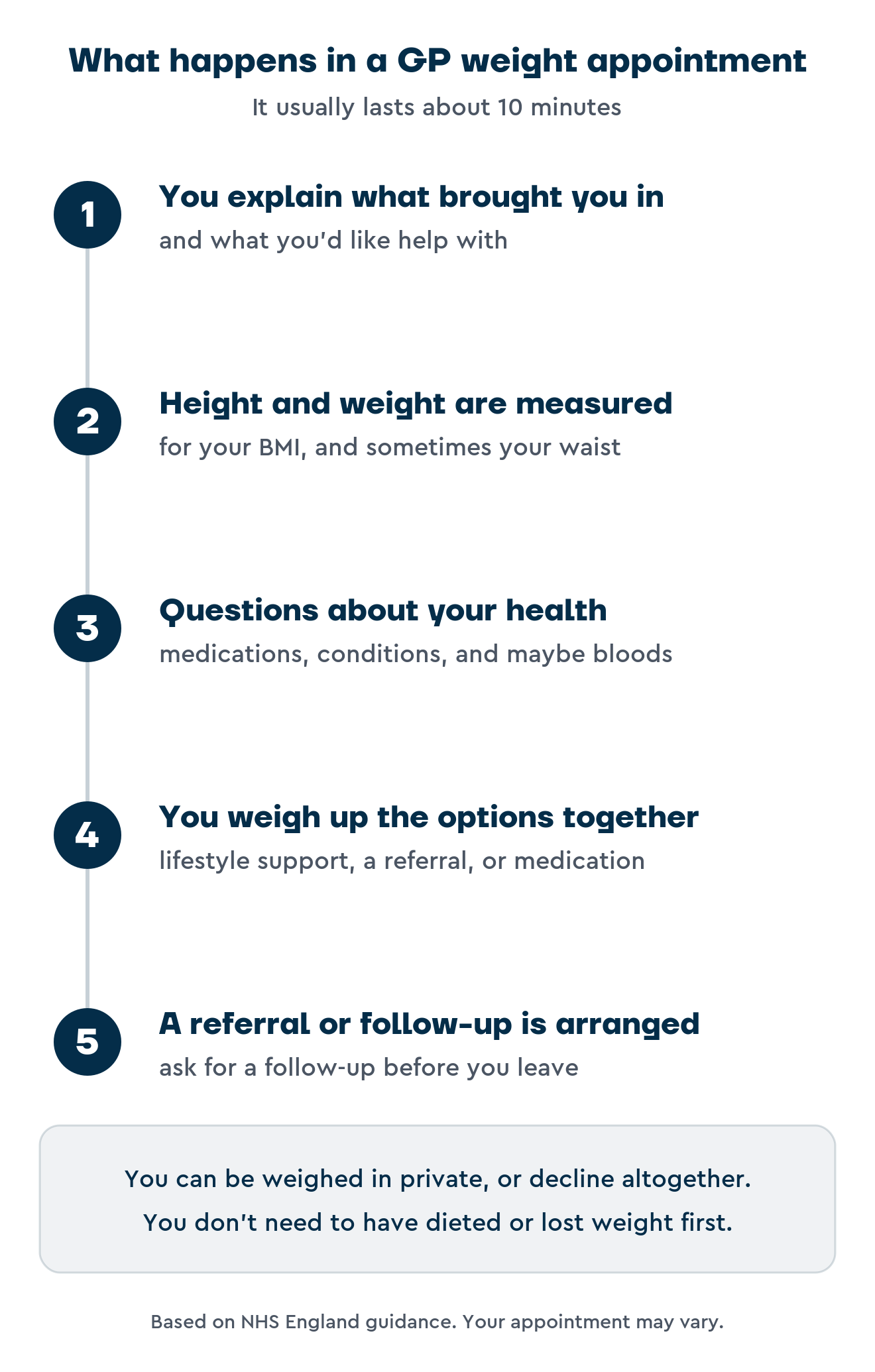
You can be weighed in private, and you can decline to be weighed if you’d prefer not to. It won’t stop the conversation.
You don’t need to justify your weight or account for how you got here. A good GP is interested in what will help from now on, not in finding blame.
If 10 minutes feels too short for everything you want to cover, you can ask reception for a longer or double appointment when you book.
How to start the conversation
You can open the conversation with any of these:
- ‘I’d like to talk about my weight and get some help with it.’
- ‘I’ve been struggling with my weight for a long time, and I’d like to know what support is available.’
- ‘I’d like to understand my options for managing my weight, including whether medication might be suitable.’
If you can, frame it around your health rather than your appearance.
Your GP can act on weight-related problems like high blood pressure, joint pain, or type 2 diabetes, and those are what NHS support is based on.
If saying it out loud feels too hard, it’s fine to write it down and hand it over, or to type it into the online form some practices use for booking.
Ten minutes goes quickly, so a few notes help you say what you came to say before the time runs out:
- Write down your main concern and the two or three things you most want to ask
- Note what you’ve already tried, and what has and hasn’t worked
- Jot down roughly how you usually eat and how active you are
- Bring a list of your current medications
- Note any family history of type 2 diabetes or heart disease
- Take someone with you if that helps you feel steadier
Questions worth asking your GP
The NHS encourages shared decision-making, where you and your GP weigh up the options together rather than being handed a single instruction.7
A simple way to do that is the NHS “Ask 3 Questions” approach:
- what are my options,
- what are the possible benefits and risks of those options,
- and what help do I need to make my decision.7
At a weight appointment, that might mean asking:
- What are my options for managing my weight, and which would you suggest for me?
- What are the benefits and risks of each one?
- Am I eligible for any NHS weight-management services, and can you refer me?
- Could weight-loss medication be suitable for me, on the NHS or privately?
- Could any of my health conditions or medications be making my weight harder to manage?
- Can we book a follow-up to see how I’m getting on?
In the UK research, only 19% of people who discussed their weight were offered a follow-up, while 62% wanted one.2
If your GP doesn’t suggest one, ask for it before you leave.
What your GP can offer on the NHS
What your GP can offer depends on your BMI, your health, and what’s commissioned in your area.
These routes apply in England. Scotland, Wales, and Northern Ireland run their own weight-management pathways, with different thresholds.
The main routes are below.
| Route |
Who it’s usually for |
What it involves |
| NHS Digital Weight Management Programme |
Adults with a BMI of 30 or above (27.5 for some ethnic groups) who also have diabetes or high blood pressure |
A free 12-week online programme; your GP or pharmacist can refer you6 |
| Community (tier 2) weight management |
Varies by area, often a BMI of 30 or above |
Group or one-to-one lifestyle support, usually around 12 weeks; availability differs by area |
| Specialist (tier 3) weight management service |
A higher BMI, often 35 or above, with a weight-related condition |
A multidisciplinary NHS team, and the route to Wegovy (semaglutide) on the NHS for up to 2 years5 |
| Weight-loss surgery (tier 4) |
Usually a BMI of 40 or above, or 35 or above with a serious weight-related condition, after a tier 3 service |
Assessment for procedures such as a gastric sleeve or bypass, with long-term follow-up8 |
| Mounjaro (tirzepatide) in primary care |
From April 2026, a small first group: a BMI of 40 or above plus at least four weight-related conditions |
Prescribed by some GP practices in England alongside diet, activity and behavioural support4 |
| Private weight-loss medication |
Adults who don’t meet the NHS criteria, or don’t want to wait |
A paid prescription through a regulated pharmacy or provider, after an online or in-person assessment |
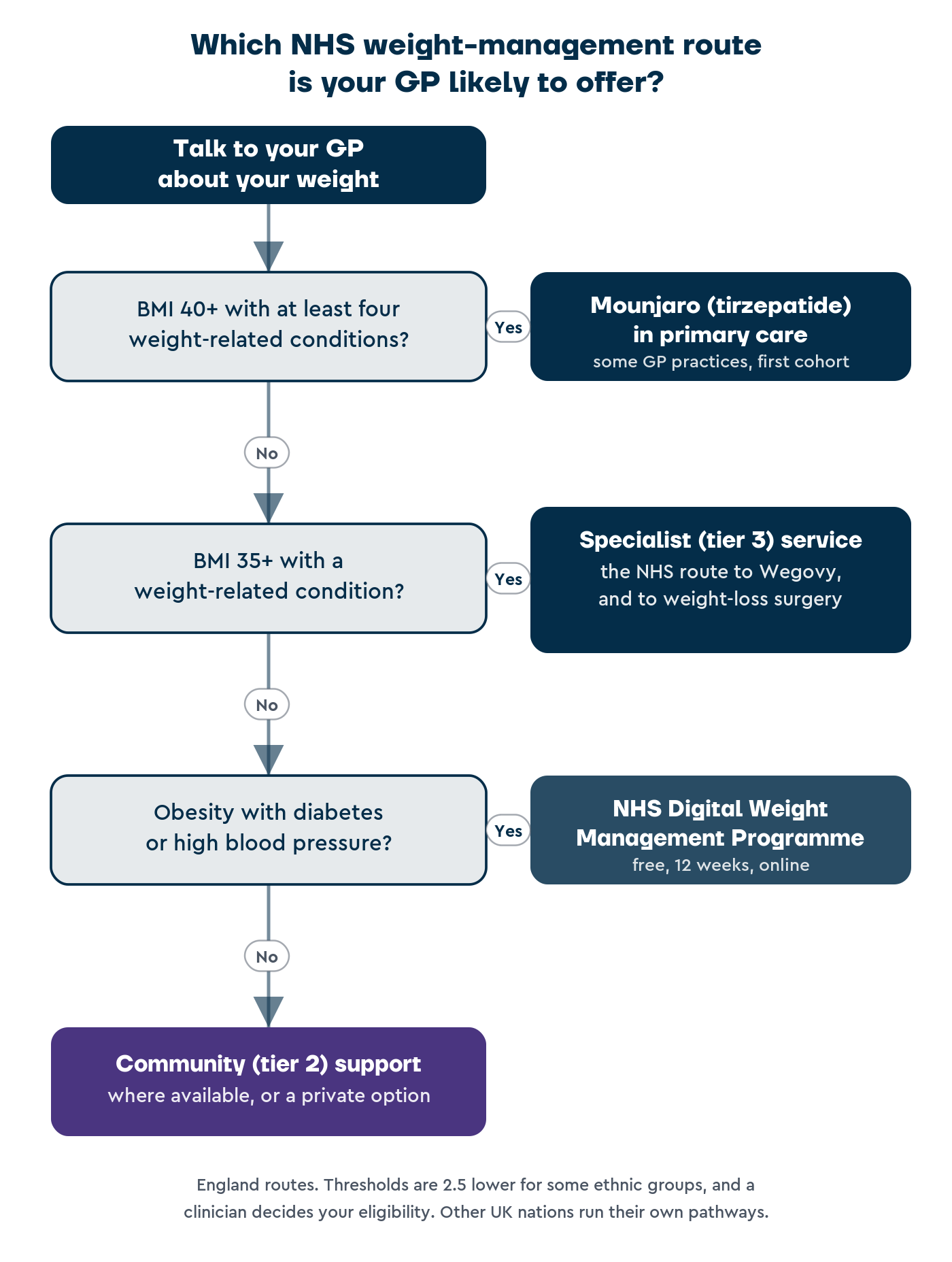
Most people are offered lifestyle support or a referral first, rather than medication. NHS access to weight-loss injections is still limited, and the eligibility criteria are strict.
Mounjaro (tirzepatide) became available for prescription in some GP practices in England from April 2026, but only for a small initial group: adults with a BMI of 40 or above who also have at least four weight-related conditions, such as type 2 diabetes, high blood pressure, or sleep apnoea. Eligibility is set to widen over the next few years.4
Wegovy (semaglutide) is available on the NHS only through a specialist weight-management service, for up to 2 years, rather than by direct GP prescription.5
For some people with a higher BMI, weight-loss surgery is an NHS option, usually considered after a specialist (tier 3) service and once other approaches have been tried.8
Our GLP-1 BMI calculator guide shows whether you’re likely to meet the BMI thresholds the NHS and private providers use, which is useful to check before you go in.
Our guide to getting Second Nature free on the NHS explains which NHS programmes you might qualify for and how to check before you see your GP.
Second Nature has worked with the NHS since 2017, combining weight-loss medication with structured habit support to help weight stay off. Take our 3-minute eligibility quiz, and a clinician will review your answers.
What to do if you feel dismissed
Sometimes the conversation doesn’t go well. If you’re told to ‘just eat less and move more’ with no practical support, you can ask for more.
Useful things to say:
- ‘I’ve tried that before, and it hasn’t worked for me. What else is available?’
- ‘Can you refer me to a weight-management service?’
- ‘What are the medication options, and am I eligible for any of them?’
You’re entitled to a second opinion, and you can ask to see a different GP at the same practice or register elsewhere.
You also have a legal right to choose which provider your GP refers you to.9
If a service isn’t commissioned in your area, ask about being referred to one delivered remotely across England.
Around 13% of people with overweight or obesity have changed doctors because of how they were treated.3
If one GP isn’t a good fit, a different clinician may be able to provide more appropriate support for you.
Found this useful? Get more Second Nature guides in your Google results.
Frequently asked questions
Can I see a GP about my weight?
Yes. You can book a standard GP appointment to talk about your weight, and you can raise it yourself without a referral.
It can be the only reason for your appointment, or something you bring up while you’re there for something else.
Will my GP judge me for being overweight?
Most won’t, and the evidence suggests most GPs have a positive impact on patients seeking support with their weight.
When GPs raised the subject of weight in a UK trial, 81% of patients found it appropriate and helpful, and fewer than 1% found it inappropriate.1
If you do have a poor experience, you can ask to see a different GP.
Do I have to be weighed?
No. You can ask to be weighed in private, or decline to be weighed altogether. It won’t stop your GP discussing your options with you.
Can I just ask my GP for Mounjaro or Wegovy?
You can ask, but NHS access is limited. Mounjaro is available through some GP practices in England only for a small first group, and Wegovy is prescribed on the NHS only through a specialist service.4,5
Many people who don’t meet the NHS criteria use a private prescription instead.
Can my GP refer me for weight-loss surgery?
Yes, if you meet the criteria. Weight-loss surgery on the NHS is usually for adults with a BMI of 40 or above, or 35 or above with a serious weight-related condition, and normally follows a specialist (tier 3) weight-management service.8
What if I get upset or cry in the appointment?
That’s common, as it’s a very personal and vulnerable position to be in. Taking someone with you, or writing down what you want to say in case the words don’t come, can both help.
Do I need to have tried dieting first?
No. You don’t need to prove you’ve earned help by failing at diets first. You can raise your weight at any point, whether you’ve tried it or not.
Will it go on my medical record?
Yes, like any health information you discuss. Your record is confidential, and having your weight noted helps your GP track your health and arrange the right support over time.
Can I book a longer appointment?
Yes. If you have a lot to discuss, ask the receptionist for a longer or double appointment when you book, and say it’s so you have time to talk things through.
What if my BMI isn’t high enough for NHS medication?
NHS weight-loss medication has strict thresholds, but lifestyle services such as the NHS Digital Weight Management Programme have lower ones, and a private prescription is another route.6
Our GLP-1 BMI calculator guide provides more information on the criteria.
How do I bring it up if I’m there for something else?
You can say, ‘While I’m here, I’d also like to talk about my weight.’ If time is short, your GP may suggest booking a separate appointment so it gets the time it needs.
Take home message
You can raise your weight with your GP yourself, and research in the UK suggests most patients find the conversation helpful.
The belief that weight is yours alone to manage is the main reason people put off this conversation, but obesity is a medical condition, and asking for help with it is no different from asking for help with any other condition, like high blood pressure.
Go in with two or three questions, ask what your options are and what support comes with them, and ask for a follow-up before you leave.
If the first conversation doesn’t help, you can ask for a referral, a second opinion, or a different GP.
Second Nature combines weight-loss medication with structured habit change and registered dietitian support, built around a balanced plate of whole foods.
In a peer-reviewed evaluation, members lost an average of 19.1% of their body weight at 12 months, and 77.7% lost at least 10%.11 The research suggests this combination makes weight regain less likely than medication on its own.
Second Nature's Mounjaro and Wegovy programmes
Second Nature provides Mounjaro or Wegovy as part of our Mounjaro and Wegovy weight-loss programmes.
Why choose Second Nature over other medication providers, assuming you're eligible?
Because peace of mind matters.
We've had the privilege of working with the NHS for over eight years, helping people across the UK take meaningful steps toward a healthier, happier life.
Our programmes are designed to meet people where they are, whether that means support with weight loss through compassionate one-to-one health coaching, or access to the latest weight-loss medications (like Mounjaro and Wegovy) delivered alongside expert care from a multidisciplinary team of doctors, psychologists, dietitians, and personal trainers.
At the heart of everything we do is a simple belief: real, lasting change comes from building better habits, not relying on quick fixes. We're here to support that change every step of the way.
With over a decade of experience, thousands of lives changed, and a long-standing record of delivering programmes used by the NHS, we believe we're the UK's most trusted weight-loss programme.
We hope to offer you something invaluable: peace of mind, and the support you need to take that first step.
References
- Aveyard, P., Lewis, A., Tearne, S., et al. (2016). Screening and brief intervention for obesity in primary care: a parallel, two-arm, randomised trial. The Lancet, 388(10059), 2492-2500. (BWeL trial)
- Hughes, C.A., Ahern, A.L., Kasetty, H., et al. (2021). Changing the narrative around obesity in the UK: a survey of people with obesity and healthcare professionals from the ACTION-IO study. BMJ Open, 11(6), e045616.
- Alberga, A.S., Edache, I.Y., Forhan, M., et al. (2019). Weight bias and health care utilization: a scoping review. Primary Health Care Research & Development, 20, e116.
- NHS England. (2025). Interim commissioning guidance: implementation of NICE TA1026 (tirzepatide).
- National Institute for Health and Care Excellence. (2023). Semaglutide for managing overweight and obesity. Technology Appraisal TA875.
- NHS England. The NHS Digital Weight Management Programme.
- Advancing Quality Alliance (NHS). Shared decision making: Ask 3 Questions.
- National Institute for Health and Care Excellence. (2025). Overweight and obesity management. NICE guideline NG246.
- NHS. Your choices in the NHS.
- NHS England. (2025). Weight Management Enhanced Service 2025/26.
- Richards, R., Whitman, M., Wren, G., et al. (2025). A Remotely Delivered GLP-1RA-Supported Specialist Weight Management Program in Adults Living With Obesity: Retrospective Service Evaluation. JMIR Formative Research, 9(1), e72577.