Jump to: What are Ozempic and Trulicity? | How these medications work | Head-to-head clinical evidence | Side effects and tolerability | Practical differences | Cost and access in the UK | Who might prefer each option? | Frequently asked questions | Take home message
Ozempic (semaglutide) produces significantly greater weight loss and blood sugar control than Trulicity (dulaglutide) at comparable doses.
The SUSTAIN 7 trial found that semaglutide 1 mg achieved 6.5 kg weight loss compared with 3.0 kg for dulaglutide 1.5 mg over 40 weeks in people with type 2 diabetes.1
Both medications are licensed in the UK for type 2 diabetes only. Neither is approved for weight loss. If weight management is your primary goal, Mounjaro (tirzepatide) or Wegovy (semaglutide 2.4 mg) are the licensed options.
Important safety information: Ozempic (semaglutide) and Trulicity (dulaglutide) are prescription-only medications licensed for type 2 diabetes only. Neither is approved for weight management. This article is for informational purposes only. Always consult with your healthcare provider before starting, stopping, or switching any medication.
| Comparison point |
Ozempic (semaglutide) |
Trulicity (dulaglutide) |
| UK licence |
Type 2 diabetes only |
Type 2 diabetes only |
| Mechanism |
GLP-1 receptor agonist |
GLP-1 receptor agonist |
| Weight loss (SUSTAIN 7) |
-6.5 kg (1 mg dose)1 |
-3.0 kg (1.5 mg dose)1 |
| HbA1c reduction (SUSTAIN 7) |
-1.8% (1 mg)1 |
-1.4% (1.5 mg)1 |
| Cardiovascular outcomes trial |
SELECT (semaglutide 2.4 mg)2 |
REWIND (dulaglutide 1.5 mg)3 |
| Maintenance doses |
0.5 mg, 1 mg, 2 mg |
0.75 mg, 1.5 mg, 3 mg, 4.5 mg |
| Injection frequency |
Once a week |
Once a week |
| Manufacturer |
Novo Nordisk |
Eli Lilly |
What are Ozempic and Trulicity?
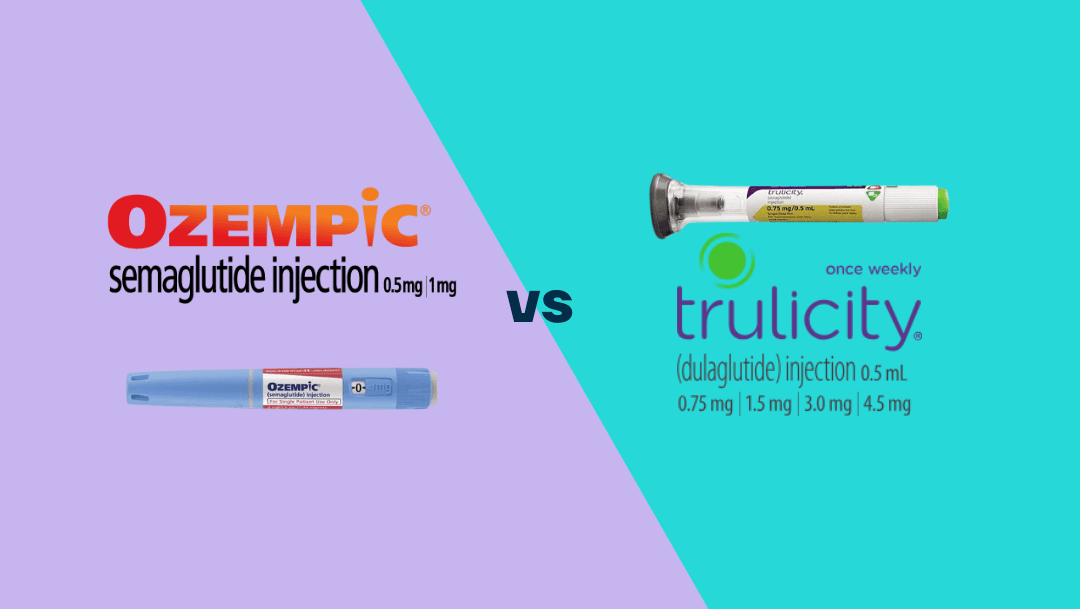
Ozempic and Trulicity are both weekly injectable medications prescribed for type 2 diabetes. They mimic a gut hormone to improve blood sugar control and reduce appetite.
Ozempic, made by Novo Nordisk, contains semaglutide. It’s available in doses of 0.5 mg, 1 mg, and 2 mg (after an initial 0.25 mg titration phase).
Trulicity, made by Eli Lilly, contains dulaglutide. It’s available in doses of 0.75 mg, 1.5 mg, 3 mg, and 4.5 mg. The starting dose for adults is 1.5 mg.
Both are prescribed when diet, exercise, and metformin alone aren’t providing sufficient blood sugar control. Neither medication is licensed for weight loss in the UK, though both produce weight loss as a secondary benefit.
How these medications work
Both Ozempic and Trulicity are GLP-1 receptor agonists. They mimic the naturally occurring hormone GLP-1 (glucagon-like peptide-1), which has three main effects:
- Slows food movement through your stomach, helping you feel fuller for longer
- Communicates with your brain’s appetite centre (the hypothalamus) to reduce hunger
- Improves blood sugar control by enhancing insulin function
The natural GLP-1 hormone lasts only minutes before being cleared. Both medications are engineered to last approximately one week, allowing once-a-week dosing.
How they differ
Although both target the same GLP-1 receptor, semaglutide and dulaglutide are structurally different molecules. Semaglutide was developed after dulaglutide and is the more potent drug as it ‘connects’ the GLP-1 receptor more effectively.
This difference in molecular design likely contributes to the consistently superior outcomes seen with semaglutide across clinical trials, particularly for weight loss and HbA1c reduction.1
Head-to-head clinical evidence
SUSTAIN 7: Ozempic vs Trulicity
The SUSTAIN 7 trial published in The Lancet Diabetes & Endocrinology directly compared semaglutide and dulaglutide at two dose levels in 1,201 people with type 2 diabetes over 40 weeks.1
Weight loss results:
- Semaglutide 0.5 mg: -4.6 kg vs dulaglutide 0.75 mg: -2.3 kg
- Semaglutide 1.0 mg: -6.5 kg vs dulaglutide 1.5 mg: -3.0 kg
- Treatment difference: approximately double the weight loss with semaglutide at both dose levels
Blood sugar control was also superior with semaglutide at all dose comparisons:
| Measure |
Semaglutide 1 mg |
Dulaglutide 1.5 mg |
| HbA1c reduction |
-1.8%1 |
-1.4%1 |
| Achieving HbA1c below 7% |
79%1 |
67%1 |
Cardiovascular outcomes
Both medications have demonstrated cardiovascular benefits, though in different trials.
The REWIND trial for dulaglutide showed a 12% reduction in major cardiovascular events (heart attack, stroke, or cardiovascular death) over a median of 5.4 years.3
Notably, 69% of participants had no prior cardiovascular disease, making this relevant to primary prevention.
The SELECT trial for semaglutide showed a 20% reduction in major cardiovascular events over a mean 3.3 years in people with obesity and established cardiovascular disease.2
However, this trial used the higher 2.4 mg dose (Wegovy), not the Ozempic doses.
Both trials support the cardiovascular benefits of GLP-1 medications, though a direct comparison is difficult due to different trial designs and populations.
Side effects and tolerability
Both medications share similar gastrointestinal side effects, which are typical for all GLP-1 receptor agonists.
| Side effect |
Ozempic (semaglutide) |
Trulicity (dulaglutide) |
| Nausea |
17-20% (dose-dependent)4 |
13-21% (dose-dependent)5 |
| Diarrhoea |
12-13%4 |
11-14%5 |
| Vomiting |
6-8%4 |
7-12%5 |
| Constipation |
Common4 |
Common5 |
Side effect profiles are broadly similar between the two medications. In the SUSTAIN 7 trial, gastrointestinal adverse events occurred in 43-44% of semaglutide-treated patients and 33-48% of dulaglutide-treated patients (depending on dose).1
Most gastrointestinal side effects occur during dose escalation and reduce significantly over time. Both medications use gradual titration to minimise these effects.
Practical differences
Dosing
Ozempic starts at 0.25 mg weekly for four weeks, then increases to 0.5 mg. Your prescriber may increase further to 1 mg or 2 mg depending on your response.
Trulicity starts at 1.5 mg weekly for adults. After at least four weeks, your prescriber may increase to 3 mg, and then to a maximum of 4.5 mg if needed.
Pen design
Ozempic uses a multi-dose pen. You attach a new needle before each injection and dial your prescribed dose. One pen contains multiple weekly doses.
Trulicity uses single-use, pre-filled pens with a hidden needle. You simply press the pen against your skin and click a button. Each pen contains one dose.
Many people find Trulicity’s pen design less intimidating, particularly if they’re uncomfortable with needles.
Storage
Both should be refrigerated (2-8°C) before first use. Once in use:
- Ozempic: Room temperature (below 30°C) for up to 56 days
- Trulicity: Room temperature (below 30°C) for up to 14 days
Ozempic’s significantly longer room-temperature window is a practical advantage for travel or if refrigerator access is limited.
Injection technique
Both are injected into the skin of your stomach, thigh, or upper arm. Rotate injection sites to avoid irritation. Both are taken once a week, and you can choose any day that’s convenient.
Cost and access in the UK
Both medications are available on the NHS for type 2 diabetes when other treatments haven’t provided sufficient blood sugar control.
Your prescriber will consider local formulary guidelines when choosing between them.
On private prescription, typical monthly costs are:
- Ozempic: £150-250 per month, depending on dose and provider
- Trulicity: £100-150 per month, depending on dose and provider
Trulicity is generally less expensive on a private prescription. However, cost should be weighed against clinical effectiveness for your individual situation.
Neither medication is licensed for weight management. If weight loss is your primary goal, Mounjaro (tirzepatide) and Wegovy (semaglutide 7.2 mg) are the licensed options in the UK.
Who might prefer each option?
Both are effective treatments for type 2 diabetes. Certain factors may make one more suitable for your situation.
Ozempic might suit you if:
- You want stronger blood sugar control: SUSTAIN 7 showed superior HbA1c reductions at all doses
- Weight loss is important alongside diabetes management: Approximately double the weight loss compared with Trulicity
- You travel frequently: The pen stays usable at room temperature for 56 days vs 14 days for Trulicity
- You’ve tried Trulicity without reaching your goals: Switching to semaglutide may provide additional benefit
Trulicity might suit you if:
- You’re uncomfortable with needles: The hidden needle design is simpler and less intimidating
- You’re managing well on it: No clinical reason to switch if you’re happy with your results
- Cost is a factor: Generally less expensive on private prescription
- You want a straightforward pen: No needle attachment or dose dialling required
Frequently asked questions
Is Ozempic better than Trulicity?
For blood sugar control and weight loss, the clinical evidence favours Ozempic. The SUSTAIN 7 trial showed semaglutide produced approximately twice the weight loss and greater HbA1c reductions than dulaglutide at comparable doses.1
However, Trulicity has practical advantages, including a simpler pen design and lower cost.
Can I switch from Trulicity to Ozempic?
Yes. Many people switch to achieve better blood sugar control or greater weight loss. There’s no washout period needed between medications. Your prescriber will advise on the appropriate Ozempic starting dose based on your current Trulicity dose.
Can I get Ozempic or Trulicity for weight loss?
Neither is licensed for weight loss in the UK. Both are approved for type 2 diabetes only. If weight management is your primary goal, Mounjaro (tirzepatide) or Wegovy (semaglutide 2.4 mg) are the licensed options.
Does Trulicity have cardiovascular benefits?
Yes. The REWIND trial demonstrated that dulaglutide 1.5 mg reduced major cardiovascular events by 12% over 5.4 years.3 This included a broad population where 69% of participants had no prior cardiovascular disease, suggesting benefit for primary prevention.
Why might someone choose Trulicity over Ozempic?
The main reasons include needle comfort (Trulicity’s hidden needle is simpler), lower cost on private prescription, and satisfaction with current results. If Trulicity is managing your blood sugar effectively and you’re happy with the outcomes, there may be no need to switch.
Are the side effects of Ozempic worse than Trulicity?
Side effect profiles are broadly similar. Both cause nausea, diarrhoea, and vomiting, primarily during dose escalation. In SUSTAIN 7, gastrointestinal side effects occurred at comparable rates across both medications.1 Individual responses vary considerably.
Is Trulicity the same as Mounjaro?
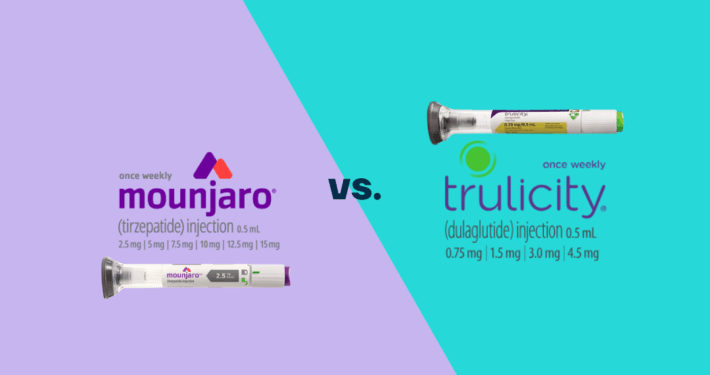
No. Trulicity (dulaglutide) and Mounjaro (tirzepatide) are different medications, though both are made by Eli Lilly. Trulicity activates one hormone receptor (GLP-1), while Mounjaro activates two (GLP-1 and GIP). Mounjaro produces significantly greater weight loss and blood sugar control.
How long do I need to take Ozempic or Trulicity?
Both are typically used long-term for type 2 diabetes. Treatment continues as long as it remains safe and effective for blood sugar control. Stopping either medication may lead to a rise in blood sugar levels. Your prescriber will review your treatment regularly.
Can I take Ozempic and Trulicity together?
No. Both are GLP-1 receptor agonists and should never be combined. Using two GLP-1 medications simultaneously would increase the risk of serious side effects without additional benefit.
Which is easier to inject, Ozempic or Trulicity?
Trulicity is generally considered easier. Its single-use pen has a hidden needle and requires no dose dialling. You place it against your skin and press a button. Ozempic requires attaching a new needle each week and dialling your dose, which some people find fiddly initially.
Take home message
Ozempic produces superior weight loss and blood sugar control compared with Trulicity across all dose comparisons in the SUSTAIN 7 trial. Semaglutide achieved approximately twice the weight loss and greater HbA1c reductions than dulaglutide.1
However, both are effective treatments for type 2 diabetes. Trulicity offers practical advantages, including a simpler pen design and lower cost. Neither medication is licensed for weight loss in the UK.
If weight management is your primary concern alongside type 2 diabetes, speak with your prescriber about Mounjaro (tirzepatide), which is licensed for both type 2 diabetes and weight management and has been shown to produce greater results than either Ozempic or Trulicity.
Second Nature's Mounjaro and Wegovy programmes
Second Nature provides Mounjaro or Wegovy as part of our Mounjaro and Wegovy weight-loss programmes.
Why choose Second Nature over other medication providers, assuming you're eligible?
Because peace of mind matters.
We've had the privilege of working with the NHS for over eight years, helping people across the UK take meaningful steps toward a healthier, happier life.
Our programmes are designed to meet people where they are, whether that means support with weight loss through compassionate one-to-one health coaching, or access to the latest weight-loss medications (like Mounjaro and Wegovy) delivered alongside expert care from a multidisciplinary team of doctors, psychologists, dietitians, and personal trainers.
At the heart of everything we do is a simple belief: real, lasting change comes from building better habits, not relying on quick fixes. We're here to support that change every step of the way.
With over a decade of experience, thousands of lives changed, and a long-standing record of delivering programmes used by the NHS, we believe we're the UK's most trusted weight-loss programme.
We hope to offer you something invaluable: peace of mind, and the support you need to take that first step.