Have you just started Foundayo, or has weight loss stalled?
If you’ve just started Foundayo, the dose may not yet reduce hunger enough to lead to significant weight loss. If weight loss has stalled, you may have reached a plateau.1,3
GLP-1 medications are intentionally started at a lower dose that gradually increases to limit side effects and allow time for the body to adjust to the drug.1,2
If you’re still on a lower dose of Foundayo and have just started treatment, it’s entirely normal for it to take time for the drug to have the desired effect of lowering hunger enough to support weight loss.
As the drug dose increases, its effect on lowering hunger also increases. Over time, you should experience more significant weight loss.
Still, if you’ve lost weight initially and it has now stalled, you’re very likely at a weight-loss plateau.
Weight-loss plateaus are a normal and necessary part of weight loss, even on GLP-1 medications. A weight-loss plateau isn’t inherently bad; it’s only a problem if we expect continuous progress on our weight-loss journey.
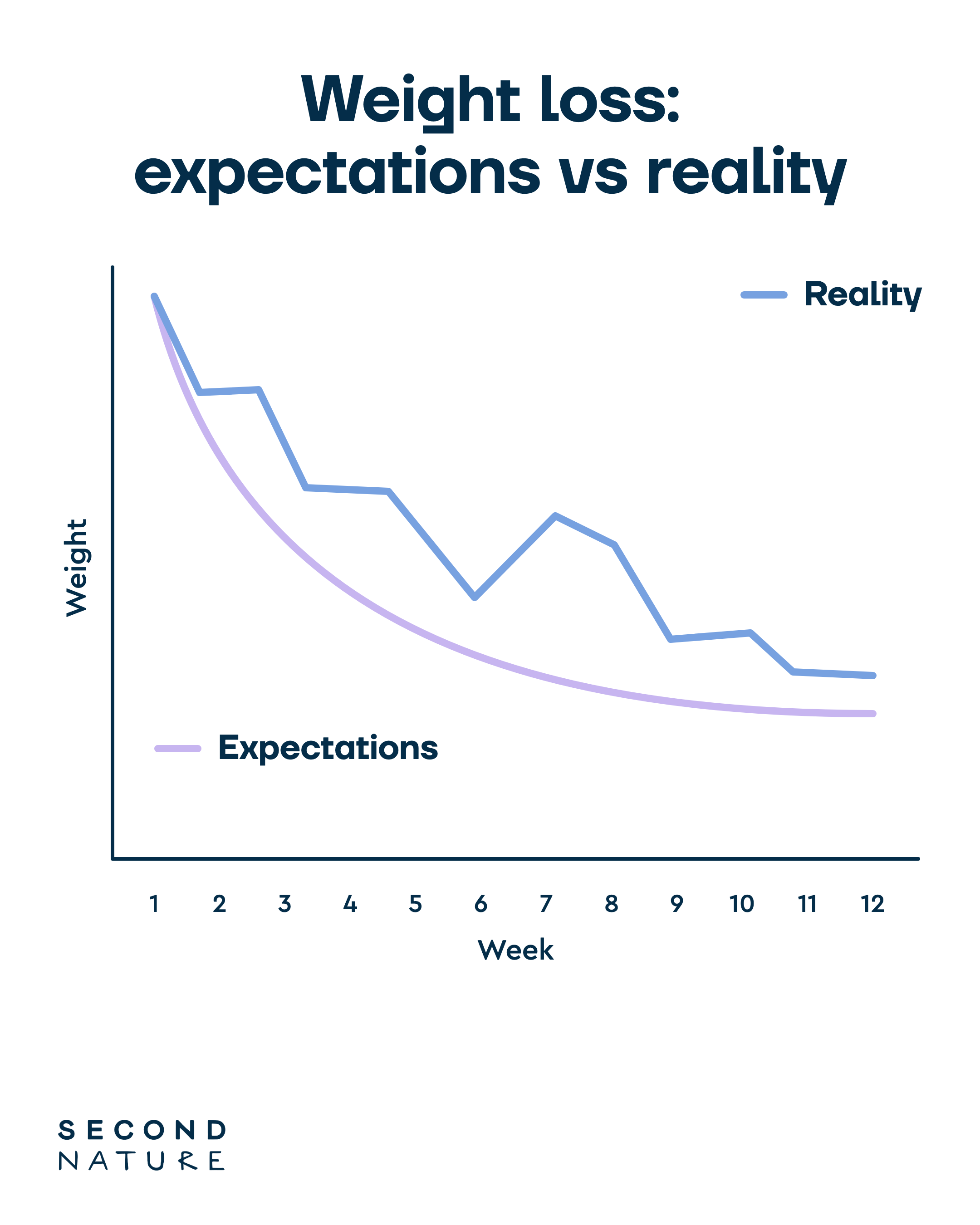
Weight-loss plateaus occur when the brain responds to lower body fat levels by slowing metabolism to protect remaining fat stores. This aligns with set-point theory, which proposes that our brain has a set-point level of body fat it becomes used to, and if weight loss reduces it, the brain will try to return the body to that set point.
When we experience a weight-loss plateau, we need to give our body and brain time to adapt to our new, lower body fat level.
Over time, the brain will adapt to a new set point, and we can start losing weight again.
Plus, it’s important to remember that our weight loss stalling doesn’t mean the medication isn’t still working.
Additionally, our weight can also fluctuate by 1-2 kg each day depending on our salt intake, hormones, which phase of the menstrual cycle you’re in if you’re female, whether we have undigested food in our gut, and our carbohydrate intake (stored carbohydrate in the form of glycogen is stored alongside water).
So, it’s essential to track our progress and look at how our weight is trending over several weeks and months. Daily fluctuations tell us nothing about our body fat levels.
When weighing in, use the same scales, on a firm surface, at a similar time of day. Try weighing in the morning, after you’ve used the toilet and before you’ve eaten or drunk anything.
| What’s happening |
What might explain it |
What to do |
| Weight hasn’t changed much since starting |
The starting dose may not yet be reducing hunger enough |
Keep to the dose schedule and tell your prescriber how hungry you’ve felt at the next review |
| One higher reading between lower readings |
Daily fluctuations due to multiple reasons, including carbohydrate intake the previous day, salt intake, hormone levels, or undigested food |
Consider the overall weight trend, not a single reading |
| Weight has stalled after an earlier loss |
A plateau or a change in hunger and eating habits |
Focus on maintaining healthy habits and trust the process. If you’re on a lower dose of Foundayo, consider increasing it at your next prescriber review. |
| Weight keeps increasing |
Another medicine, a health condition, or changes in eating habits |
Speak to your prescriber and healthcare team before changing the dose |
How Foundayo reduces hunger
Foundayo reduces hunger and can help us feel fuller. It activates GLP-1 receptors in the brain and gut, which receive signals from the GLP-1 hormone that helps control appetite. So, Foundayo mimics the function of the GLP-1 hormone.5
In a 12-week study of 60 Japanese adults living with type 2 diabetes, researchers measured hunger, fullness, and how much people ate at test meals.5
People taking Foundayo generally felt less hungry and fuller, and ate less than before starting treatment.5
So, Foundayo addresses many of the biological reasons why we may overeat, such as excessive hunger levels, food noise, and cravings. Lower hunger can make it easier to eat less and lose weight.
Still, we may eat out of habit, like eating chocolate in the evening in front of the TV, or turn to food as a coping mechanism for managing challenging feelings and emotions.
Our brain can create learned associations between situational and emotional cues and food. For example, we may have learned to respond to sadness by eating something sweet, like chocolate.
Over time, our brain learns to associate sadness with the reward of eating something sweet.
This learned association leads to many food cravings we experience day to day. Whether it’s an emotional or situational cue, the result is the same: we crave something, and we respond by eating.
All of this means that while Foundayo can help us feel less physically hungry and may address food noise so we crave food less, we still have learned associations in our brain that may encourage us to eat more than we need to, even if we’re on Foundayo.
So, alongside taking Foundayo, we also recommend building healthier habits and a healthier relationship with food so you can manage your eating habits over the long term.
Constipation and changes in water weight
Foundayo can cause constipation. This can temporarily cause weight fluctuations because bowel contents add to your weight.1
Total body weight includes water, so fluid changes can alter the reading without a corresponding change in body fat.
If you’re experiencing constipation, speak to a pharmacist or your prescriber. Drink fluids regularly and gradually add fibre-rich foods, such as rolled oats, beans, nuts, milled seeds, lentils, and fruits and vegetables.
Could a higher dose help?
A higher dose of Foundayo may help support more weight loss if the current dose isn’t reducing hunger enough for you to eat less. Any increase should follow the prescribed schedule.1,2
Foundayo is started at 0.8 mg a day and increased to 2.5 mg after at least 30 days. The lower doses allow our body to adapt to the medication and reduce the risk of digestive side effects.1
Further increases to 5.5 mg, 9 mg, 14.5 mg, and 17.2 mg require at least 30 days at each previous dose, depending on how well treatment works and the severity of side effects.1
If every increase is prescribed, it takes at least 150 days, or about five months, to reach the highest dose of 17.2 mg.1
Still, not everyone needs the maximum dose of Foundayo. We recommend that our members stay on the lowest effective dose for as long as possible.
If you’re losing weight sustainably and side effects aren’t impacting your quality of life, there’s no clinical reason to increase the dose.
However, if your weight isn’t changing and you don’t notice a measurable decrease in hunger, talk to your prescriber about increasing your dose.
If you’re struggling to eat enough because of side effects like nausea, we wouldn’t recommend increasing your dose, as eating too little can increase the risk of nutrient deficiencies, hair loss, and bone and muscle loss. Speak to your prescriber if your side effects are limiting your ability to eat 3 meals a day.
Take one whole tablet a day, as prescribed. You can take it with or without food.1
If you miss a dose, take a tablet as soon as possible, but don’t take more than one in the same day.1
Could another medicine make Foundayo less effective?
Some medicines make the body break down Foundayo faster, which can make it less effective.1
For example, carbamazepine reduced Foundayo’s blood levels by 82% over time in a study.1
The UK prescribing guidance says to avoid taking Foundayo with carbamazepine, phenytoin, rifampicin, or St John’s wort.1
Bosentan and efavirenz can also reduce Foundayo’s effect. If they’re prescribed together, the prescriber should check how well Foundayo is working and adjust the dose if needed.1
If you take one of these, speak to your pharmacist or prescriber. Don’t stop another prescribed medicine yourself; your pharmacist or prescriber can help decide which treatment to change.
How much weight do people lose on Foundayo?
In a trial of adults without diabetes, people taking the highest Foundayo dose lost an average of 11.2% of their starting weight over 72 weeks.2
The ATTAIN-1 trial included 3,127 people and compared Foundayo with an inactive pill (a placebo). Everyone received guidance on healthy eating and physical activity.2
Lilly funded the trial. The results include everyone assigned to each group, including those who stopped treatment early.2
| UK tablet equivalent |
Average weight loss at 72 weeks |
| 5.5 mg |
7.5% |
| 9 mg |
8.4% |
| 17.2 mg |
11.2% |
| Placebo |
2.1% |
The trial used 6 mg, 12 mg, and 36 mg capsules. These are equivalent to the UK 5.5 mg, 9 mg, and 17.2 mg tablets, respectively.1,2
Unsurprisingly, the higher doses of Foundayo led to more weight loss. People taking the highest dose lost an average of 11.2%, compared with 7.5% at the lowest dose.2
However, as we discussed above, not everyone needs to move up to the highest dose, as many people can lose weight sustainably and reach their goal weight on lower doses. You should always discuss dose changes with your prescriber.
Still, on average, more people do lose more weight on the higher doses of Foundayo.
At the highest dose, 54.6% of participants lost at least 10% of their starting weight, the point at which many clinical benefits of weight loss, such as a lower risk of type 2 diabetes, are observed.2
These averages describe weight loss after 72 weeks. They don’t tell us what to expect in the first weeks on 0.8 mg, the starting dose.
The trial also excluded people living with type 2 diabetes, so these averages don’t describe weight loss in that group.2
What to eat while taking Foundayo
We recommend eating a diet based on whole foods that contains enough protein, fibre, fat, and complex carbohydrates, and limits ultra-processed foods.
In a study of 20 adults, people gained an average of 0.9 kg during two weeks on an ultra-processed diet and lost 0.9 kg on an unprocessed diet.4
Each person tried both diets for two weeks and could eat as much as they wanted.4
They ate more and faster on the ultra-processed diet, but the study found no clear difference in hunger or fullness.
This lack of a difference in hunger levels might sound counterintuitive, but because both groups could eat as much as they liked, they ate until they were full. Thus, when on the ultra-processed diet, the participants had to eat more to feel full.4
This research suggests the foods we eat can change how much we eat. If we eat more ultra-processed foods, we likely have to eat more of them before we feel full. Whereas if we eat a diet based on whole foods, we’ll feel fuller for longer and eat less overall.
So, even when Foundayo reduces hunger, our diet can still influence how much we eat and how much weight we can lose.
We recommend using the Second Nature balanced plate as a guide: half vegetables, a quarter protein, a quarter complex carbohydrates, plus a serving of fat.
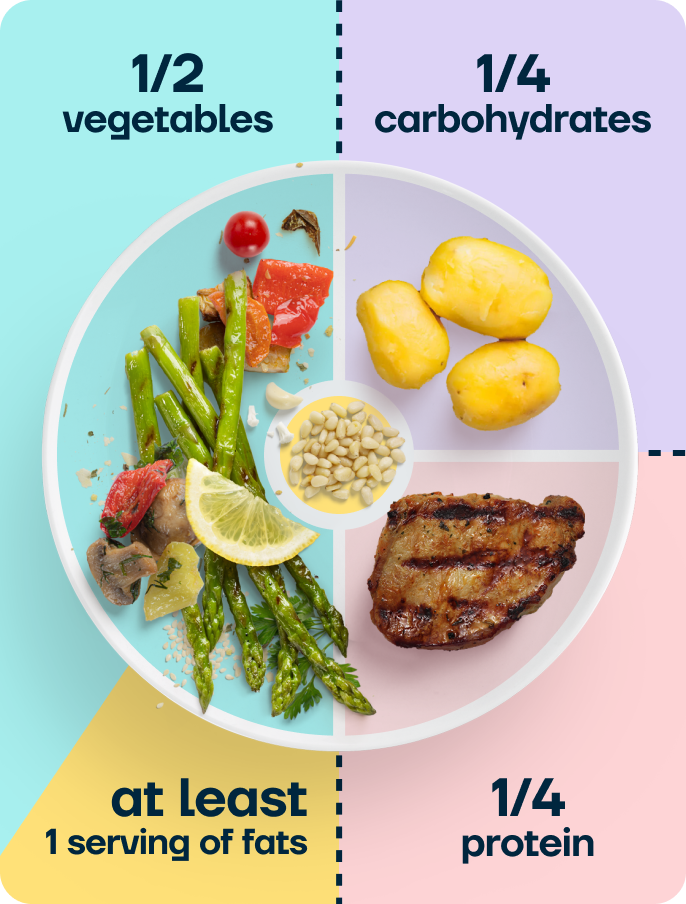
To protect our lean tissues like muscle and bone, we recommend including a portion of protein about the size of the palm of your hand at main meals. Examples include eggs, Greek yoghurt, chicken, fish, tofu, beans, and lentils.

Our food environment
Our food environment significantly affects our eating choices. If our home and office spaces offer healthier options, we’re more likely to choose them. The reverse is also true: if our environment contains more ultra-processed foods, we’re more likely to choose them.
So, we recommend creating a healthier food environment at home and at work.
Here are our top tips for creating a healthier food environment at home and work:
- Plan your meals in advance so you don’t have to make rushed food choices every day
- Batch cook when you have the time. Having freshly prepared meals in the fridge and freezer means you always have a healthier option when you don’t want to cook.
- Limit the number of ultra-processed foods you keep in the house. If you do have them, store them out of sight.
- Keep healthier snack options available and within easy reach. For example, keep a fruit bowl on the side, store vegetables and hummus in the fridge, or boil eggs at the start of each week and keep them in the fridge.
Additionally, don’t feel like you need to eat ‘perfectly’ to be healthy. Not every meal will contain a perfect amount of fibre, protein, fat, and carbohydrate. Still, the more meals we can eat from fresh whole ingredients, the better.
If you’d like a 7-day meal plan to get you started, our Foundayo meal plan is free and provides tips on building healthier meals.
When to speak to your prescriber
If you’re not losing weight, talk to your prescriber at the next dose or prescription review. If you don’t have one booked, arrange an appointment.
Speak to them sooner if you’re gaining weight, another medicine may be interfering with Foundayo, or side effects may be limiting your ability to maintain healthier eating habits.
Bring a record of:
- When you started Foundayo, the current dose, and dates of dose changes
- Weight readings and their dates
- Changes in hunger, fullness, and food noise
- Missed doses or difficulty getting the medication
- Constipation, other side effects, and all medicines and supplements, including anything new
Ask whether the dose should change and when you’ll discuss progress again. If you feel Foundayo isn’t working for you, ask about other treatments.
If you’re taking Foundayo for type 2 diabetes, discuss blood sugar levels as well as weight.1
Get urgent medical help for severe stomach pain that doesn’t go away, or repeated vomiting that stops you from keeping fluids down.1
Our Foundayo side-effects guide explains other symptoms to report.
What if I’ve switched from an injection?
If you’ve switched to Foundayo after losing weight on an injection, the aim may be to maintain weight loss. Foundayo is licensed for both.1
Tell your prescriber what you were taking, the dose, and when you changed. Mention whether hunger or food noise has increased since.
Take home message
You might not be losing weight on Foundayo because the dose you’re on isn’t reducing hunger enough, you’ve reached a plateau, or you haven’t changed your eating habits alongside the medication.
Use the medication alongside regular, balanced meals, more whole foods, while also improving your relationship with food and finding other ways to manage challenging emotions.
Understanding when we eat for comfort and finding other ways to manage those feelings are also part of developing healthier habits.
Second Nature combines medication support with guidance from registered dietitians and nutritionists to help develop healthier eating habits.
In a study of our semaglutide-supported programme, 135 active subscribers lost an average of 19.1% of their starting weight at 12 months.7
Among all 179 people with 12-month weight data, including inactive subscribers, 77.7% lost at least 10%.7
Second Nature's Mounjaro and Wegovy programmes
Second Nature provides Mounjaro or Wegovy as part of our Mounjaro and Wegovy weight-loss programmes.
Why choose Second Nature over other medication providers, assuming you're eligible?
Because peace of mind matters.
We've had the privilege of working with the NHS for over eight years, helping people across the UK take meaningful steps toward a healthier, happier life.
Our programmes are designed to meet people where they are, whether that means support with weight loss through compassionate one-to-one health coaching, or access to the latest weight-loss medications (like Mounjaro and Wegovy) delivered alongside expert care from a multidisciplinary team of doctors, psychologists, dietitians, and personal trainers.
At the heart of everything we do is a simple belief: real, lasting change comes from building better habits, not relying on quick fixes. We're here to support that change every step of the way.
With over a decade of experience, thousands of lives changed, and a long-standing record of delivering programmes used by the NHS, we believe we're the UK's most trusted weight-loss programme.
We hope to offer you something invaluable: peace of mind, and the support you need to take that first step.