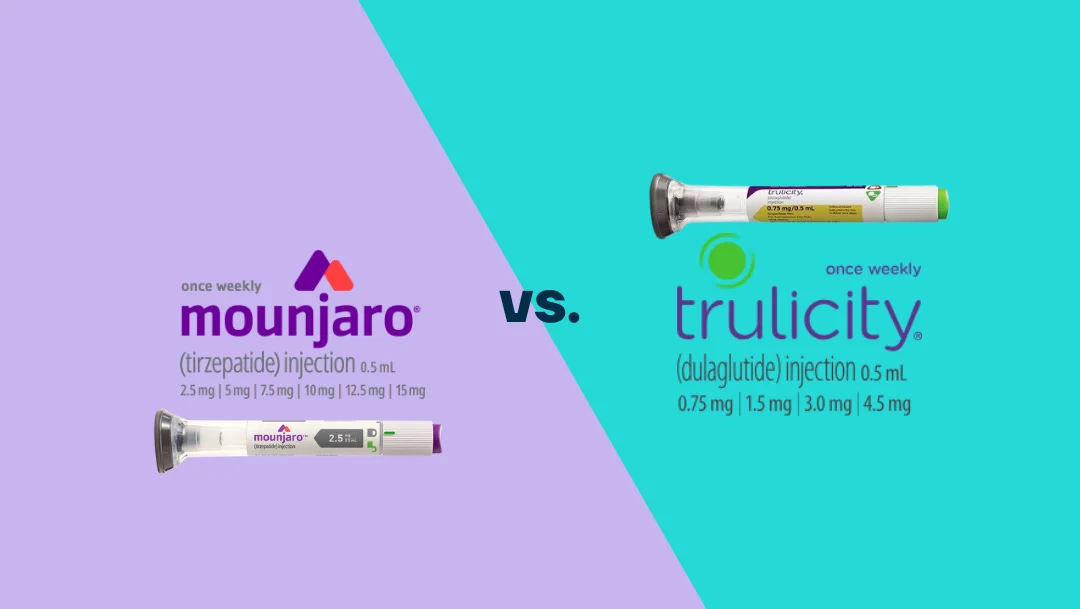
Jump to: What are Mounjaro and Trulicity? | How these medications work | Head-to-head clinical evidence | Side effects and tolerability | Practical differences | Cost and access in the UK | Who might prefer each option? | Frequently asked questions | Take home message
Mounjaro (tirzepatide) is significantly more effective than Trulicity (dulaglutide) for both weight loss and blood sugar control.
The SURPASS-CVOT trial, which directly compared these two medications in over 13,000 people with type 2 diabetes, found that tirzepatide produced approximately 12% weight loss compared with 5% for dulaglutide over 4 years.1
Both medications are made by Eli Lilly. Mounjaro is essentially the next-generation replacement for Trulicity, using a dual-hormone function rather than the single-hormone approach.
Mounjaro is licensed for both type 2 diabetes and weight management in the UK. Trulicity is licensed for type 2 diabetes only.
Important safety information: Mounjaro (tirzepatide) and Trulicity (dulaglutide) are prescription-only medications for treating type 2 diabetes. Mounjaro is also licensed for weight management. This article is for informational purposes only. Always consult with your healthcare provider before starting, stopping, or switching any medication.
| Comparison point |
Mounjaro (tirzepatide) |
Trulicity (dulaglutide) |
| UK licence |
Type 2 diabetes + weight management |
Type 2 diabetes only |
| Manufacturer |
Eli Lilly |
Eli Lilly |
| Mechanism |
Dual GLP-1/GIP receptor agonist |
GLP-1 receptor agonist |
| Weight loss (SURPASS-CVOT, 4 years) |
~12% body weight1 |
~5% body weight1 |
| HbA1c reduction (SURPASS-CVOT) |
-1.73%1 |
-0.90%1 |
| Cardiovascular outcomes |
Non-inferior to dulaglutide for MACE1 |
Reduced MACE by 12% vs placebo (REWIND)2 |
| Maintenance doses |
5 mg, 10 mg, 15 mg |
0.75 mg, 1.5 mg, 3 mg, 4.5 mg |
| Injection frequency |
Once a week |
Once a week |
What are Mounjaro and Trulicity?
Mounjaro and Trulicity are both weekly injectable medications made by Eli Lilly. They share the same manufacturer but use different active ingredients and work in different ways.
Mounjaro contains tirzepatide. It received UK approval for type 2 diabetes in 2023 and for weight management in late 2024, following NICE guidance (TA1026).3
Trulicity contains dulaglutide. It’s been available in the UK since 2015 and is one of the most widely prescribed GLP-1 medications globally. It’s approved for type 2 diabetes only.4
Trulicity was Eli Lilly’s first GLP-1 medication. Mounjaro represents the next generation, adding a second hormone receptor to the mechanism. For many prescribers, Mounjaro has become the preferred choice where available.
How these medications work
Both medications mimic gut hormones that regulate hunger and blood sugar, but Mounjaro targets an additional pathway.
How Trulicity works
Trulicity mimics one hormone called GLP-1 (glucagon-like peptide-1), which:
- Slows food movement through your stomach, helping you feel fuller for longer
- Communicates with your brain’s appetite centre to reduce hunger
- Improves blood sugar control by enhancing insulin function
How Mounjaro works
Mounjaro activates two hormone receptors:
- Like Trulicity, it activates the GLP-1 receptor
- It also activates GIP (glucose-dependent insulinotropic polypeptide), a second gut hormone involved in appetite and blood sugar regulation
This dual-action is the primary reason Mounjaro produces greater weight loss and blood sugar improvements than GLP-1-only medications like Trulicity.1
Head-to-head clinical evidence
SURPASS-CVOT: tirzepatide vs dulaglutide in type 2 diabetes
The SURPASS-CVOT trial is the largest study directly comparing these medications. It randomised 13,299 people with type 2 diabetes and cardiovascular disease to tirzepatide or dulaglutide 1.5 mg, with a median follow-up of 4 years.1
Weight loss results:
- Tirzepatide: approximately 12% body weight loss from baseline
- Dulaglutide 1.5 mg: approximately 5% body weight loss from baseline
- Difference: roughly 7 percentage points in favour of tirzepatide
Blood sugar control:
- Tirzepatide: -1.73% HbA1c reduction
- Dulaglutide 1.5 mg: -0.90% HbA1c reduction
- Difference: approximately 0.83 percentage points in favour of tirzepatide
Cardiovascular outcomes
Both medications have demonstrated cardiovascular safety and benefit in people with type 2 diabetes.
In SURPASS-CVOT, tirzepatide was non-inferior to dulaglutide for major cardiovascular events (cardiovascular death, non-fatal heart attack, or non-fatal stroke). All-cause mortality was 16% lower with tirzepatide (HR 0.84).1
Trulicity’s cardiovascular credentials were established in the REWIND trial, which showed a 12% reduction in major cardiovascular events compared with placebo over 5.4 years.2
Side effects and tolerability
Both medications share similar gastrointestinal side effects. Most are mild to moderate and improve as your body adjusts during dose escalation.
| Side effect |
Mounjaro (tirzepatide)5 |
Trulicity (dulaglutide)4 |
| Nausea |
12-18% (dose-dependent) |
13-21% (dose-dependent) |
| Diarrhoea |
Common during titration |
11-14% (dose-dependent) |
| Vomiting |
Common during titration |
7-12% (dose-dependent) |
| Constipation |
6-17% (dose-dependent) |
Less common |
Side effect profiles are broadly similar between the two medications. The gradual dose titration for both is designed to minimise gastrointestinal effects. Most symptoms peak during the first few weeks and reduce over time.
Neither medication has shown unexpected safety concerns in long-term trials. SURPASS-CVOT provided 4 years of safety data for tirzepatide, while REWIND provided over 5 years of safety data for dulaglutide.
Practical differences
Both medications are weekly injections, so the day-to-day experience is similar. The main practical differences are in dosing flexibility and storage.
Dosing
Mounjaro starts at 2.5 mg a week for four weeks, then increases to 5 mg. Your prescriber can increase your dose to 7.5 mg, 10 mg, 12.5 mg, or 15 mg based on your response. Six dose levels offer fine-grained adjustments.
Trulicity starts at 0.75 mg a week. Your prescriber can increase to 1.5 mg, then to 3 mg, and finally to 4.5 mg. Four dose levels are available.
Both offer good flexibility, though Mounjaro’s six levels allow slightly finer tuning of the balance between effectiveness and tolerability.
Injection technique
Both use pre-filled pens injected once weekly into the stomach, thigh, or upper arm. Neither requires priming. The injection process for both takes about 10 seconds.
Storage
- Mounjaro: Refrigerate (2-8°C) before first use; room temperature (below 30°C) for up to 21 days once in use
- Trulicity: Refrigerate (2-8°C) before first use; room temperature (below 30°C) for up to 14 days once in use
Mounjaro has a slightly longer room-temperature window (21 days vs 14 days), which can be a minor practical advantage for travel.
Cost and access in the UK
For type 2 diabetes
Both medications may be available through the NHS for type 2 diabetes under NICE guideline NG28, depending on your clinical profile and local formulary.
On private prescription, typical monthly costs are:
- Trulicity: £100-150 per month, depending on dose and provider
- Mounjaro: £229-349 per month, depending on dose and provider
Trulicity is typically less expensive than Mounjaro on private prescription.
For weight management
Trulicity isn’t licensed for weight loss in the UK. If weight management is your primary goal, Mounjaro is the appropriate option.
It received NICE approval for weight management (TA1026) in December 2024.3
Who might prefer each option?
For most people, the clinical evidence favours Mounjaro. However, there are circumstances where Trulicity may still be appropriate.
Mounjaro might suit you if:
- Weight loss is a priority alongside diabetes management — Mounjaro produces roughly 2.5 times the weight loss of Trulicity and is licensed for weight management
- You want stronger blood sugar control — nearly twice the HbA1c reduction in head-to-head trials
- You’re currently on Trulicity without reaching your goals — the dual mechanism offers additional benefit
Trulicity might suit you if:
- You’re managing well on it already — if your blood sugar and weight are well controlled, there may be no need to switch
- Cost is a significant factor — Trulicity is typically less expensive on private prescription
- You prefer an established medication — Trulicity has over a decade of real-world use and long-term safety data from REWIND
Frequently asked questions
Is Mounjaro better than Trulicity?
For weight loss and blood sugar control, the head-to-head evidence clearly favours Mounjaro. The SURPASS-CVOT trial showed approximately 12% weight loss with tirzepatide compared with 5% with dulaglutide, along with nearly double the HbA1c reduction.1
Mounjaro also has the broader UK licence covering both diabetes and weight management.
Can I switch from Trulicity to Mounjaro?
Yes. As both are made by Eli Lilly and are injected once a week, the switch is straightforward.
Your prescriber will typically start you at Mounjaro’s lowest dose (2.5 mg) and titrate up. There’s no washout period needed.
Are Mounjaro and Trulicity made by the same company?
Yes. Both are manufactured by Eli Lilly. Trulicity was Lilly’s first GLP-1 medication, launched in 2015. Mounjaro is their newer, dual-action alternative that targets both GLP-1 and GIP receptors.
Does Trulicity help with weight loss?
Trulicity can produce modest weight loss as a secondary effect of its GLP-1 mechanism. In the SURPASS-CVOT trial, people on dulaglutide lost approximately 5% of their body weight.1
However, Trulicity isn’t licensed for weight loss in the UK. If weight management is your primary goal, Mounjaro or Wegovy are the licensed options.
Is Trulicity still worth taking now that Mounjaro is available?
Trulicity remains a well-established, effective medication for type 2 diabetes. If you’re responding well to Trulicity and meeting your health goals, there’s no urgent need to switch.
If you’re not reaching your weight or blood sugar targets, discussing Mounjaro with your prescriber is reasonable.
Are the side effects of Mounjaro worse than Trulicity?
Both have similar gastrointestinal side effects. Nausea rates are broadly comparable (12-18% for Mounjaro vs 13-21% for Trulicity depending on dose).45 Side effects typically improve over time with both medications.
Does Mounjaro have better cardiovascular outcomes than Trulicity?
In SURPASS-CVOT, tirzepatide was non-inferior to dulaglutide in the prevention of major cardiovascular events.
All-cause mortality was 16% lower with tirzepatide.1 Both medications have demonstrated cardiovascular safety and benefit in large, long-term trials.
Can I use Trulicity for weight loss without diabetes?
Trulicity is only licensed for type 2 diabetes in the UK. It should not be prescribed for weight loss in people without diabetes.
If you’re looking for a GLP-1 medication specifically for weight management, Mounjaro and Wegovy are the licensed options.
How long does it take to see results with Mounjaro vs Trulicity?
Both medications begin reducing blood sugar levels within the first few weeks. Weight loss typically becomes noticeable within 4-8 weeks as the dose is titrated up. Mounjaro generally produces faster and greater weight loss than Trulicity, though individual responses vary.
Can I drink alcohol while taking Mounjaro or Trulicity?
Moderate alcohol consumption is generally fine with both medications. Many people find that their tolerance decreases.
Both medications can cause nausea, and alcohol may worsen this, particularly during dose escalation.
If treatment is for type 2 diabetes, read our guide to taking Mounjaro with type 2 diabetes. You can also compare Mounjaro with Ozempic, check Trulicity’s NHS availability, and review the current UK cost of Mounjaro.
Take home message
Mounjaro is the more effective medication for both weight loss and blood sugar control based on direct head-to-head evidence.
n the SURPASS-CVOT trial, tirzepatide produced approximately 12% weight loss compared with 5% for dulaglutide, alongside nearly double the HbA1c reduction.1
Both medications are made by Eli Lilly and share a similar weekly injection routine. The advantage of Mounjaro is its dual GIP/GLP-1 mechanism, which delivers substantially greater results than Trulicity’s GLP-1-only approach.
If you’re currently on Trulicity and meeting your health goals, there’s no urgent need to change. If you’re not reaching your targets, Mounjaro represents a meaningful step up in both effectiveness and licensed indications.
Second Nature's Mounjaro and Wegovy programmes
Second Nature provides Mounjaro or Wegovy as part of our Mounjaro and Wegovy weight-loss programmes.
Why choose Second Nature over other medication providers, assuming you're eligible?
Because peace of mind matters.
We've had the privilege of working with the NHS for over eight years, helping people across the UK take meaningful steps toward a healthier, happier life.
Our programmes are designed to meet people where they are, whether that means support with weight loss through compassionate one-to-one health coaching, or access to the latest weight-loss medications (like Mounjaro and Wegovy) delivered alongside expert care from a multidisciplinary team of doctors, psychologists, dietitians, and personal trainers.
At the heart of everything we do is a simple belief: real, lasting change comes from building better habits, not relying on quick fixes. We're here to support that change every step of the way.
With over a decade of experience, thousands of lives changed, and a long-standing record of delivering programmes used by the NHS, we believe we're the UK's most trusted weight-loss programme.
We hope to offer you something invaluable: peace of mind, and the support you need to take that first step.