Jump to: Quick comparison | How do Wegovy and liraglutide work? | Weight loss: what the evidence shows | Side effects and tolerability | Dosing and practical differences | Cost and access in the UK | Who might prefer each option? | FAQs | Take home message
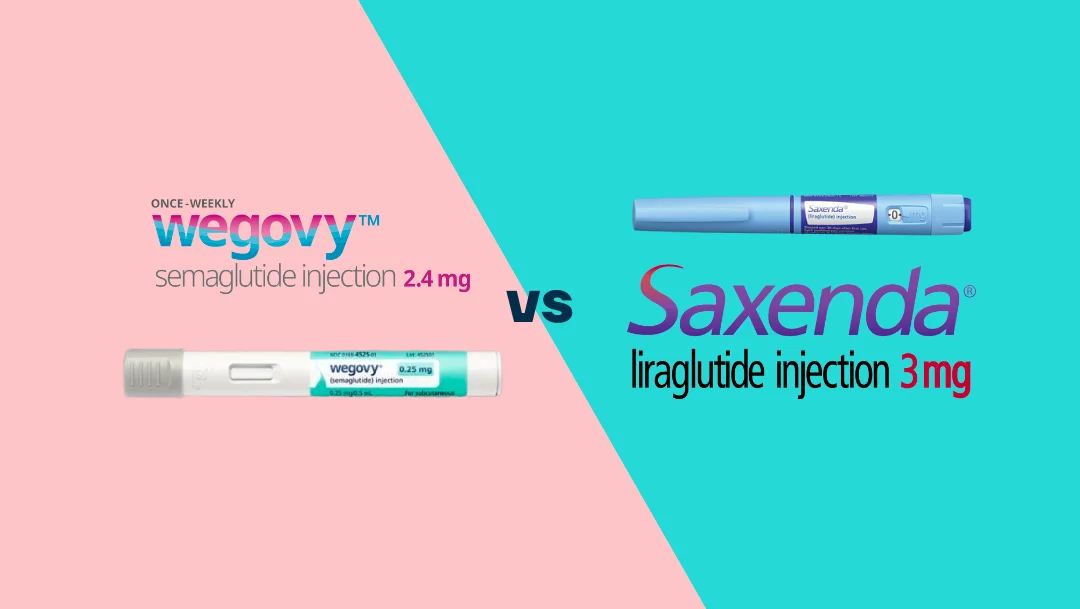
Wegovy (semaglutide) produces significantly more weight loss than Saxenda (liraglutide).
In the only direct head-to-head trial, semaglutide 2.4 mg led to 15.8% average weight loss compared with 6.4% with liraglutide 3.0 mg over 68 weeks.1
Both medications are GLP-1 receptor agonists made by Novo Nordisk, but semaglutide is more potent and stays active in the body for longer, which is why Wegovy is injected once a week while Saxenda requires daily injections.
A higher dose of Wegovy (7.2 mg) is now also available in the UK, which produces even greater weight loss of around 20.7% on average.2
If you’re searching for this comparison, it’s worth knowing that Saxenda has been discontinued by Novo Nordisk.
The branded product is no longer manufactured, though a generic version of liraglutide called Nevolat is now available in the UK from various pharmacies.
If you’re currently taking liraglutide and considering your options, or you’re comparing these medications for the first time, this guide covers the clinical evidence, side effects, practical differences, and cost to help you make an informed decision.
Important safety information: Wegovy (semaglutide) and Saxenda (liraglutide) are prescription-only medications for managing obesity. This article is for informational purposes only. Always consult with your healthcare provider before starting, stopping, or switching any medication.
Wegovy vs Saxenda: quick comparison
| Comparison point |
Wegovy (semaglutide) |
Saxenda / Nevolat (liraglutide) |
| Mechanism |
GLP-1 receptor agonist |
GLP-1 receptor agonist |
| Average weight loss (head-to-head trial) |
15.8% (68 weeks)1 |
6.4% (68 weeks)1 |
| Average weight loss (7.2 mg dose) |
20.7% (68 weeks)2 |
N/A |
| Injection frequency |
Once weekly |
Once daily |
| Maintenance dose options |
2.4 mg (or up to 7.2 mg) |
Fixed at 3.0 mg |
| UK approval for weight management |
September 2022 (7.2 mg approved January 2026) |
2015 (branded Saxenda is now discontinued) |
| Manufacturer |
Novo Nordisk |
Novo Nordisk (Saxenda); Zentiva (Nevolat) |
| NHS availability |
Limited specialist services |
Limited |
| Typical private cost |
£150–£300/month (varies by provider and dose) |
£70–£160/month for generic liraglutide |
How do Wegovy and liraglutide work?
Both Wegovy and liraglutide are GLP-1 receptor agonists, meaning they mimic the same gut hormone: GLP-1 (glucagon-like peptide-1).
GLP-1 is released naturally after eating. It slows digestion, reduces appetite by communicating with the brain’s appetite control centre, and helps the pancreas release insulin to regulate blood sugar.
Our body breaks down natural GLP-1 very quickly, within minutes of its release. Both Wegovy and liraglutide resist this breakdown, so their effects last much longer.
How liraglutide (Saxenda/Nevolat) works
Liraglutide was one of the first GLP-1 medications approved for weight management. It has approximately 97% similarity to natural human GLP-1.
Because liraglutide is cleared from the body relatively quickly compared with newer GLP-1 medications, it must be injected every day to maintain its effectiveness.
How Wegovy works
Semaglutide (the drug in Wegovy) is a newer, more potent GLP-1 receptor agonist.
It has been engineered to bind more strongly to albumin (a protein in the blood), which means it stays active in the body for much longer than liraglutide.
This is why Wegovy only needs to be injected once a week. It also explains why semaglutide produces greater weight loss: the sustained, higher-level activation of GLP-1 receptors provides more consistent reductions in hunger throughout the week.1
Both medications target the same receptor, but semaglutide does so more effectively and for longer.
Key points:
- Both Wegovy and liraglutide (Saxenda/Nevolat) are GLP-1 receptor agonists that mimic the same gut hormone
- Semaglutide (Wegovy) is more potent and stays active in the body for longer than liraglutide
- Wegovy is injected weekly; liraglutide is injected daily
- The longer duration of action is the main reason Wegovy produces greater weight loss
Weight loss: what the evidence shows
Head-to-head trial: STEP 8
Unlike many medication comparisons, we have a direct head-to-head randomised controlled trial comparing semaglutide and liraglutide for weight loss.
The STEP 8 trial (published in JAMA, 2022) enrolled 338 adults with overweight or obesity, without type 2 diabetes, and randomised them to receive either semaglutide 2.4 mg weekly or liraglutide 3.0 mg daily for 68 weeks.1
The results were clear:
- Semaglutide group: 15.8% average weight loss
- Liraglutide group: 6.4% average weight loss
- 70.9% of semaglutide participants lost at least 10% of body weight, compared with 25.6% on liraglutide
- 55.0% of semaglutide participants lost at least 15%, compared with 12.0% on liraglutide
This trial provides the strongest available evidence that Wegovy is substantially more effective than Saxenda for weight loss.
Wegovy standalone trials
The STEP 1 trial (published in NEJM, 2021) enrolled 1,961 adults without type 2 diabetes and found that semaglutide 2.4 mg produced 14.9% average weight loss over 68 weeks, compared with 2.4% on placebo.3
86.4% of participants on semaglutide lost at least 5% of their body weight, and 69.1% lost at least 10%.3
What about Wegovy 7.2 mg?
A higher dose of Wegovy (7.2 mg) was approved by the MHRA in January 2026 following the STEP UP trial, which showed:2
- Wegovy 7.2 mg: 20.7% average weight loss
- Wegovy 2.4 mg: 17.5% average weight loss
- 50.9% of those on 7.2 mg lost at least 20% of body weight
The 7.2 mg dose is not a starting dose. It is delivered as three 2.4 mg pens and is only suitable for people who have already tolerated the standard dose well and want additional weight loss.
For a detailed comparison, see our guide to Wegovy 7.2 mg vs 2.4 mg.
Real-world data with behavioural support
Second Nature’s peer-reviewed research, published in JMIR Formative Research (2025), showed that semaglutide, combined with registered dietitian support and a structured behaviour change programme, produced an average 19.1% weight loss at 12 months, with 77.7% of participants achieving at least 10% weight loss.4
This exceeded the results of the STEP clinical trials, suggesting that comprehensive behavioural support may enhance medication outcomes.
No equivalent real-world data for liraglutide combined with similar structured support are available.
Key points:
- In the only head-to-head trial, Wegovy produced 15.8% weight loss compared with 6.4% for Saxenda over the same 68-week period
- Wegovy 7.2 mg (approved January 2026) produces even greater results at 20.7% average weight loss
- Real-world data from Second Nature shows 19.1% weight loss with semaglutide when combined with behavioural support
- Semaglutide participants were nearly three times more likely to achieve at least 10% weight loss than liraglutide participants
Side effects and tolerability
Both medications share a similar side-effect profile, predominantly affecting the gastrointestinal tract.
Most side effects are mild to moderate and tend to improve as the body adjusts.
Head-to-head comparison (STEP 8)
The STEP 8 trial provides direct side-effect comparison data:1
- Gastrointestinal adverse events: 84.1% with semaglutide vs 82.7% with liraglutide
- Treatment discontinuation due to adverse events: 13.5% with semaglutide vs 27.6% with liraglutide
While the overall rate of gastrointestinal side effects was similar, liraglutide had a substantially higher discontinuation rate. This suggests that although both medications cause similar types of side effects, the severity or persistence may be greater with liraglutide for some people.
Common side effects
The most frequently reported side effects for both medications include nausea, vomiting, diarrhoea, and constipation. These typically occur during the initial weeks of treatment or during dose increases.
Side effects improve over time
Second Nature’s published research found that side effects with semaglutide decreased substantially over 12 months:4
- Nausea dropped from 31.5% at month 1 to 3.1% by month 12
- Fatigue dropped from 24.6% at month 1 to 3.1% by month 12
- By month 12, 67.7% of semaglutide users reported no side effects
Long-term real-world side-effect tracking data for liraglutide are limited, though clinical trials showed a similar pattern of improvement over time.
Side effects with Wegovy 7.2 mg
The STEP UP trial found that side effects were somewhat more common at the higher dose:2
- GI side effects: 70.8% (7.2 mg) vs 61.2% (2.4 mg)
- Dysaesthesia (tingling/numbness): 22.9% (7.2 mg) vs 6.0% (2.4 mg)
- Discontinuation due to side effects remained low at 3.3%
The dysaesthesia finding is notable, though 85.7% of cases resolved while continuing treatment.
Safety considerations for both
Neither medication should be used if you have a personal or family history of medullary thyroid carcinoma or Multiple Endocrine Neoplasia syndrome type 2 (MEN 2).
Both medications can affect the absorption of oral medications by slowing gastric emptying. If you take other medications, discuss potential interactions with your prescriber.
Liraglutide has a longer overall safety track record, having been approved for weight management since 2015, compared with Wegovy, which was approved in 2022.
However, semaglutide also has extensive safety data from its use in type 2 diabetes (as Ozempic) since 2018.
Wegovy also has cardiovascular outcome data from the SELECT trial, which showed a 20% reduction in major cardiovascular events in people with obesity and established cardiovascular disease.5 No equivalent cardiovascular outcome trial exists for liraglutide at the 3.0 mg weight management dose.
Key points:
- Both medications cause similar gastrointestinal side effects, most commonly nausea, diarrhoea, and constipation
- In the head-to-head trial, liraglutide had double the discontinuation rate of semaglutide (27.6% vs 13.5%)
- Side effects tend to occur early in treatment and improve over time
- Wegovy has cardiovascular outcome data (SELECT trial) that liraglutide does not
Dosing and practical differences
Injection frequency
One of the most significant practical differences is how often you inject.
Wegovy is injected once per week. Many people prefer this because it’s easier to fit into a routine and involves fewer injections overall.
Liraglutide (Saxenda/Nevolat) is injected once per day. While some people are comfortable with daily injections, others find the frequency inconvenient or difficult to maintain, particularly when travelling.
Dose escalation
Wegovy follows a fixed escalation schedule over 16-20 weeks: 0.25 mg, 0.5 mg, 1.0 mg, 1.7 mg, then the maintenance dose of 2.4 mg. For those who need additional support, the dose can be increased further to 7.2 mg (delivered as three 2.4 mg pens).
Liraglutide starts at 0.6 mg daily, increasing by 0.6 mg each week over five weeks until reaching the maintenance dose of 3.0 mg. There is only one maintenance dose, offering less flexibility.
Storage
Both medications should be stored in the fridge (2-8°C) before first use.
- Wegovy: Once in use, it can be kept at room temperature (below 30°C) for up to 28 days
- Liraglutide: Once in use, it can be kept at room temperature (below 30°C) for up to 30 days
Neither medication should be frozen. Both can be carried in hand luggage for travel.
Missed doses
Wegovy: If you miss a dose and there are more than 2 days until your next scheduled dose, take it as soon as you remember. If there are fewer than 2 days, skip the missed dose and take your next one on the scheduled day.
Liraglutide: If you miss a dose, skip it and take your next dose at the usual time the following day. Do not take a double dose.
Injection technique
Both use pre-filled pens and are injected subcutaneously (under the skin) into the stomach, thigh, or upper arm. Rotate injection sites to reduce irritation.
Cost and access in the UK
Private prescription costs
Costs vary by provider and depend on the dose you’re taking.
Wegovy typically costs between £150 and £300 per month through private providers, depending on the dose and what’s included in the service. The 7.2 mg dose is more expensive, typically around £350-£400 per month.
Generic liraglutide (Nevolat) is significantly cheaper, typically costing between £70 and £160 per month from UK online pharmacies. Branded Saxenda is no longer being manufactured.
When comparing costs, it’s worth considering what you’re getting alongside the medication. Research consistently shows that medication combined with structured support produces better outcomes than medication alone.4
Saxenda has been discontinued
Novo Nordisk has discontinued production of Saxenda to focus manufacturing capacity on newer medications like Wegovy.
In the UK, branded Saxenda is now long-term out of stock.
A generic version of liraglutide, called Nevolat (manufactured by Zentiva), is widely available in the UK as a direct replacement. It contains the same drug at the same doses, so there is no clinical difference between the two.
If you’re currently taking Saxenda and your supply has been affected, speak with your prescriber about switching to Nevolat, or about whether Wegovy might be a more effective alternative.
NHS availability
Both medications are theoretically available through NHS specialist weight management services (Tier 3 and Tier 4), though access remains limited.
Eligibility typically requires a BMI of 35 or above (or 30+ with weight-related conditions), documented attempts at weight loss, and a referral to specialist services. Waiting times vary significantly by region.
NICE has published guidance recommending both semaglutide and tirzepatide for obesity management alongside lifestyle modification.6
Who might prefer each option?
Individual responses to medications vary significantly, and the right choice depends on your personal circumstances.
Liraglutide (Nevolat) might be preferred if:
- Cost is a primary concern. Generic liraglutide is substantially cheaper than Wegovy.
- You’ve previously responded well to liraglutide. If Saxenda has worked for you and you’re comfortable with it, switching to Nevolat keeps you on the same medication at a lower cost.
- You prefer a medication with a longer safety track record. Liraglutide has been used for weight management since 2015.
- You want to stop quickly if side effects occur. Because liraglutide is cleared from the body more quickly, its effects wear off sooner if you stop taking it, which some people prefer.
Wegovy might be preferred if:
- You want significantly greater weight loss. Head-to-head trial data show Wegovy produces roughly 2.5 times the weight loss of liraglutide.
- You prefer weekly injections. One injection per week is more convenient than daily.
- You have cardiovascular risk factors. Wegovy is the only weight-loss medication with proven cardiovascular benefits (SELECT trial).5
- You want the option of a higher dose. The 7.2 mg dose provides additional weight loss for those who need it.
- You’ve tried liraglutide but haven’t achieved desired results. Semaglutide’s greater potency may produce a better response.
Frequently asked questions
Is Saxenda still available in the UK?
Branded Saxenda has been discontinued by Novo Nordisk and is no longer being manufactured.
However, a generic version of liraglutide called Nevolat (made by Zentiva) is widely available through UK pharmacies. It contains the same drug and works in exactly the same way.
Can I switch from Saxenda or Nevolat to Wegovy?
Yes. If you’re currently taking liraglutide and want to switch to Wegovy, speak with your prescriber.
Because both medications are GLP-1 receptor agonists, your prescriber may recommend starting Wegovy at a higher dose than the usual starting point, depending on your current liraglutide dose. They will advise on timing and appropriate escalation.
Why is Wegovy weekly but Saxenda daily?
Semaglutide (Wegovy) has been engineered to bind more strongly to albumin in the blood, thereby protecting it from being broken down by the body. This gives Wegovy a much longer half-life than liraglutide, meaning it maintains effective levels in the body for about a week. Liraglutide is cleared more quickly and needs daily dosing.
Is liraglutide the same as Nevolat?
Yes. Liraglutide is the drug in Nevolat.
Nevolat is the brand name for a generic version of liraglutide, replacing the now-discontinued Saxenda. Both contain the same medication at the same concentration.
Do you lose more weight on Wegovy or liraglutide?
Significantly more on Wegovy. In the head-to-head STEP 8 trial, semaglutide 2.4 mg produced 15.8% weight loss compared with 6.4% for liraglutide 3.0 mg over the same 68-week period.1
The higher Wegovy 7.2 mg dose produces even greater weight loss of 20.7%.2
Is Wegovy safer than liraglutide?
Both medications have acceptable safety profiles, with similar side effects, mainly gastrointestinal. Liraglutide has been available longer (since 2015), but semaglutide also has extensive safety data from its use in diabetes.
In the head-to-head trial, liraglutide actually had a higher discontinuation rate due to side effects (27.6% vs 13.5%).1 Wegovy also has cardiovascular outcome data that liraglutide does not.5
How long do I need to take these medications?
Current NICE guidance treats obesity as a chronic condition and recommends treatment for at least 12 months, with potential continuation if it remains safe and effective.6
Research shows that significant weight regain commonly occurs when stopping medication without having established sustainable habits.
Will I gain weight back if I stop?
Some weight regain is common after stopping either medication if sustainable habits have not been established.
Clinical trials with GLP-1 medications show that people typically regain a significant proportion of lost weight within a year of stopping, without ongoing support.7
This is one reason why combining medication with structured behavioural support, rather than taking medication alone, may produce more lasting results.
Can I take liraglutide and Wegovy together?
No. You should not take two GLP-1 medications at the same time. If you’re switching from one to the other, your prescriber will advise on the appropriate timing.
Does either medication interact with the contraceptive pill?
Both medications can slow gastric emptying, which may affect how quickly oral medications (including the contraceptive pill) are absorbed.
If you take oral contraception, discuss with your prescriber whether alternative contraceptive methods might be advisable during the first few months of treatment. There is no evidence of interaction with contraceptive patches or injections.
Our comparison guides cover Mounjaro versus Saxenda and Ozempic versus Saxenda. We also explain NHS access to Saxenda and current UK costs.
Take home message
Wegovy (semaglutide) produces significantly more weight loss than liraglutide (Saxenda/Nevolat). In the only head-to-head trial, Wegovy achieved 15.8% weight loss compared with 6.4% for Saxenda over 68 weeks.1
The newer Wegovy 7.2 mg dose further widens this gap, producing an average of 20.7% weight loss.2
Wegovy also offers practical advantages: weekly rather than daily injections, the option of a higher dose, and proven cardiovascular benefits.
Liraglutide remains a viable option for people who are cost-sensitive, have responded well to it previously, or prefer a medication with a longer safety history. With Saxenda discontinued, Nevolat provides the same medication at a lower price.
Research consistently shows that weight-loss medications are most effective when combined with structured support that helps you build sustainable habits.
Taking medication alone can produce significant short-term weight loss, but maintaining that weight loss after stopping typically requires the healthy eating patterns and behaviours developed alongside the medication.4,7
Second Nature's Mounjaro and Wegovy programmes
Second Nature provides Mounjaro or Wegovy as part of our Mounjaro and Wegovy weight-loss programmes.
Why choose Second Nature over other medication providers, assuming you're eligible?
Because peace of mind matters.
We've had the privilege of working with the NHS for over eight years, helping people across the UK take meaningful steps toward a healthier, happier life.
Our programmes are designed to meet people where they are, whether that means support with weight loss through compassionate one-to-one health coaching, or access to the latest weight-loss medications (like Mounjaro and Wegovy) delivered alongside expert care from a multidisciplinary team of doctors, psychologists, dietitians, and personal trainers.
At the heart of everything we do is a simple belief: real, lasting change comes from building better habits, not relying on quick fixes. We're here to support that change every step of the way.
With over a decade of experience, thousands of lives changed, and a long-standing record of delivering programmes used by the NHS, we believe we're the UK's most trusted weight-loss programme.
We hope to offer you something invaluable: peace of mind, and the support you need to take that first step.