Wegovy is licensed to lower your risk of heart attack and stroke
In July 2024, the MHRA approved Wegovy to reduce the risk of major cardiovascular events (mainly heart attacks, strokes, and deaths from heart disease) in adults who have established cardiovascular disease and a BMI of 27 or above.2 This made Wegovy the first weight-loss medication in the UK licensed for this purpose, not only for weight loss.2
The cardiovascular licence applies to adults who:
- have established cardiovascular disease, such as a previous heart attack, stroke, or narrowed arteries
- have a BMI of 27 or above
The licence is based on the SELECT trial, a Phase 3 study (a large human trial with thousands of participants).1
SELECT enrolled 17,604 adults aged 45 or older who had already been diagnosed with cardiovascular disease, such as a previous heart attack or stroke, and who were overweight or living with obesity.1 None of them was living with type 2 diabetes.1
Half were given Wegovy at a 2.4 mg dose once a week, and half were given a placebo (a dummy injection with no medicine).1 Everyone kept taking their usual heart medications.1
Over an average of around 3.3 years, 6.5% of people on Wegovy had a major cardiovascular event, compared with 8.0% of those on the placebo, a 20% relative reduction in risk.1
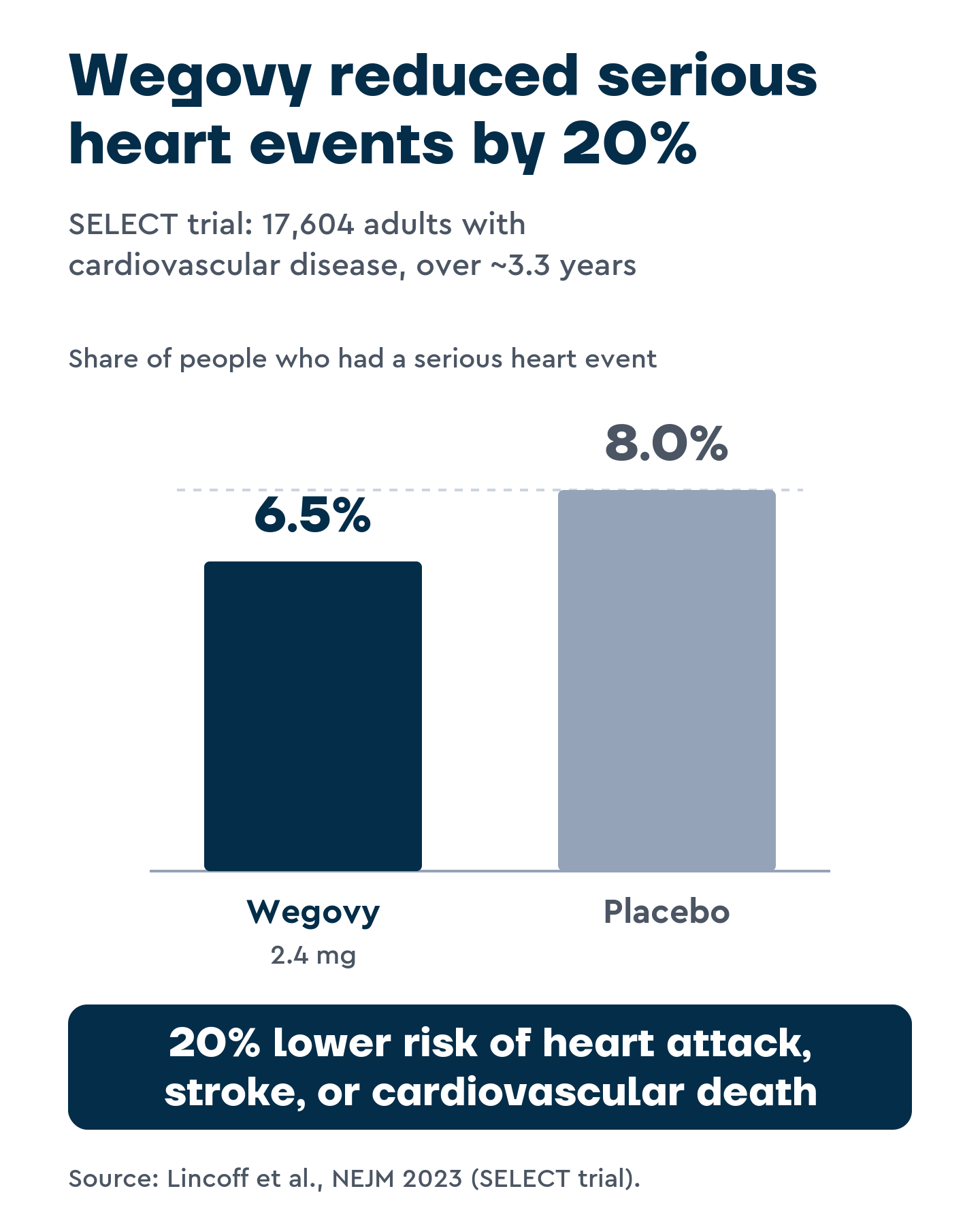
| SELECT trial result |
Wegovy (semaglutide 2.4 mg) |
Placebo |
| People in the group |
8,803 |
8,801 |
| Had a heart attack, stroke, or cardiovascular death |
6.5% |
8.0% |
| Overall change in risk |
20% lower |
Reference group |
The benefit came on top of standard cardiovascular care. Participants were already taking medications such as statins and blood pressure tablets, and Wegovy reduced their risk further.1
How Wegovy protects your heart
Wegovy works by mimicking a hormone called GLP-1, which our body produces naturally in the gut.
It communicates with the appetite centre in the brain to reduce hunger and quieten ‘food noise’, the constant background thoughts about food.
With less hunger, most people eat less and lose weight.
Losing weight reduces strain on your heart and improves blood pressure, blood sugar, and cholesterol levels.
At its top dose for weight management, 7.2 mg, Wegovy produced an average weight loss of 20.7% in trials.4
Some of that heart protection comes from losing weight, but it isn’t the main reason.
In SELECT, the protective effect appeared within the first few months, before people had lost much weight.1,3
A prespecified analysis of the trial (a question the researchers planned to study from the outset) found that only about a third of the reduction in cardiovascular events could be explained by weight loss. The rest came from other effects of the medication.3
Those other effects include lower blood pressure and less inflammation in the blood vessels.3
Across the weight-management trials, Wegovy lowered systolic blood pressure (the top number) by around 5 mmHg on average.5
It also improves blood sugar control. High blood sugar and ongoing inflammation both damage arterial walls over time.1
Quieter food noise also makes it easier to eat fewer ultra-processed foods and more whole foods that support heart health, such as vegetables, oily fish, and wholegrains.
Is Wegovy safe if you have heart disease?
For most people with cardiovascular disease, yes. The Wegovy product information doesn’t list heart disease as a reason not to take it.5
The only contraindication (a reason the medication shouldn’t be prescribed) is a known allergy to semaglutide or any of the other ingredients.5
Wegovy does raise resting heart rate slightly, by about 3 beats per minute on average.5
For most people, this isn’t a problem, but tell your cardiology team if you notice a fast or irregular heartbeat, or palpitations, that don’t settle.
There’s also limited information on Wegovy in people with the most severe form of heart failure (class IV, where symptoms occur even at rest).5
If you have heart failure, your prescriber will take it into account before recommending it. Wegovy is meant to be taken alongside your usual heart treatment, not as a replacement for them.
In SELECT, people kept taking their statins, blood pressure tablets, and blood thinners, and Wegovy reduced their risk on top of that care.1
It’s sensible to monitor your blood pressure while you’re on Wegovy, because as it falls, you may need your blood pressure medication reviewed.
Second Nature has worked with the NHS since 2017, and our clinical team monitors your blood pressure and response to medication while you’re taking Wegovy. Take our 3-minute eligibility quiz, and a clinician will review your answers.
How to eat on Wegovy
We recommend eating a diet based on whole foods, that contains enough protein, fibre, fat, and complex carbohydrates, and limits ultra-processed foods.
For heart health specifically, it helps to focus on:
- Oily fish such as salmon, mackerel, sardines, and trout can help increase your intake of omega-3 fats. Aim for 2 portions of fish a week, one of which is oily.
- Fibre from complex carbohydrates like wholegrain or sourdough bread, rolled oats, brown rice, beans, and lentils, which helps to maintain stable blood sugar levels
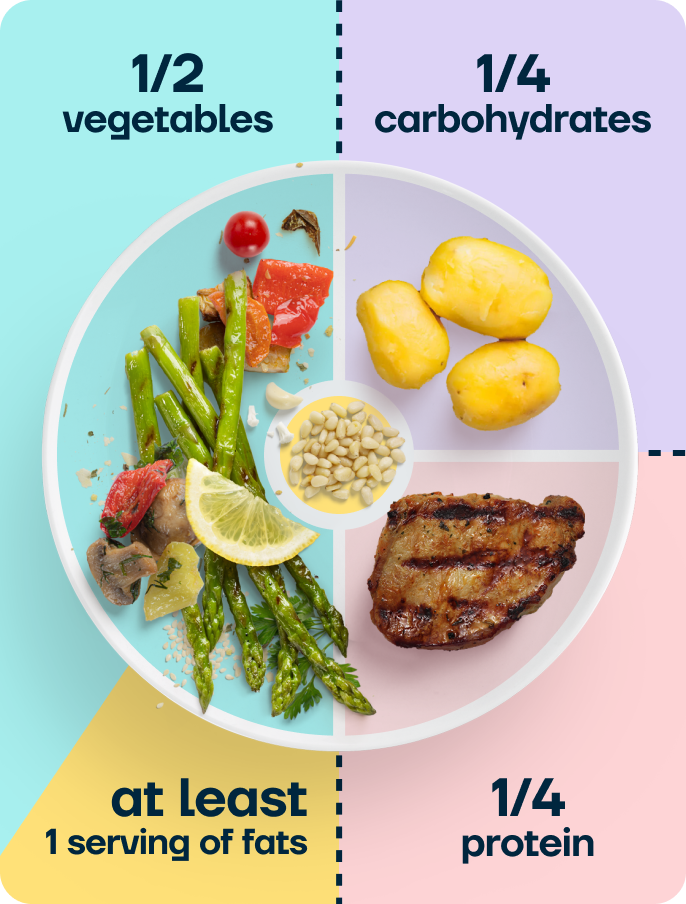
- Plenty of vegetables, aiming for around half your plate
- Fewer ultra-processed foods, both of which are linked to higher blood pressure
The Second Nature balanced plate is a simple guide of half vegetables, a quarter protein, a quarter complex carbohydrates, and a serving of fat.
Eating too little is a common problem on Wegovy.
Wegovy reduces appetite and quietens food noise, and many people end up eating too little.
Eating too little makes it challenging to maintain muscle and supply the nutrients your heart and body need.
Including a portion of protein about the size of your palm at each meal helps protect your muscles as you lose weight. Aim for around 1.2 to 1.6 g of protein per kg of body weight a day.
Losing weight at a steady pace also helps to maintain muscle mass. We recommend a sustainable rate of around 1lb a week. On Wegovy, that usually means staying on the lowest effective dose for as long as possible.
Many of our members lose a significant amount of weight on lower doses of Wegovy and Mounjaro without losing excess muscle.
Staying active with cardiovascular disease
If you have cardiovascular disease, check with your GP or cardiology team before you start exercising or do more than you’re used to, particularly if you’ve recently had a heart attack, stroke, or heart surgery.
If you’ve had a cardiac event, you may be offered cardiac rehabilitation, a supervised exercise programme run by the NHS. It’s one of the safest ways to build activity back up, so ask your team whether you’re eligible.
The aim is to build a routine you can maintain, rather than aiming for an unrealistic weekly target.
A 10-minute walk after a meal is a realistic place to start, and you can do a little more as you feel ready.
Walking, cycling, and swimming are good for your heart and lungs.
Resistance work, like bodyweight exercises or light weights, a couple of times a week, is especially useful while you’re on Wegovy, because it helps you hold on to muscle as you lose weight.
What happens to your heart if you stop Wegovy
The heart protection seen in SELECT came from taking Wegovy continuously for up to around 5 years.1
If you stop Wegovy suddenly without having built the habits needed to maintain your new weight, some weight regain is likely.
In the STEP 4 trial, people who stopped semaglutide and switched to a placebo regained about 7% of their body weight over the following year, while those who kept taking it continued to lose weight.6
This pattern of regain is consistent across trials that have examined what happens when people stop the medication suddenly.6
As weight is regained, it’s likely that blood pressure improvements and other factors that improved with weight loss will also worsen. That’s why we recommend coming off the medication slowly, by gradually reducing the dose, and making sure you have habits in place to manage hunger naturally.
Our free weight regain prevention planner walks you through how to do this.
Frequently asked questions
Is Wegovy safe if you have heart disease?
For most people, yes. Wegovy is licensed in the UK to reduce the risk of heart attack and stroke in adults with established cardiovascular disease, and the product information doesn’t list heart disease as a reason not to take it.2,5 Your prescriber will still check your full medical history first.
Can you take Wegovy after a heart attack or stroke?
The SELECT trial included people who had already had a heart attack or stroke, and Wegovy reduced their risk of a further event.1
The right time to start after a recent event should be decided with your cardiology team.
Does Wegovy reduce the risk of heart attack and stroke?
Yes. In adults with established cardiovascular disease who were overweight or living with obesity, Wegovy reduced major cardiovascular events by 20% over around 3.3 years compared with a placebo.1
Does Wegovy raise your heart rate?
Wegovy slightly raises resting heart rate by about 3 beats per minute on average.5
For most people, this isn’t a problem, but tell your doctor if you notice a persistently fast or irregular heartbeat.
Can Wegovy cause heart palpitations?
Some people notice palpitations, particularly after a dose increase, which may be linked to a small rise in heart rate or to rapid weight loss.
If palpitations are frequent or severe, or come with chest pain, dizziness, or breathlessness, contact your doctor.
Does Wegovy lower blood pressure?
Yes, modestly. In the weight-management trials, Wegovy lowered systolic blood pressure by around 5 mmHg on average.5
If you take blood pressure medication, your prescriber may need to review the dose as your blood pressure falls.
Can you take Wegovy with heart medications like statins, blood pressure tablets, or blood thinners?
Yes. In the SELECT trial, people took Wegovy alongside their usual heart medications, including statins, blood pressure tablets, and blood thinners.1
Keep taking your prescribed medications and don’t stop any of them without speaking to your doctor.
Can you take Wegovy if you have heart failure?
Wegovy can be used in many people with heart failure, but there’s limited information on its use in the most severe form (class IV, where symptoms occur at rest).5
If you have heart failure, your prescriber will weigh this up before recommending it.
Can you get Wegovy on the NHS if you have cardiovascular disease?
NHS access to Wegovy is currently through specialist weight-management services and is limited, and it isn’t routinely prescribed specifically to prevent cardiovascular events.
Most people in the UK access Wegovy through a private provider.
Is Wegovy or Mounjaro better for cardiovascular disease?
Wegovy currently has the strongest evidence for preventing cardiovascular disease because it’s the only weight-loss medication with a completed cardiovascular outcomes trial and a UK licence to reduce cardiovascular risk.1,2
Mounjaro’s cardiovascular outcomes trial (SURMOUNT-MMO) is still running.
Our guide to taking Mounjaro with cardiovascular disease covers the evidence for Mounjaro in more detail.
Our guides cover Wegovy with statins and high blood pressure. Use our Wegovy exercise plan to adapt activity around symptoms, and read what can happen after stopping weight-loss injections.
Take home message
Wegovy is the first weight-loss medication licensed in the UK to reduce the risk of heart attack and stroke, for adults with established cardiovascular disease and a BMI of 27 or above.2
In the SELECT trial, it reduced major cardiovascular events by 20% over around 3.3 years, on top of standard heart care.1
Much of that benefit appears to be independent of weight loss, coming instead from lower blood pressure, less inflammation, and better blood sugar control.3
It’s generally safe to take alongside heart medications. The main things to keep an eye on are a small rise in heart rate and, for people with severe heart failure, the limited evidence in that group.5
Second Nature combines medication with support from a registered dietitian or nutritionist and a structured habit-change programme built around the balanced plate.
In our published service evaluation of members on a GLP-1-supported programme, the average weight loss was 19.1% at 12 months, and 77.7% of members lost at least 10% of their body weight.7
Second Nature's Mounjaro and Wegovy programmes
Second Nature provides Mounjaro or Wegovy as part of our Mounjaro and Wegovy weight-loss programmes.
Why choose Second Nature over other medication providers, assuming you're eligible?
Because peace of mind matters.
We've had the privilege of working with the NHS for over eight years, helping people across the UK take meaningful steps toward a healthier, happier life.
Our programmes are designed to meet people where they are, whether that means support with weight loss through compassionate one-to-one health coaching, or access to the latest weight-loss medications (like Mounjaro and Wegovy) delivered alongside expert care from a multidisciplinary team of doctors, psychologists, dietitians, and personal trainers.
At the heart of everything we do is a simple belief: real, lasting change comes from building better habits, not relying on quick fixes. We're here to support that change every step of the way.
With over a decade of experience, thousands of lives changed, and a long-standing record of delivering programmes used by the NHS, we believe we're the UK's most trusted weight-loss programme.
We hope to offer you something invaluable: peace of mind, and the support you need to take that first step.