What the evidence says
The Mounjaro SmPC is the most reliable source on whether the two can be taken together.
It states that tirzepatide slows the rate at which our stomach empties after eating, which can affect how quickly oral medications are absorbed.1
For most oral medications, this doesn’t matter in practice.
The SmPC recommends extra monitoring for drugs in which small changes in blood levels can have a big effect, naming warfarin and digoxin as examples.1 Propranolol isn’t in this category.
The paracetamol study used to test this is a useful reference point.
After the first 5 mg dose of tirzepatide, the peak blood level of paracetamol was reduced by 50% and its time to peak was delayed by 1 hour. After four weekly doses, no effect was seen.1
In other words, our stomach adjusts to tirzepatide within the first month of treatment.
For low blood sugar, the SmPC is clear that the increased risk only applies when tirzepatide is combined with insulin or a sulphonylurea (such as gliclazide).1
Propranolol on its own doesn’t lower blood sugar, but it can hide the symptoms that would otherwise warn you it’s dropping.
| Consideration |
What the evidence shows |
| Direct drug interaction |
None listed in the Mounjaro SmPC, and propranolol isn’t a narrow therapeutic index drug.1 |
| Blood pressure |
In SURMOUNT-1, tirzepatide reduced systolic blood pressure by an average of 6.8 mmHg and diastolic by 4.2 mmHg compared to placebo at 72 weeks.2 Combined with propranolol, blood pressure can drop further, particularly during dose escalation. |
| Heart rate |
Tirzepatide increases resting heart rate by an average of 2 to 3 bpm in weight management trials, with continuous monitoring showing up to 5 bpm at the highest dose.1,3 Propranolol slows heart rate, so the two partly offset each other. |
| Low blood sugar symptoms |
Propranolol hides tremor, palpitations, and a fast heartbeat. Relevant if you also take insulin or a sulphonylurea alongside Mounjaro. |
| Gastric emptying and absorption |
The slowing is largest after the first Mounjaro dose and disappears by week four.1 No specific concern for propranolol. |
How Mounjaro and propranolol affect each other
Both medications lower blood pressure
Mounjaro lowers blood pressure mainly through weight loss, with a small additional effect on top of that.
In the SURMOUNT-1 trial, tirzepatide reduced systolic blood pressure by an average of 6.8 mmHg compared to placebo at 72 weeks, with about 68% of that change explained by weight loss.2
Propranolol lowers blood pressure by slowing your heart rate and reducing the force with which it pumps.
When you combine the two, blood pressure can drop further than you’d see on either medication alone.
For most people taking propranolol for high blood pressure, the added blood pressure reduction with Mounjaro is a benefit. It’s also the reason your prescriber may need to reduce your propranolol dose as you lose weight.
However, if you feel dizzy when you stand up, lightheaded, or faint, call 111 or your GP, as your blood pressure may have dropped too low.
Your heart rate is unlikely to change
Tirzepatide raises resting heart rate by an average of 2 to 3 beats per minute in the weight management trials, with continuous 24-hour monitoring showing increases of up to about 5 bpm at the 15 mg dose.1,3
Propranolol slows resting heart rate, often by 10 to 20 bpm.
The effect of propranolol on lowering heart rate is stronger than Mounjaro’s effect on increasing it.
If you’re already taking propranolol when you start Mounjaro, you’re unlikely to notice a significant change in your resting heart rate.
Your prescriber may still want a baseline reading and a check after a few weeks.
Propranolol can hide some low blood sugar symptoms
Propranolol is a non-selective beta-blocker, meaning it blocks both receptors that control heart rate and those that trigger many of the adrenaline-driven warning signs of low blood sugar.
Tremor, palpitations, and a fast heartbeat are the most commonly affected symptoms.
Sweating isn’t blocked, and may actually be the clearest remaining warning sign.
These effects are mainly relevant if you’re living with type 2 diabetes and take Mounjaro alongside insulin or a sulphonylurea, the two diabetes drug classes that carry a meaningful low blood sugar risk.1
If you take Mounjaro purely for weight management, or alongside metformin only, the risk of low blood sugar is very low, and propranolol, which hides the symptoms, is unlikely to cause any problems in practice.
Slower stomach emptying and propranolol absorption
Mounjaro slows the rate at which our stomach empties, particularly after the first dose.
Propranolol is taken orally, so its absorption could, in theory, be affected.
In practice, the slowing of stomach emptying adjusts within weeks, and propranolol isn’t a drug where small changes in absorption produce meaningful changes in effect.1
You don’t need to change when you take propranolol after starting Mounjaro. Continue with your usual timing.
Guidance depending on why you take propranolol
Propranolol is licensed in the UK for high blood pressure, angina, certain irregular heart rhythms, migraine prevention, essential tremor, the short-term control of overactive thyroid symptoms, and the physical symptoms of situational anxiety.4
The practical considerations differ depending on which of these applies.
High blood pressure, angina, or irregular heart rhythms
This is the situation where the most monitoring is needed. You’re taking propranolol to lower your blood pressure or heart rate, and Mounjaro will lower your blood pressure further as you lose weight.
Your prescriber may reduce your propranolol dose during the first three to six months of Mounjaro, particularly if you’re already at the lower end of the target blood pressure range.
Don’t reduce or stop propranolol on your own.
Stopping a beta-blocker suddenly can cause a rebound rise in heart rate and blood pressure, which can be dangerous if you’re being treated for angina or an irregular heart rhythm.
Migraine prevention
Propranolol is one of the most commonly used preventive medications for migraines in the UK.
Typical doses are 80 to 160 mg a day, usually split across two doses.4
Headaches are listed as a possible side effect of Mounjaro itself, particularly during dose increases.
If your migraines get worse, it can be hard to tell whether that’s the Mounjaro or a coincidence.
Keep a record of migraine frequency for a month before starting Mounjaro, so you have a baseline to compare against.
Some people experience a small reduction in migraine frequency as they lose weight, particularly if their migraines are linked to obesity, sleep apnoea, or high blood pressure.
If your migraines settle on Mounjaro, your prescriber may consider reducing your propranolol dose over time.
Essential tremor
Propranolol is licensed for essential tremor at doses of 40 to 320 mg a day, with the dose adjusted to symptoms.4 There’s no interaction with Mounjaro to worry about.
Propranolol’s effect on tremor doesn’t change with weight loss, so your dose shouldn’t need adjusting on the basis of starting Mounjaro alone.
If you also have an overactive thyroid as the underlying cause of your tremor, see your endocrinologist before starting Mounjaro, as significant weight loss can change how much thyroid hormone you need.
Situational or performance anxiety
Propranolol is licensed in the UK for the physical symptoms of situational anxiety, typically at 40 to 80 mg a day in divided doses.4
The National Institute for Health and Care Excellence (NICE) doesn’t recommend propranolol as a routine treatment for generalised anxiety disorder, but it remains commonly prescribed for short-term use before presentations, interviews, or specific stressful events.
There’s no interaction with Mounjaro itself. If you take propranolol only as needed, the slower stomach emptying after the first Mounjaro dose could slightly delay how quickly the propranolol kicks in.
Taking your dose 60 to 90 minutes before the event you’re preparing for, rather than 30 minutes, is a reasonable adjustment for the first few weeks. This isn’t usually needed after the first month.
Symptoms of an overactive thyroid (thyrotoxicosis)
Propranolol is used short-term to control the physical symptoms of an overactive thyroid while definitive treatment (carbimazole, radioactive iodine, or surgery) is started.4
If you’re being treated for thyrotoxicosis, weight loss is part of the underlying condition, and Mounjaro isn’t usually prescribed until your thyroid levels are controlled. Speak to your endocrinologist before considering Mounjaro.
Second Nature has worked with the NHS since 2017, combining medication with structured habit support designed for people managing multiple prescriptions.
Take our 3-minute eligibility quiz, and a clinician will review your answers, including any beta-blocker you’re taking.
Blood pressure and heart rate monitoring
A reasonable monitoring plan when starting Mounjaro alongside propranolol is:
- Take a baseline blood pressure and resting heart rate reading at home, ideally averaged across a few days, before you start Mounjaro
- Check your blood pressure once a week during the first month, then at each dose escalation
- If your systolic blood pressure consistently drops below 110 mmHg, or you feel dizzy when you stand up, book a review with your GP
- If your resting heart rate drops below 55 bpm, or you feel unusually tired or short of breath, contact your GP
If you’re being treated for atrial fibrillation, angina, or heart failure, your specialist team will guide the monitoring frequency. Tell them you’ve started, or are considering, Mounjaro.
Weight loss and propranolol dosing
For propranolol prescribed to lower blood pressure, weight loss reduces the workload on your cardiovascular system, which often reduces how much medication you need.
Research consistently shows that losing 5 to 10% of body weight produces a measurable fall in blood pressure, on top of any medication effect.2
In SURMOUNT-1, 58% of participants on tirzepatide had normal blood pressure at week 72, compared to 35% on placebo.2
A proportion of those participants would have been on blood pressure medication at the start of the trial.
As your blood pressure improves on Mounjaro, your prescriber may reduce your propranolol dose.
For propranolol prescribed for migraine, essential tremor, or anxiety, weight loss has little or no direct effect on how much medication you need. Your dose should stay stable.
Foods to focus on
How you eat on Mounjaro is largely similar whether you take propranolol or not.
We recommend eating a diet based on whole foods that minimises the consumption of ultra-processed foods.
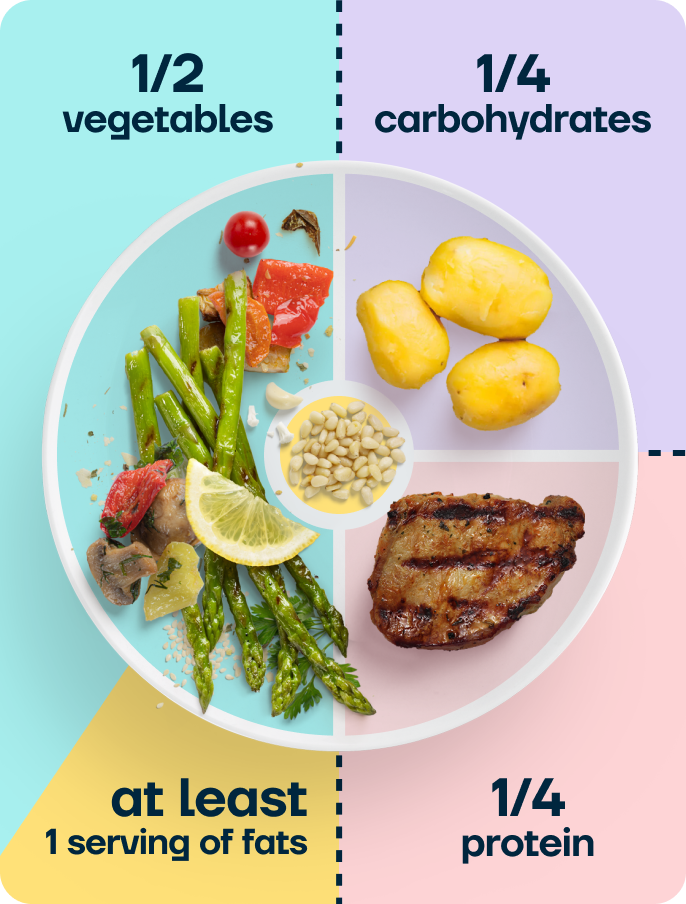
A balanced plate at every meal
Second Nature uses a balanced plate model: half vegetables, a quarter protein, a quarter complex carbohydrates, and a small serving of healthy fat.
Our whole-food approach works well with propranolol because the fibre, potassium, and unsaturated fats support blood pressure control, while the protein helps maintain muscle mass during weight loss.
- Vegetables: leafy greens, peppers, courgettes, broccoli, cauliflower, mushrooms, tomatoes, carrots
- Protein: chicken, turkey, fish, eggs, Greek yoghurt, tofu, lentils, beans
- Complex carbohydrates: wholegrain or sourdough bread, rolled oats, brown rice, sweet potato, quinoa, wholemeal pasta
- Healthy fats: extra virgin olive oil, avocado, nuts, seeds, oily fish
Foods and drinks to limit
A few of these are propranolol-specific:
- Alcohol can lower blood pressure further when combined with propranolol, and can worsen lightheadedness. If you drink, keep within UK guidelines (14 units a week, spread across the week) and watch for dizziness.
- Caffeine is fine in moderation, but high intakes can counteract propranolol’s effect on tremor and anxiety. If you take propranolol for either of these, reducing caffeine may help.
- Salt: season your food to taste; if it tastes too salty, you know to reduce it next time.
- Ultra-processed foods tend to be high in salt and refined carbohydrates and can increase side effects on GLP-1 medications like Mounjaro. They’re also low in the essential nutrients our bodies need to thrive.
Physical activity
Movement supports weight loss, blood pressure, and mood, all of which are relevant whether you take propranolol for cardiovascular reasons or for anxiety or migraine.
Getting started with propranolol
Propranolol blunts the heart rate response to exercise, which means your heart rate won’t rise as much as it would otherwise. That has two practical implications.
First, heart rate isn’t a reliable measure of exercise intensity on propranolol.
The ‘talk test’ is more useful: at a moderate intensity, you should be able to hold a conversation but not sing. At a vigorous intensity, you can speak only in short phrases.
Second, propranolol can make exercise feel harder, particularly during the first few weeks of treatment or after a dose increase. This usually improves as your body adapts.
If you’ve been on a stable propranolol dose for months or years, your exercise tolerance should already be settled.
A 10-minute walk after dinner is a practical first step. Research on habit formation suggests that linking a new behaviour to an existing routine helps it become automatic over time.5
Building strength
Resistance training helps maintain muscle mass during weight loss on Mounjaro, supports bone health, and improves blood pressure independently of cardio exercise. It’s safe on propranolol with the usual caveats:
- Start with bodyweight exercises like squats, wall push-ups, and seated rows
- Avoid holding your breath during heavy lifts, as this can cause sharp spikes in blood pressure
- Build up gradually over weeks rather than days
- If you feel lightheaded between sets, sit down and let your blood pressure recover before continuing
When to speak to your GP
Contact your GP, prescriber, or specialist team if you experience:
- Dizziness or lightheadedness when standing up, particularly during the first month of Mounjaro or after a dose increase
- A resting heart rate consistently below 55 bpm, or unusual shortness of breath at rest
- Symptoms of low blood sugar that you can’t easily identify (confusion, sweating without an obvious cause, unusual hunger), particularly if you also take insulin or a sulphonylurea
- A worsening of migraine frequency or anxiety symptoms during Mounjaro dose escalation
- Significant or rapid weight loss without expected reductions in blood pressure, which may mean your propranolol dose now needs adjusting
- Cold hands or feet, sleep disturbance, or low mood that started or worsened after combining the medications
If you experience chest pain, severe shortness of breath, fainting, or signs of a slow or irregular heart rhythm, call 111 for urgent advice or 999 if symptoms are severe.
Frequently asked questions
Is it safe to take Mounjaro with propranolol?
Yes, based on current evidence. There’s no direct interaction listed in the Mounjaro SmPC, and propranolol isn’t classed as a narrow therapeutic index drug, the category that needs extra monitoring.1
The two things to be aware of are the added blood pressure effects and that propranolol hides some of the warning signs of low blood sugar.
Will Mounjaro lower my blood pressure too much when I’m on propranolol?
It can, particularly during dose increases or once you’ve lost a meaningful amount of weight.
In SURMOUNT-1, tirzepatide reduced systolic blood pressure by an average of 6.8 mmHg compared to placebo.2
Your prescriber may reduce your propranolol dose as your blood pressure improves. Don’t adjust either medication on your own.
Will propranolol blunt my weight loss on Mounjaro?
Probably not in any meaningful way. Beta-blockers can cause modest weight gain (up to about 2 kg) through small reductions in metabolic rate and reduced activity tolerance.
Mounjaro produces an average weight loss of 16 to 22.5% of body weight in trials,6 so any blunting from propranolol is small in comparison.
Do I need to take propranolol at a different time after starting Mounjaro?
No. Continue with your usual timing. The slower stomach emptying from Mounjaro is greatest after the first dose and returns to normal within four weeks.1
Propranolol isn’t a drug where small changes in absorption produce meaningful changes in effect.
Can I take Mounjaro if I’m on propranolol for migraines?
Yes. There’s no interaction with Mounjaro, and weight loss may reduce migraine frequency in people whose migraines are linked to weight, sleep, or blood pressure.
Keep a record of migraine frequency for a month before starting Mounjaro, so you have something to compare against during dose escalation.
Will I notice low blood sugar if I’m on both medications?
If you take Mounjaro for weight management only, or alongside metformin, your risk of low blood sugar is very low.1
If you take Mounjaro alongside insulin or a sulphonylurea, propranolol can hide some of the early warning signs. Sweating, confusion, and unusual hunger are the symptoms to watch for.
Your diabetes team may want to reduce your insulin or sulphonylurea dose when you start Mounjaro to lower the risk of low blood sugar levels.
Can I stop propranolol once I’ve lost weight on Mounjaro?
Possibly, but never on your own. Propranolol should be stopped gradually because stopping suddenly can cause a rebound rise in heart rate and blood pressure, which can be dangerous if you’re being treated for angina or an irregular heart rhythm.
Your GP will guide the taper if your blood pressure has improved enough to consider it.
I take propranolol only as needed for performance anxiety. Does Mounjaro change that?
Not significantly. Continue taking it as your prescriber has directed.
During the first few weeks of Mounjaro, taking your propranolol dose 60 to 90 minutes before the event, rather than 30 minutes, allows for the slightly slower stomach emptying.1 This adjustment isn’t usually needed after the first month.
Can I drink alcohol on Mounjaro and propranolol?
Within UK guidelines and with caution. Both Mounjaro and propranolol can contribute to lower blood pressure, and alcohol adds to this.
If you drink, stay within the 14 units a week limit, spread across several days, and watch for lightheadedness or feeling faint.
Can I get Mounjaro on the NHS if I’m on propranolol?
Taking propranolol doesn’t disqualify you.
NHS access to Mounjaro is set by NICE (TA1026) at a BMI of 35 or higher with at least one weight-related condition, being rolled out in phases over 12 years.
The MHRA licence, which applies to private prescribing, is broader, covering a BMI of 30 or higher, or a BMI between 27 and 30 with at least one weight-related condition.1
Your GP can refer you to a specialist weight management service if you meet the NHS threshold, and your prescriber will coordinate with whoever manages your propranolol.
Our related guides cover Mounjaro with beta blockers, anxiety, and high blood pressure. Use the medication compatibility checker for other conditions and medicines.
Take home message
Mounjaro can be taken alongside propranolol. There’s no direct drug interaction, and propranolol isn’t the kind of drug the Mounjaro SmPC flags for extra monitoring.
The two things to be aware of are the added blood pressure effects, which usually work in your favour but can occasionally cause lightheadedness during Mounjaro dose increases, and that propranolol hides some of the warning signs of low blood sugar.
The low blood sugar effect of propranolol is only relevant if you take Mounjaro alongside insulin or a sulphonylurea for type 2 diabetes.
The practical guidance depends on why you take propranolol. For high blood pressure or heart conditions, monitor your blood pressure and heart rate at home and expect your prescriber to review your propranolol dose as you lose weight.
For migraines, essential tremor, or situational anxiety, your propranolol dose should stay stable.
The only adjustment may be the timing of as-needed propranolol during the first few weeks of Mounjaro.
Second Nature’s programme combines medication support with personalised guidance from registered dietitians and nutritionists, built around a balanced plate of vegetables, protein, complex carbohydrates, and healthy fats.
The same balanced plate model supports blood pressure control through fibre, potassium, and unsaturated fats.
A peer-reviewed study published in JMIR Formative Research found that active subscribers on Second Nature’s GLP-1RA-supported programme lost an average of 19.1% of their body weight at 12 months, with 77.7% achieving at least 10% weight loss.7
Tell your prescriber when you start Mounjaro so they can coordinate your propranolol dose if needed, and check your blood pressure at home during the first month and at each dose escalation.
Second Nature's Mounjaro and Wegovy programmes
Second Nature provides Mounjaro or Wegovy as part of our Mounjaro and Wegovy weight-loss programmes.
Why choose Second Nature over other medication providers, assuming you're eligible?
Because peace of mind matters.
We've had the privilege of working with the NHS for over eight years, helping people across the UK take meaningful steps toward a healthier, happier life.
Our programmes are designed to meet people where they are, whether that means support with weight loss through compassionate one-to-one health coaching, or access to the latest weight-loss medications (like Mounjaro and Wegovy) delivered alongside expert care from a multidisciplinary team of doctors, psychologists, dietitians, and personal trainers.
At the heart of everything we do is a simple belief: real, lasting change comes from building better habits, not relying on quick fixes. We're here to support that change every step of the way.
With over a decade of experience, thousands of lives changed, and a long-standing record of delivering programmes used by the NHS, we believe we're the UK's most trusted weight-loss programme.
We hope to offer you something invaluable: peace of mind, and the support you need to take that first step.