What did the brain-disorder study find?
Lev and colleagues published their study in Clinical Nutrition in 2026. They examined reports of Wernicke encephalopathy involving GLP-1 medicines, combining a U.S. drug-safety database with a literature review and a case from their own centre.1
They identified 15 cases: 13 from the reporting database, one from published literature, and one from their centre. Thirteen described rapid weight loss, vomiting, reduced appetite, or malnutrition.1
Wernicke encephalopathy was reported more often than expected for GLP-1 medicines, based on how often it was reported for other medicines in the same database.1
This comparison only tells us what was reported. It can’t show how often the condition occurs among all GLP-1 users or prove that the medicines caused it.
Why this doesn’t tell us how likely it is to happen
The database contains reports submitted when someone suspects a medicine may be involved in a health problem. It doesn’t follow everyone taking the medicine, and submitting a report doesn’t establish that the drug caused the event.3
Reporting can increase after publicity, some events go unreported, and medical details may be incomplete. Other illnesses, medicines, or pre-existing nutritional problems can also contribute.3
A higher proportion of reports therefore doesn’t mean the same increase in risk among people taking the drug. We can’t calculate a reliable rate by dividing these 15 cases by the number of prescriptions either.3
The study can’t tell us how common Wernicke encephalopathy is. However, it gives clinicians a reason to consider thiamine deficiency when someone taking a GLP-1 medicine is vomiting repeatedly or eating very little.
If neurological symptoms develop, Wernicke encephalopathy needs urgent treatment to reduce the risk of permanent brain damage.1,5
A published case of severe undernutrition
A 2024 case report described a 37-year-old man taking Ozempic who developed nausea, vomiting, and reduced appetite. He lost around 32 kg over three months, then developed difficulty speaking and swallowing and abnormal eye movements.4
Losing 32 kg in three months while vomiting and struggling to eat is not healthy or sustainable weight loss. Based on the information reported, this pattern should never have been allowed to continue until neurological symptoms developed.
He needed closer medical and nutritional support to manage the side effects, maintain an adequate food and fluid intake, and lose weight at a safer rate. His prescriber should also have reviewed the dose and whether it was safe for him to continue taking Ozempic.
Doctors diagnosed Wernicke encephalopathy from his symptoms and brain scan. Several symptoms improved after intravenous thiamine, although he still needed support with swallowing.4
No blood thiamine result was reported, but this doesn’t rule out Wernicke encephalopathy. No single blood test can reliably confirm or exclude the condition, and clinicians shouldn’t delay treatment while waiting for results.2,5
The report doesn’t include a detailed dietary assessment, and other health problems may have contributed. We therefore can’t say that Ozempic was the sole cause.4
However, that uncertainty doesn’t change the fact that repeated vomiting, inadequate food intake, and a loss of 32 kg in three months should have prompted his healthcare team to review and change his treatment before neurological symptoms developed.4
The case report doesn’t explain what follow-up he received. However, people taking GLP-1 medicines need regular clinical and nutritional support, particularly when side effects prevent them from eating.
Healthcare teams should monitor symptoms and food intake alongside weight loss, and change the dose or treatment when someone’s nutrition is being compromised.
How could thiamine deficiency affect the brain?
Thiamine helps our cells use glucose and other nutrients to produce energy. Without enough of it, this process becomes less efficient, and our cells can struggle to work normally.2 This can affect the parts of the brain involved in memory, coordination, and eye movements.
The brain is particularly vulnerable because it needs a continuous energy supply, and severe deficiency can cause the neurological changes known as Wernicke encephalopathy.2
Without prompt treatment, Wernicke encephalopathy can leave lasting memory problems and can be fatal.5
Our bodies store only small amounts of thiamine, so we need to get it regularly from foods such as pork, whole grains, beans, lentils, and nuts.
If someone eats very little thiamine for several weeks, the body can use up its small thiamine stores. This can happen sooner if their diet was already low in thiamine before a change in intake, such as when someone starts taking GLP-1 medications.
Wegovy and Ozempic contain semaglutide, which mimics a hormone called GLP-1. Mounjaro contains tirzepatide, which mimics two hormones, GLP-1 and GIP.
These medicines reduce appetite and can cause nausea and vomiting as side effects.7
If someone repeatedly vomits or eats very little, they may struggle to obtain enough thiamine. Over time, inadequate intake could lead to deficiency and, if severe, neurological illness.2,6
Studies haven’t shown that these medicines directly block thiamine absorption. Slower stomach emptying alone doesn’t establish that nutrients can’t be absorbed, and the reported cases don’t prove direct toxicity to brain cells.1
GLP-1 medicines can contribute to thiamine deficiency without blocking its absorption. Nausea, vomiting, and loss of appetite can reduce how much someone eats, leaving them with too little thiamine. Their prescriber should review the side effects and whether the dose or treatment needs changing.
Thiamine deficiency can also occur without these medicines, including with prolonged vomiting, severely restricted diets, and after some types of weight-loss surgery. Alcohol dependence is one risk factor, but it isn’t required for the condition to develop.2,6
Can people lose weight without improving their diet?
People can lose weight on GLP-1 medicines without improving the nutritional quality of what they eat. The CRAVE study, published in 2026, followed people starting Wegovy or Zepbound, the U.S. weight-management brand of Mounjaro.8
Participants didn’t receive a structured nutrition intervention. Weight fell during treatment, but overall diet quality didn’t improve in the 28 people analysed over 24 weeks.8
The average diet-quality score changed from 59.3 to 55.4 out of 100. The score measures how closely someone’s diet follows dietary recommendations. It fell by 3.9 points, but with only 28 people, the researchers couldn’t tell whether diet quality had actually worsened or the difference was due to chance.8
Still, the group ate less and lost weight without improving what they ate. For these participants, taking a GLP-1 without structured nutrition support didn’t lead to a healthier diet.
Reported intakes of several vitamins and minerals fell. However, the researchers didn’t take blood samples, so they couldn’t tell whether any participants developed a deficiency. Only 28 of the 43 participants completed the 24 weeks. The study also relied on food records, which can identify broad dietary patterns but don’t measure intake precisely, and it had no untreated comparison group.8
This small study can’t tell us how many people improve their diets while taking GLP-1 medicines. Still, it does show that weight loss can occur without better food choices.
If someone continues eating the same poor-quality diet in smaller amounts, they’ll eat even less protein, fibre, vitamins, and minerals than before, which will inevitably lead to health complications over time,
As more people use GLP-1 medicines, healthcare teams are likely to see more nutrition-related complications unless dietary assessment and support become routine parts of treatment.
Some people do change their eating habits
For example, the sugar content of purchased foods fell from 15.7 g to 15.1 g per 100 g. The improvements were modest, and shopping receipts can’t tell us what each person ate or whether their diet met their nutritional needs.9
However, the findings show that diet quality doesn’t inevitably decline when someone starts a GLP-1 medicine. These households bought slightly healthier foods, although the study can’t tell us whether this was a deliberate change or what prompted it.
Taken alongside the previous study, the message is clear: GLP-1 medicines can reduce how much someone eats, but they don’t determine diet quality.
Some people may improve their food choices, while others continue eating the same foods in smaller amounts. That’s why nutrition support should be part of GLP-1 treatment, not left to chance.
The study took place in Denmark, so the findings may not apply directly to countries with different healthcare systems and food environments, including the U.S.9
What does wider nutrient-deficiency research show?
Broader research suggests people may consume less protein, vitamins, and minerals after starting GLP-1 medicines, but we don’t yet know how often this leads to a diagnosed deficiency.
Most studies record what people eat rather than measuring nutritional status through clinical assessments and blood tests. Food records can show that someone reports eating less of a nutrient, but they can’t confirm that the person has become deficient.
| What researchers measure |
What it can show |
What it can’t establish alone |
| Food records |
Estimated nutrient intake and dietary patterns |
Whether someone has a clinical deficiency |
| Blood nutrient measurements |
Biochemical evidence that helps assess nutritional status |
The cause of a low result or a diagnosis from every result |
| Diagnoses in medical records |
Problems identified and recorded during care |
Every person’s nutritional status before and after treatment |
| Adverse-event reports |
Potential problems that warrant investigation |
The frequency of a problem among all medicine users |
Low intake of some nutrients doesn’t mean everyone is low in B1
A 2025 study collected three-day food records from 69 people taking GLP-1 medicines. Average intakes of several nutrients, including fibre, calcium, and magnesium, were below the U.S. daily reference values used for comparison.10
However, average thiamine intake was 1.4 mg a day, above the study’s 1.2 mg reference value. That doesn’t tell us whether each person ate enough B1, because the average combines people with higher and lower intakes.10
The study included no pre-treatment measurements or blood tests to establish deficiency, and it didn’t include supplements in the nutrient totals. Supplement retailer GNC funded the study, and its employees conducted the research.10
Medical records suggest a possible increase in nutritional problems
A larger study examined insurance records for 461,382 people starting GLP-1 treatment. Within a year, 22.4% had a recorded nutritional deficiency or related complication, a broad category that included problems such as dehydration.11
That figure isn’t the percentage who developed a vitamin deficiency caused by their medicine. Having no previously recorded deficiency doesn’t mean everyone had normal nutrient levels before treatment.11
In a smaller comparison involving 4,505 people in each group, 18.6% taking a GLP-1 medicine with metformin had a recorded nutritional deficiency or related complication within a year, compared with 16.5% taking metformin alone.11
The researchers matched the groups on several characteristics, but people tested more often are more likely to have a deficiency recorded. Other health differences could also contribute.11
Most participants were living with type 2 diabetes, so the findings may not apply directly to people using medication solely for weight loss.11
Several authors worked for Abbott, including its nutrition business. These commercial interests should be considered alongside the study’s methods and limitations.11
Thiamine deficiency during rapid weight loss isn’t unique to GLP-1 medicines
A 2012 weight-loss study in people living with type 2 diabetes found that a blood marker of thiamine status fell among those consuming 1.1 mg of thiamine a day, even though this met the recommended intake. The marker remained stable among those consuming 2.8 mg a day.12
The diets differed in their protein and carbohydrate content and food sources, so the study can’t tell us that everyone needs 2.8 mg of thiamine or should take a supplement. It also measured a change in thiamine status rather than a diagnosed deficiency or Wernicke encephalopathy.12
However, the findings show why weight-loss treatment can’t focus solely on eating less. When someone’s appetite and food intake fall, the nutritional quality of what they still eat becomes even more important. They need regular meals based on nutrient-rich whole foods, even when they’re losing weight successfully.
At Second Nature, we recommend our members eat three balanced meals a day based mainly on whole foods, including protein-rich snacks in between meals if they’re losing weight too quickly (beyond 1-2lbs per week).
Do ultra-processed foods increase the risk of thiamine deficiency?
A diet based mainly on ultra-processed foods (UPFs) can make it harder to meet our nutritional needs. A meta-analysis of national dietary surveys found that higher consumption UPFs of was associated with lower intakes of fibre and several vitamins and minerals.13
However, the association with thiamine specifically wasn’t statistically significant. The research also wasn’t conducted specifically in GLP-1 users and didn’t measure Wernicke encephalopathy.13
Some processed foods supply thiamine through fortification, where nutrients are added during production. UK rules set a minimum thiamine content for most non-wholemeal wheat flour, so foods made with this flour can contribute B1.14
We therefore can’t conclude that ultra-processed foods caused the reported brain disorders. Someone could become undernourished while eating mostly whole foods if their portions were consistently too small or they were eating a restricted dietd diet, while a diet higher in ultra-processed foods could theoretically provide many of the essential nutrients we need through fortification.
Still, this doesn’t mean eating a diet based on ultra-processed foods is appropriate. For all-round health, we recommend eating a diet based mainly on whole foods to provide our body with everything it needs to thrive.
If we eat a varied diet based mainly on whole foods, we’re much more likely to provide our bodies with more than adequate levels of essential vitamins and minerals, even if we’re eating less to lose weight.
How to eat well when appetite is low
At Second Nature, we recommend eating a diet based on whole foods that contains enough protein, fibre, fat, and complex carbohydrates, and limits ultra-processed foods. This applies whether you’re taking weight-loss medication or not.
While it can be challenging to eat three meals a day when you’re less hungry, we recommend maintaining this eating pattern, even if you’re not hungry.
Work out why you’re eating less
If side effects like nausea or vomiting prevent you from eating three balanced meals a day or keeping fluids down, contact your prescriber. They should review your symptoms and decide whether your dose or treatment needs changing.
GLP-1 medicines also reduce hunger and quieten food noise, the constant intrusive thoughts about food. Some people may then inadvertently miss meals because hunger no longer reminds them to eat. Planning meals in advance and eating at set times can prevent this.
Some people deliberately restrict their food because they believe faster weight loss proves that the medication is working. Diet culture reinforces this belief, even when someone is already struggling to eat.
Losing weight rapidly isn’t healthy or sustainable. It increases the risk of losing muscle and getting too little protein, thiamine, and other essential nutrients.
Keep each meal balanced, even if the portion is smaller
For a main meal, we recommend using our balanced plate: half a plate of vegetables, a quarter of protein, a quarter of complex carbohydrates, and a source of fat.
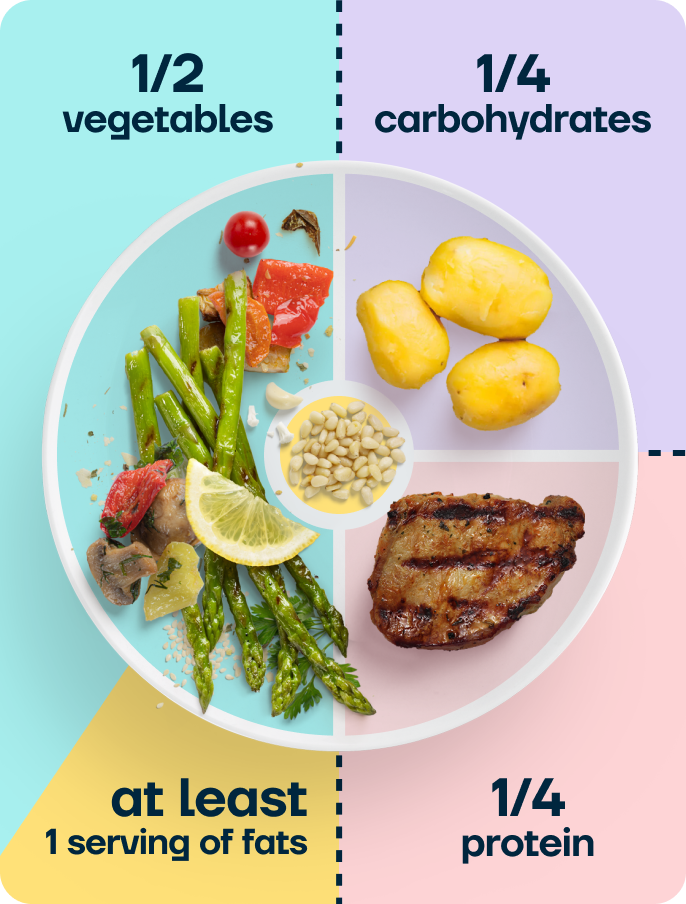
Aim for a palm-sized portion of protein, such as fish, meat, or tofu. Eggs, beans, lentils, and Greek yoghurt are other useful sources.

Pork, wholegrains, beans, lentils, peas, nuts, and seeds provide thiamine.6 Eating a range of these foods also provides protein, fibre, and other vitamins and minerals.
If you can’t finish a full meal, reduce the portion but keep the same balance. Eat three balanced meals a day, with protein-rich snacks between them if needed.
These Second Nature recipes provide protein, fibre, fat, complex carbohydrates, vitamins, and minerals:
- Peanut butter and jam oats, made with milk, berries, peanut butter, and chia seeds or milled flaxseed. Milled flaxseed is easier to digest than whole flaxseed. Add Greek yoghurt for more protein.
- Tomato soup, made with cannellini beans, carrots, tomatoes, cream, and olive oil. Serve it with wholegrain toast.
- Mediterranean cod tray bake, made with cod, potatoes, peppers, tomatoes, olives, and olive oil
If side effects like nausea or vomiting make it challenging to maintain a regular eating pattern, contact your prescriber. Changing what you eat won’t resolve side effects that need medical treatment.
Our guide to eating too little on Mounjaro expands on why it’s crucial to lose weight slowly on GLP-1 medications. Our Mounjaro meal plan provides examples of balanced meals across a full week.
Only take high-dose thiamine supplements on clinical advice
The current research doesn’t support recommending high-dose thiamine to everyone taking a GLP-1 medicine.
A clinician may recommend a supplement after reviewing your diet, symptoms, medical history, and any relevant blood tests. The type and dose should depend on what they find.
Supplements won’t stop persistent vomiting or make an unsuitable GLP-1 dose easier to tolerate. If the medication prevents you from eating regularly, your prescriber needs to review your treatment.
Confusion, difficulty walking, or abnormal eye movements after prolonged vomiting or very little food require urgent medical assessment.
Suspected Wernicke encephalopathy is usually treated in hospital with thiamine given into a vein, rather than an over-the-counter supplement.5
When to get medical help
Contact your prescriber or GP the same day if you’re repeatedly vomiting, can’t keep fluids down, or are consistently managing very little food. If they’re unavailable, contact NHS 111.7
Don’t wait for neurological symptoms to seek help for inadequate intake.
Sudden confusion, new difficulty speaking or walking, or sudden changes in vision need emergency assessment. Call 999 or go to A&E; don’t drive yourself.15
These symptoms can have several causes, including stroke, and shouldn’t be assumed to be a vitamin deficiency.15
Wernicke encephalopathy can involve confusion, poor coordination, and abnormal eye movements, but these don’t always occur together. Tell the medical team about recent vomiting, difficulty eating, weight loss, and any medication you’re taking.5
Your prescriber can review whether treatment needs adjusting. For example, Wegovy’s prescribing information allows for delaying a dose increase or returning to a previous dose when nausea, vomiting, or other digestive symptoms are severe; agree to any change with your prescriber.16
Frequently asked questions
Can GLP-1 medicines cause brain damage?
Severe thiamine deficiency can damage the brain, and cases have been reported during GLP-1 treatment.
The study discussed here raises concern about a possible nutritional cause; it doesn’t establish that these medicines directly damage brain cells.1,2
Can Ozempic or Mounjaro cause vitamin B1 deficiency?
They could contribute if reduced hunger or side effects lead to persistently inadequate thiamine intake. However, the available studies don’t show that everyone taking them becomes deficient or establish a direct block of B1 absorption.1,10
Can I become deficient without vomiting?
Prolonged inadequate intake can cause deficiency even without vomiting.6 If you’re regularly missing meals or only eating small amounts, discuss this with your prescriber or dietitian rather than waiting for additional symptoms.
Is brain fog a sign of Wernicke encephalopathy?
Difficulty concentrating alone can’t diagnose Wernicke encephalopathy. Persistent symptoms need assessment, and sudden confusion or new problems with speech, walking, or vision need emergency attention rather than self-treatment.5,15
Should everyone on GLP-1 medicines take vitamin B1?
These studies don’t establish a need for universal high-dose B1 supplementation. A prescriber or dietitian can assess whether dietary changes, supplements, or further investigation are appropriate for your intake and symptoms.
Which foods provide thiamine?
Wholegrains, meat, beans, lentils, and nuts provide thiamine. Some fortified foods also contribute.6,14 Include a wide variety of whole foods in your meals, because meeting B1 needs doesn’t mean the rest of your diet is adequate.
Does successful weight loss mean my diet is healthy?
Weight loss alone doesn’t establish that a diet meets nutritional needs. CRAVE found weight loss without improved overall diet quality, so reviewing food variety and intake remains useful even when weight is falling.8
Take home message
The evidence so far doesn’t show that GLP-1 medicines directly damage the brain. The more plausible link with Wernicke encephalopathy is severe thiamine deficiency after someone has been vomiting repeatedly or eating too little (or too few food sources containing thiamine due to a restricted diet).
Of the 15 reported cases, 13 described rapid weight loss, reduced food intake, loss of appetite, vomiting, or malnutrition.1 These reports can’t tell us how often Wernicke encephalopathy occurs, but they give prescribers clear warning signs to look for.
Healthcare teams should ask what someone is eating, whether they can keep food and fluids down, and how quickly they’re losing weight. Rapid weight loss shouldn’t be viewed as a success, particularly if an individual is also experiencing vomiting and other side effects impacting quality of life.
We recommend eating regular meals based on whole foods, with protein, vegetables, complex carbohydrates, and a source of fat.
Persistent vomiting needs prompt medical support. Confusion, difficulty walking, or abnormal eye movements after prolonged vomiting or very little food require urgent medical assessment, as Wernicke encephalopathy needs immediate treatment with thiamine.5
Second Nature combines medication support with personalised guidance from registered nutritionists and dietitians, helping people plan meals and develop eating habits that meet their needs.
A peer-reviewed service evaluation of Second Nature’s programme found an average weight loss of 19.1% at 12 months among completers who maintained an active subscription. Across all 179 completers, 77.7% achieved at least 10% weight loss.17
Second Nature's Mounjaro and Wegovy programmes
Second Nature provides Mounjaro or Wegovy as part of our Mounjaro and Wegovy weight-loss programmes.
Why choose Second Nature over other medication providers, assuming you're eligible?
Because peace of mind matters.
We've had the privilege of working with the NHS for over eight years, helping people across the UK take meaningful steps toward a healthier, happier life.
Our programmes are designed to meet people where they are, whether that means support with weight loss through compassionate one-to-one health coaching, or access to the latest weight-loss medications (like Mounjaro and Wegovy) delivered alongside expert care from a multidisciplinary team of doctors, psychologists, dietitians, and personal trainers.
At the heart of everything we do is a simple belief: real, lasting change comes from building better habits, not relying on quick fixes. We're here to support that change every step of the way.
With over a decade of experience, thousands of lives changed, and a long-standing record of delivering programmes used by the NHS, we believe we're the UK's most trusted weight-loss programme.
We hope to offer you something invaluable: peace of mind, and the support you need to take that first step.