What the TRIUMPH-1 trial found
Phase 3 (large-scale human trials with thousands of participants) is the late-stage phase that regulators rely on to decide whether to approve a new medication.
TRIUMPH-1 is the first Phase 3 trial in retatrutide’s obesity programme to report results.
The trial randomised 2,339 adults living with obesity, or with overweight and a weight-related health problem, all without type 2 diabetes.1
Participants were assigned in equal numbers to one of three retatrutide doses (4 mg, 9 mg or 12 mg) or to placebo, as a once-a-week injection for 80 weeks.
Lilly reported two average weight-loss figures for each dose, based on two ways of analysing the same trial (known as estimands).
The first is based only on people who stayed on treatment. On this measure, average weight loss at 80 weeks was 19.0% on 4 mg, 25.9% on 9 mg and 28.3% on 12 mg, compared with 2.2% on placebo.1
The second includes everyone who started, even those who later stopped. On this measure, the averages were 17.6%, 23.7% and 25.0%, compared with 3.9% on placebo.
The second figure is the more conservative one, and it’s closer to what tends to happen in a real-world group than only among people who complete a full course.
At the top dose, 45.3% of participants lost at least 30% of their body weight, and 65.3% reached a BMI below 30.1
| Weight loss reached |
4 mg |
9 mg |
12 mg |
Placebo |
| At least 25% of body weight |
27.8% |
52.9% |
62.5% |
2.2% |
| At least 30% |
15.3% |
37.9% |
45.3% |
0.5% |
| At least 35% |
5.9% |
20.8% |
27.2% |
0.3% |
A separate two-year extension followed participants with a BMI of 35 or higher who completed the main trial and tolerated their dose.
On the 12 mg pathway, average weight loss reached 30.3% at 104 weeks.
Waist circumference fell by an average of 24.1 cm at the top dose.
Lilly also reported improvements in non-HDL cholesterol, triglycerides, blood pressure and an inflammation marker called hsCRP.1
The most common side effects affected the gut, as with other GLP-1 medications.
Nausea affected 42.4% of people on the top dose, compared with 14.8% on placebo, and vomiting affected 25.3%, compared with 4.8%.1
Diarrhoea and constipation were also more common on retatrutide than on placebo.
About 1 in 9 people on the top dose (11.3%) stopped because of side effects, compared with 4.9% on placebo.
Lilly describes the overall safety profile as consistent with other medications in this class, such as Mounjaro and Wegovy.1
These are headline figures from the company, not yet the full published data, so the detailed results still need to be checked when they’re released.
How retatrutide works
Retatrutide is a once-a-week injection.
It’s the first weight-loss medication designed to mimic three of the hormones our bodies produce in response to food at once: GLP-1, GIP, and glucagon.2
GLP-1 (glucagon-like peptide-1) lowers hunger, slows down how quickly the stomach empties, and helps the pancreas release insulin after a meal.
GLP-1 is the hormone Wegovy, Ozempic, and Mounjaro all mimic.
GIP (glucose-dependent insulinotropic polypeptide) affects insulin sensitivity and how the body handles fat storage. Mounjaro mimics this hormone alongside GLP-1.
Glucagon is the third. It encourages the body to burn more fat and increases the energy it uses at rest.
Mimicking all three hormones is the reason retatrutide is described as a triple-hormone agonist (a drug that mimics three hormones rather than one or two).
Retatrutide reduces hunger through its GLP-1 component, similar to Wegovy and Mounjaro.
People taking these medications often describe a drop in ‘food noise’, the constant background thoughts about food that make eating harder to manage.
Retatrutide has earlier trial evidence to support its effectiveness, too.
A Phase 2 trial (a mid-stage human trial, typically involving a few hundred participants) published in the New England Journal of Medicine in 2023 reported an average weight loss of about 24% at 48 weeks with the highest dose.2
TRIUMPH-1 is the larger, longer trial that confirms those earlier results.
How it compares to Mounjaro and Wegovy
The most useful comparison is what the main Phase 3 trials of each medication have shown for weight loss in adults without type 2 diabetes.
| Medication (developer) |
Hormones it mimics |
Phase 3 trial |
Average weight loss at the top dose |
UK status |
| Retatrutide (Eli Lilly) |
GLP-1, GIP and glucagon |
TRIUMPH-1, 2,339 adults, 80 weeks |
Up to 28.3% at 12 mg, and 30.3% in a two-year extension in people with a BMI of 35 or higher1 |
Experimental; not yet submitted for approval anywhere |
| Mounjaro (Eli Lilly) |
GLP-1 and GIP |
SURMOUNT-1, 2,539 adults, 72 weeks |
22.5% at 15 mg3 |
MHRA-approved; available privately and on the NHS through a NICE-approved pathway |
| Wegovy (Novo Nordisk) |
GLP-1 only |
STEP UP, 1,407 adults, 72 weeks |
20.7% at 7.2 mg4 |
MHRA-approved; available privately and on the NHS through a NICE-approved pathway |
Retatrutide mimics three appetite and metabolic hormones, Mounjaro mimics two, and Wegovy mimics one.
The glucagon component is the part that neither Mounjaro nor Wegovy has.
It increases the body’s energy expenditure and changes how it handles fat, which is likely why retatrutide’s average weight loss was higher in its trial.2
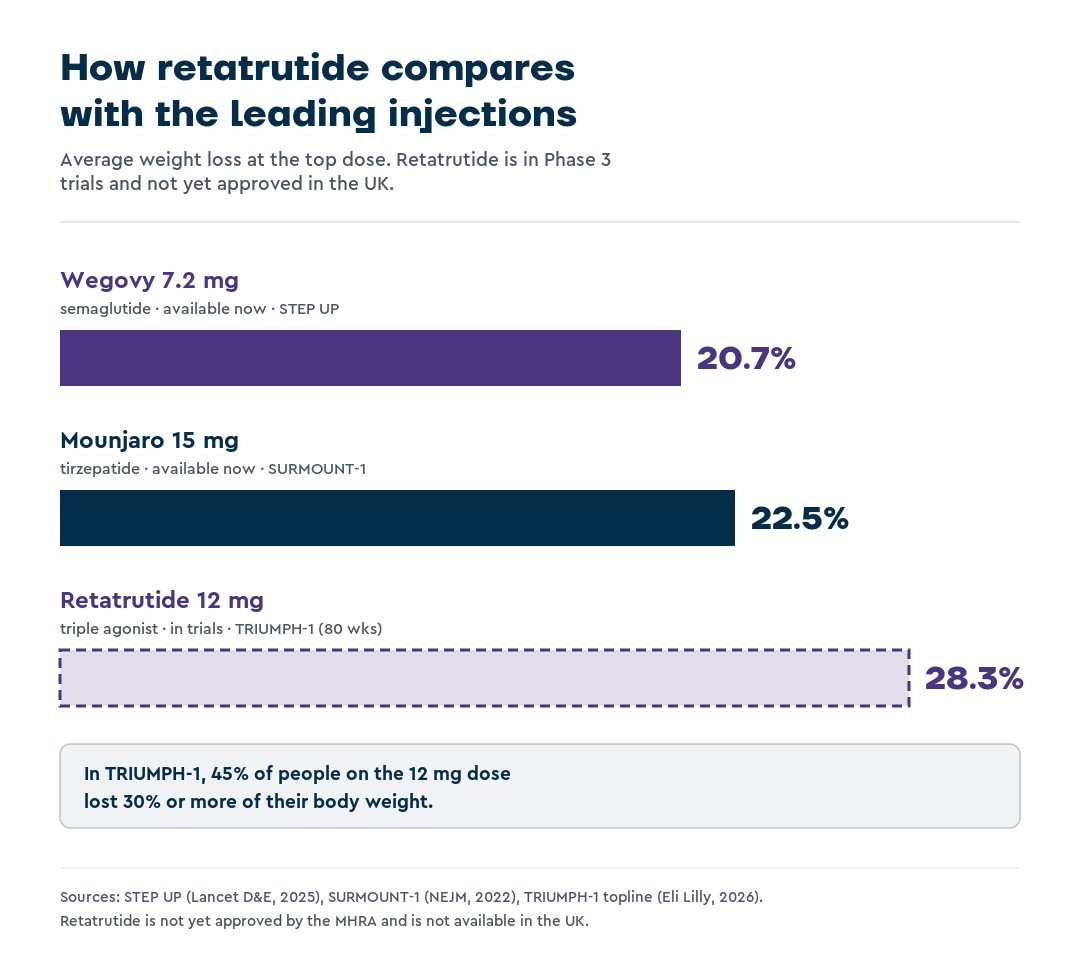
Retatrutide’s on-treatment average was 28.3%, compared with 22.5% for Mounjaro and 20.7% for Wegovy in their separate trials. The added glucagon component is likely the reason its average was higher.
These figures come from different trials, with different participants, durations and ways of reporting the results, so the comparison is indicative rather than a direct measurement.
There’s no head-to-head trial of retatrutide against Mounjaro or Wegovy, and none has been announced.
Our guides on retatrutide vs Mounjaro and retatrutide vs Wegovy go through the trial-by-trial detail.
When could retatrutide be available in the UK?
Eli Lilly hasn’t submitted retatrutide for approval for obesity in any major market.
A realistic timeline, based on where the Phase 3 programme is now, looks like this:
- FDA submission in the U.S.: late 2026 or 2027
- FDA approval: 2027 or 2028
- UK MHRA review: typically 12 to 24 months after FDA approval
- NHS access through a NICE appraisal: a separate process, usually 12 to 24 months after MHRA approval
The earliest UK private access through online pharmacies, mirroring how Mounjaro and Wegovy first launched here, is likely 2027 or 2028. NHS access would come later.
Two further Phase 3 trials are due to report later in 2026. TRIUMPH-2 is testing retatrutide in adults living with type 2 diabetes, and TRIUMPH-3 is looking at heart disease outcomes.1
Retatrutide doesn’t have a brand name yet. In trial documents, it’s referred to as retatrutide or by its development code, LY3437943.
Our guide on what retatrutide is covers the background of the drug and its development.
What this means if you’re on Mounjaro or Wegovy
In the short term, the TRIUMPH-1 results don’t change anything practical for people currently taking Mounjaro or Wegovy.
Retatrutide isn’t approved or available in the UK, and won’t be for some years.
More weight-loss medications are on the way. Mounjaro and Wegovy are already approved, and retatrutide, survodutide and mazdutide are all in late-stage trials.
With several effective options available, the choice is less about whether to take a medication and more about which one is the best fit for someone.
For now, the more useful question is whether your current medication is working for you.
If you’re losing weight at a sustainable rate, tolerating the side effects, and building habits alongside the medication, there’s little reason to switch.
If you’re not responding well to one GLP-1 medication, there are now more options to discuss with a healthcare professional.
Weight regain is also a common concern for those taking weight-loss medications, and that will be no different with retatrutide.
In SURMOUNT-4, people who stopped Mounjaro suddenly and switched to a placebo regained much of the weight they had lost, while those who continued taking it lost more.5
That pattern of regain is consistent across trials, particularly when people stop these medications suddenly before they’ve built the habits needed to maintain their new weight.
Whatever weight-loss medication you’re on, it’s essential to build healthy habits during treatment, and to come off slowly by reducing the dose gradually rather than stopping abruptly.
Still, we recommend talking to a healthcare professional before changing or stopping any prescribed medication.
At Second Nature, we recommend that our members stay on the lowest effective dose for as long as possible and receive habit-building support from registered dietitians to prevent future weight regain.
Second Nature has worked with the NHS since 2017, combining weight-loss medication with structured habit support from registered dietitians to help the weight loss last.
Take our 3-minute eligibility quiz, and a clinician will review your answers.
Limitations of the TRIUMPH-1 results
The results of TRIUMPH-1 have only come through a press release, not the publication of a peer-reviewed journal.
That means the full results, the subgroup data and the detailed side-effect breakdown aren’t yet available for analysis.
The trial enrolled adults living with obesity and without type 2 diabetes.
It doesn’t tell us how effective the drug is in people living with type 2 diabetes, or in people with established heart disease. Those are the questions TRIUMPH-2 and TRIUMPH-3 are designed to answer later in 2026.1
There’s no head-to-head comparison with Mounjaro or Wegovy, so the differences between the trials should be read with caution.
The 30.3% figure is a two-year result in a selected group: people with a BMI of 35 or higher who completed the main trial and tolerated their dose. It isn’t the average across everyone who started.
The trial was funded by Eli Lilly. It’s standard for Phase 3 trials to be sponsor-funded, but it’s useful context when the first figures come through a press release rather than a journal.
Our guide on retatrutide side effects covers what the trials have shown so far and how gut-related effects are typically managed.
Frequently asked questions
How much weight can you lose on retatrutide?
In TRIUMPH-1, people on the top 12 mg dose lost an average of 28.3% of their body weight over 80 weeks if they stayed on treatment, and 25.0%, including everyone who started.
In a two-year extension limited to people with a BMI of 35 or higher, average weight loss reached 30.3% at 104 weeks.
These are topline figures from Eli Lilly, not yet the full published data.
Is retatrutide better than Mounjaro?
In their separate trials, retatrutide’s top dose produced a higher average weight loss (28.3%) than Mounjaro’s (22.5% in SURMOUNT-1), a difference of roughly 6 percentage points.
No trial has directly compared the two, so this is an indirect comparison across trials rather than a measured difference.
Retatrutide mimics three hormones (GLP-1, GIP and glucagon), whereas Mounjaro mimics two (GLP-1 and GIP).
When will retatrutide be available in the UK?
Eli Lilly hasn’t submitted retatrutide for approval anywhere yet.
The earliest UK private access via online pharmacies is likely in 2027 or 2028, with NHS access following a NICE appraisal.
Can I buy retatrutide in the UK now?
No. Retatrutide isn’t approved or licensed in the UK or any other country, so it can’t be prescribed for weight loss.
Unlicensed ‘research’ versions sold online aren’t quality-controlled or intended for use in people, and we’d strongly recommend against using them.
How does retatrutide work?
Retatrutide is a once-a-week injection that mimics three hormones the body releases in response to food: GLP-1, GIP and glucagon.
GLP-1 and GIP reduce hunger and affect how the body handles fat and insulin, and the added glucagon component increases the energy the body uses at rest.
What are the side effects of retatrutide?
The most common side effects in TRIUMPH-1 were gut-related.
At the top dose, nausea affected 42.4% of people and vomiting affected 25.3%, with diarrhoea and constipation also more common than on placebo.
About 1 in 9 people on the top dose stopped because of side effects.
Is retatrutide approved by the MHRA or FDA?
No. Retatrutide is still investigational and hasn’t been submitted to the MHRA, the FDA, or any other regulator for approval.
What’s the difference between retatrutide and Wegovy?
Wegovy mimics one hormone (GLP-1), while retatrutide mimics three (GLP-1, GIP and glucagon).
In their separate trials, retatrutide’s top dose produced an average weight loss of 28.3%, compared with 20.7% for Wegovy 7.2 mg in STEP UP.
Does retatrutide cause muscle loss?
Any rapid weight loss, including weight loss from a GLP-1 medication, can include some loss of muscle as well as fat.
This risk of muscle loss is why we focus on getting enough protein and incorporating resistance exercise during treatment to help maintain muscle mass while losing weight.
Will you regain weight after stopping retatrutide?
Retatrutide’s withdrawal data hasn’t been published yet.
In trials of other GLP-1 medications, people who stopped suddenly without having built supporting habits regained much of the weight, so we recommend building habits during treatment and reducing the dose gradually rather than stopping abruptly.
Take home message
Eli Lilly reported on 21 May 2026 that retatrutide produced an average weight loss of up to 30.3% in its Phase 3 TRIUMPH-1 trial, the largest figure reported so far for a weight-loss injection.
That 30.3% is a two-year result in people with a BMI of 35 or higher.
In the main 80-week trial, the top dose produced an average of 28.3% among those who stayed on treatment, and 25.0% for everyone who started.
Retatrutide is the first medication to mimic three hormones, GLP-1, GIP and glucagon, rather than the one or two that current medications use.
In their separate trials, the top licensed doses of Mounjaro and Wegovy produced average reductions of 22.5% (SURMOUNT-1) and 20.7% (STEP UP), though no study has directly compared the three.
The side effects were the familiar nausea and sickness, and about 1 in 9 people on the top dose stopped because of them.
These are topline figures from the company, not the full published data, and retatrutide isn’t approved anywhere yet.
Realistic UK availability, first privately and then through the NHS, isn’t expected until 2027 or 2028.
If you’re already on Mounjaro or Wegovy and it’s working for you, this announcement doesn’t change anything practical today.
As more medications arrive, the more useful question is which one suits which person, and what someone is doing alongside it to make the weight loss last.
At Second Nature, we support members through medication-supported weight-loss programmes that combine support from registered dietitians with daily food and habit tracking and a strong focus on maintaining muscle mass during rapid weight loss.
The research suggests you’re more likely to avoid weight regain when a medication is combined with structured habit-change support than when it’s prescribed on its own.
Our published research found that members taking semaglutide alongside this support achieved an average of 19.1% weight loss at 12 months, with 77.7% reaching at least 10% weight loss.6
Second Nature's Mounjaro and Wegovy programmes
Second Nature provides Mounjaro or Wegovy as part of our Mounjaro and Wegovy weight-loss programmes.
Why choose Second Nature over other medication providers, assuming you're eligible?
Because peace of mind matters.
We've had the privilege of working with the NHS for over eight years, helping people across the UK take meaningful steps toward a healthier, happier life.
Our programmes are designed to meet people where they are, whether that means support with weight loss through compassionate one-to-one health coaching, or access to the latest weight-loss medications (like Mounjaro and Wegovy) delivered alongside expert care from a multidisciplinary team of doctors, psychologists, dietitians, and personal trainers.
At the heart of everything we do is a simple belief: real, lasting change comes from building better habits, not relying on quick fixes. We're here to support that change every step of the way.
With over a decade of experience, thousands of lives changed, and a long-standing record of delivering programmes used by the NHS, we believe we're the UK's most trusted weight-loss programme.
We hope to offer you something invaluable: peace of mind, and the support you need to take that first step.