What the new retatrutide study found
Retatrutide reduced breathing interruptions more than placebo in both trials, although adults living with type 2 diabetes experienced fewer improvements, possibly due to their baseline health being worse with their existing health condition.1
Retatrutide is a once-a-week injection that mimics three hormones: GLP-1, GIP, and glucagon.1
Retatrutide is unique in its triple action. Mounjaro (tirzepatide), for example, mimics two hormones (GLP-1 and GIP), while Wegovy (semaglutide) mimics one (GLP-1).4
Our guide to what retatrutide is covers how the drug was developed and how it works in more detail.
The 243 adults without diabetes were part of the larger TRIUMPH-1 trial, and the main paper published in September reported their results.5
The new paper analyses the results of 448 adults living with type 2 diabetes, around two-thirds of the 691 people in the two sleep apnoea trials.1
Both were phase 3 trials, which investigate how well a treatment works and how safe it is in large groups of people.
To join, people needed a body mass index (BMI) of 27 or higher and moderate-to-severe sleep apnoea, confirmed by an overnight sleep study.1,6 On average, their weight was around 116 to 120 kg.1
People already using continuous positive airway pressure (CPAP), a machine that keeps the airway open with pressurised air, could join if they stopped using it for about 7 days before each sleep study. Everyone else had to be unable or unwilling to use CPAP, so each sleep study measured breathing without it.6
Participants were randomly assigned to a weekly injection of retatrutide (4 mg, 9 mg, or 12 mg) or placebo for 80 weeks.1
The researchers counted how many times an hour each person’s breathing stopped or partly stopped during sleep. This is called the apnoea-hypopnoea index (AHI).1
The main results compared retatrutide 9 mg and 12 mg once a week with placebo, and the table below shows the average fall in AHI in each group.1
| Who took part |
Retatrutide 4 mg |
Retatrutide 9 mg |
Retatrutide 12 mg |
Placebo |
| Adults without diabetes |
22.9 fewer per hour |
34.3 fewer per hour |
31.7 fewer per hour |
9.9 fewer per hour |
| Adults living with type 2 diabetes |
19.2 fewer per hour |
24.7 fewer per hour |
25.4 fewer per hour |
10.3 fewer per hour |
People on placebo also had fewer breathing interruptions, so we need to subtract this improvement to see how much more retatrutide helped.1
At 9 mg and 12 mg once a week, retatrutide led to about 22 to 24 fewer breathing interruptions per hour than placebo in adults without diabetes, and about 14 to 15 fewer in adults living with type 2 diabetes.
At 4 mg, it was around 13 fewer in adults without diabetes and around 9 fewer in adults with type 2 diabetes.1
Adults without diabetes had an average weight loss of 12.5% to 22.2%, depending on the dose, compared with 4.8% on placebo. For someone starting at 120 kg, that’s around 15 to 27 kg, compared with around 6 kg.1
Adults living with type 2 diabetes had an average weight loss of 12.1% to 18.5%, compared with 5.6% on placebo.1
Digestive problems were the most common side effects in both trials.1
At a 2026 conference, Lilly reported that 4% to 11% of people on retatrutide stopped because of side effects, compared with 5% on placebo. That includes everyone in the TRIUMPH-1 trial, not only the people with sleep apnoea.7
The trials also set out to measure daytime sleepiness and how well people slept.6 The published summary of the results doesn’t report them, so we can’t yet say how much better people felt.
Our guide to retatrutide side effects covers what other retatrutide trials have reported.
Eli Lilly, which makes retatrutide, funded both trials.1
What is obstructive sleep apnoea?
Obstructive sleep apnoea happens when the airway behind our mouth and nose repeatedly narrows or closes while we’re asleep. Our breathing becomes shallower or stops for 10 seconds or more, even though we’re still trying to breathe.8
We then wake or move into lighter sleep so that breathing can start again. We may not remember waking, but this broken sleep can leave us feeling unrefreshed and sleepy during the day, and make it harder to concentrate.8
Sleep apnoea is more common in people living with obesity or overweight, and in people living with type 2 diabetes.8
NICE recommends an assessment for sleep apnoea when someone has two or more of these signs: snoring, pauses in breathing that someone else notices, choking during sleep, unrefreshing sleep, broken sleep or insomnia, waking headaches, waking at night to urinate, unexplained sleepiness or tiredness, and problems with memory or concentration.8
We’d recommend speaking to your GP if you recognise these signs.
NICE describes sleep apnoea as mild if our breathing stops or partly stops 5 to under 15 times an hour, moderate at 15 to under 30, and severe at 30 or more. At 30 times an hour, that’s once every 2 minutes on average.8
How obesity makes the airway more likely to close
Obesity is the main risk factor for sleep apnoea, partly because fat can build up inside our tongue and in the tissues around our throat.2,9
This fat build-up leaves less room for air to pass. When the muscles that keep our airway open relax during sleep, the narrowing from increased fat storage makes it more likely to close.8
Fat around our chest and abdomen may also reduce the amount of air our lungs hold between breaths.9,10
Our lungs normally pull down on our windpipe, helping to keep the airway above it open. With less air in our lungs, this pull is weaker, and our airway is more likely to collapse.10
A 2020 U.S. study examined the tongue directly. Researchers used MRI scans in 67 adults living with obesity and sleep apnoea, before and six months after an intensive lifestyle programme (49 people) or weight-loss surgery (18 people).2
On average, people lost 9.5% of their body weight, and their breathing interruptions fell by about 31%, although this varied widely from person to person.2
People who lost more fat from their tongue saw larger improvements in breathing, even after accounting for how much weight they’d lost.2
The researchers estimated that tongue fat accounted for about 30% of the link between weight loss and better breathing, so it’s clearly an important factor, but not the only one. Abdominal fat wasn’t associated with sleep apnoea. 2
This was a before-and-after study in which nobody took retatrutide, so it suggests why losing tongue fat might improve breathing, but it can’t directly show why retatrutide improved sleep apnoea.2
Why we think fat loss explains much of retatrutide’s effect on sleep apnoea
Fat loss likely explains much of retatrutide’s benefit, because reducing fat in the tissues around the airway makes it less likely to close.2,9
A 2016 trial of an older GLP-1 medicine, liraglutide 3.0 mg, in 359 adults living with obesity and moderate or severe sleep apnoea supports this.
Once the researchers accounted for how much weight people had lost, liraglutide made no clear difference in breathing, so weight loss appeared to explain its effect.11
This study was an additional post-trial analysis of a medicine that mimics one hormone and led to much less weight loss (an average of 5.7%), so it can’t tell us the same is true of retatrutide.11
Adults living with type 2 diabetes in the retatrutide trials lost less weight than adults without diabetes, up to 18.5% on average compared with up to 22.2%, and their breathing improved less.1
These results support our view that fat loss explains the improvements in sleep apnoea, although we can’t say losing less weight caused the smaller improvement, as the two groups took part in separate trials.1
We can’t tell how much of the improvement came from fat loss because no group lost a similar amount of weight without retatrutide.1
There may be other ways that retatrutide is impacting breathing and sleep apnoea, but we haven’t seen evidence of what those ways might be.
The trials also reported body weight, not fat in the tongue or throat, so our view also comes from the wider research on tongue fat.1,2
Lifestyle changes can also improve sleep apnoea. Sleep AHEAD compared an intensive weight-loss programme of diet and physical activity with diabetes education sessions in 264 adults living with overweight or obesity, type 2 diabetes, and sleep apnoea.12
After 1 year, people on the lifestyle programme had lost 10.7 kg on average and had 9.7 fewer breathing interruptions an hour than the education group.
By 10 years, people on the lifestyle programme had 4.0 fewer breathing interruptions an hour than the education group, which was no longer a clear difference, and only 134 people had a sleep study by then.12
Sleep apnoea had gone into remission (fewer than 5 breathing interruptions an hour) in 34.4% of the lifestyle group at 10 years, compared with 22.2% of the education group.12
Taken together, research consistently shows that weight loss, specifically fat loss, improves sleep apnoea, most likely because of fat loss around the tongue and lungs.
How retatrutide compares with Mounjaro for sleep apnoea
In adults without diabetes, Mounjaro reduced breathing interruptions by a similar amount in its own sleep apnoea trials, called SURMOUNT-OSA, but the two medications haven’t been compared directly.1,4,6,13
|
Retatrutide |
Mounjaro |
| Who took part |
691 adults: 243 without diabetes and 448 living with type 2 diabetes |
469 adults without diabetes |
| CPAP |
Both trials included people using CPAP and people unable or unwilling to use it |
One trial took people unable or unwilling to use it, the other took people using it |
| Starting breathing interruptions an hour |
Around 56 to 59 |
Around 50 to 52 |
| Weekly dose |
9 mg or 12 mg, the doses used for the main results |
10 mg or 15 mg, the highest dose each person could tolerate |
| Length of treatment |
80 weeks |
52 weeks |
| Average weight loss |
Up to 22.2% without diabetes and up to 18.5% with type 2 diabetes, across all doses |
17.7% to 19.6% |
| Fewer breathing interruptions per hour than placebo |
Around 22 to 24 without diabetes and around 14 to 15 with type 2 diabetes |
Around 20 to 24 |
| UK status |
Not approved |
Licensed for weight management and type 2 diabetes, not specifically for sleep apnoea |
We can’t use these figures to say which medication works better for sleep apnoea, because different people took part, treatment lasted longer with retatrutide, and people in the retatrutide trials started with more breathing interruptions.1,4
The Mounjaro trials also reported how many people reached fewer than 5 breathing interruptions an hour, or 5 to 14 without excessive daytime sleepiness, a level at which CPAP may not be recommended.
In the trial of participants not using CPAP, 42.2% reached this level on Mounjaro, compared with 15.9% on placebo. In the trial of people already using CPAP, it was 50.2% compared with 14.3%.4
People on Mounjaro also reported better sleep and fewer sleep-related problems during the day.4
The new retatrutide trials show that a weight-loss medication can also improve sleep apnoea in adults living with type 2 diabetes, who weren’t included in SURMOUNT-OSA.1,4
Our retatrutide vs Mounjaro guide covers how the two medications compare for weight loss.
The 80-week results also can’t tell us whether breathing improvements are maintained beyond this point. Realistically, this will depend on whether weight loss and lifestyle habits are maintained beyond this point.
What the retatrutide trials mean if you have sleep apnoea
If you’re using CPAP or other prescribed breathing support, keep using it while you talk to your GP or sleep service about losing weight.8
CPAP delivers pressurised air through a mask to keep our airway open while we sleep. NICE recommends it for moderate or severe obstructive sleep apnoea, alongside support to lose weight, stop smoking, cut down on alcohol, and improve sleep habits.8
If you can’t tolerate CPAP, your sleep service may consider a mandibular advancement splint, worn over your teeth at night, that holds your lower jaw forward to make more room at the back of your mouth.8
You may need CPAP alongside support to lose weight, because CPAP keeps our airway open while we use it, and weight loss can gradually reduce the fat that narrows it.8,9
We recommend eating a diet based on whole foods, that contains enough protein, fibre, fat, and complex carbohydrates, and limits ultra-processed foods.
Our balanced plate is half vegetables, a quarter protein, and a quarter complex carbohydrates, plus a serving of fat.
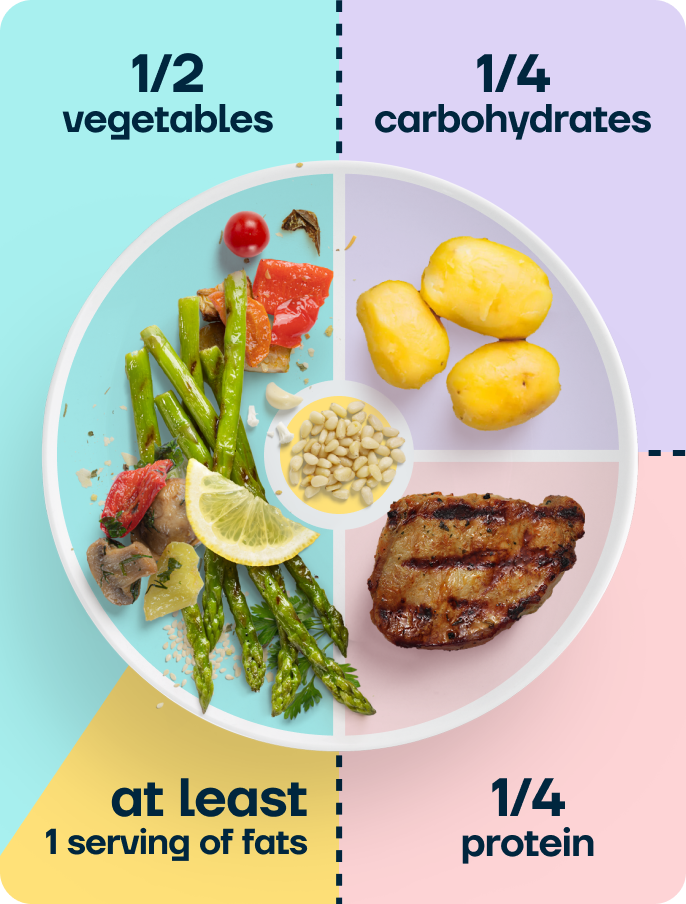
For example, that could be a palm-sized salmon fillet with broccoli, peppers, and a fist-sized portion of brown rice, cooked in olive oil.
Our meal plan generator provides more examples to help you plan your meals.
Mounjaro is licensed for weight management in adults with a BMI of 30 or higher, or a BMI of 27 to under 30 with a weight-related health condition, and Mounjaro’s UK prescribing information lists sleep apnoea as one of these conditions. It’s an option you can discuss with your prescriber, who’ll need to check whether it’s suitable for you.13
Some people will still need CPAP after losing weight. The way our jaw is formed, enlarged tonsils, and how our airway muscles respond during sleep also affect whether the airway closes, so weight loss on its own isn’t a guarantee of achieving remission of sleep apnoea.9,10
At the start of the trials, participants averaged around 59 breathing interruptions an hour without diabetes and around 56 with type 2 diabetes, which is severe sleep apnoea.1,8 At that level, sleep apnoea may persist, even after a significant reduction in breathing interruptions.
These are averages, so they can’t show who no longer needs treatment. There’s also no set amount of weight loss that guarantees sleep apnoea will go away.9
If you’ve lost weight and your sleep has improved, ask your sleep service to reassess you rather than stopping treatment yourself.
NICE advises that your sleep service can consider stopping treatment if sleep apnoea may have gone away, for example after significant weight loss. They can then check whether your symptoms return after at least 2 weeks, and consider another sleep study.8
Sleepiness also affects driving. You must tell the DVLA if you have confirmed moderate or severe sleep apnoea with excessive sleepiness, or suspected or confirmed mild sleep apnoea that has caused excessive sleepiness for at least 3 months.14
You must not drive until you’re free from excessive sleepiness, or until your symptoms are under control and you’re strictly following any necessary treatment.14
Retatrutide hadn’t been approved in the UK as of October 2026, so you can’t be prescribed it. The MHRA warns that products sold as retatrutide outside clinical trials are being supplied illegally and could pose serious risks to public health.3
Our guide to the risks of buying retatrutide online explains what these products can contain.
Take home message
After 80 weeks, retatrutide 9 mg and 12 mg once a week led to around 22 to 24 fewer breathing interruptions per hour than placebo in adults without diabetes, and around 14 to 15 fewer in adults living with type 2 diabetes.1
Fat loss likely explains much of this benefit, because losing fat from the tongue may help keep the airway open. This is supported by the wider research on fat loss and sleep apnoea.
Still, the trials can’t separate fat loss from other possible effects of retatrutide on breathing.
People started the trials with severe sleep apnoea on average. Even with far fewer breathing interruptions, they could still have sleep apnoea.1,8
If your sleep improves after losing weight, ask your sleep service to review your treatment before you stop CPAP.
Retatrutide isn’t approved in the UK, so these results don’t change the treatments available to you.3 Licensed weight-loss medicines such as Mounjaro, Wegovy (and the pill), or Foundayo are an option to discuss with your prescriber.13
At Second Nature, our registered dietitians and nutritionists support members through one-to-one messaging in our app, alongside prescribed medication where appropriate.15
Our programme doesn’t replace your sleep service, and we don’t provide retatrutide.
Our published JMIR study reported an average weight loss of 19.1% at 12 months among active subscribers on the semaglutide-supported programme. Among members with recorded 12-month weights, 77.7% lost at least 10% of their starting weight.15
Second Nature's Mounjaro and Wegovy programmes
Second Nature provides Mounjaro or Wegovy as part of our Mounjaro and Wegovy weight-loss programmes.
Why choose Second Nature over other medication providers, assuming you're eligible?
Because peace of mind matters.
We've had the privilege of working with the NHS for over eight years, helping people across the UK take meaningful steps toward a healthier, happier life.
Our programmes are designed to meet people where they are, whether that means support with weight loss through compassionate one-to-one health coaching, or access to the latest weight-loss medications (like Mounjaro and Wegovy) delivered alongside expert care from a multidisciplinary team of doctors, psychologists, dietitians, and personal trainers.
At the heart of everything we do is a simple belief: real, lasting change comes from building better habits, not relying on quick fixes. We're here to support that change every step of the way.
With over a decade of experience, thousands of lives changed, and a long-standing record of delivering programmes used by the NHS, we believe we're the UK's most trusted weight-loss programme.
We hope to offer you something invaluable: peace of mind, and the support you need to take that first step.
Frequently asked questions
Does retatrutide cure sleep apnoea?
Retatrutide made sleep apnoea less severe in the trials, but it hasn’t been shown to cure it.
People needed moderate-to-severe sleep apnoea to join the trials, and on average they started with severe sleep apnoea.
Some will have improved more than others. Only a reassessment can show whether someone’s breathing has returned to normal.1,8
Why can losing weight improve sleep apnoea?
Losing fat from our tongue seems to help, although researchers don’t yet know exactly how. It may make more room in the airway, or help the tongue muscles work better.2
Losing fat around our chest and abdomen may also allow our lungs to hold more air, so they pull down more strongly on our windpipe and help keep the airway open.10
Is obesity the only cause of sleep apnoea?
Obesity is the main risk factor for sleep apnoea, but it isn’t the only cause, and people with a BMI under 30 can have it too.16
The size and position of the lower jaw and enlarged tonsils can narrow the airway, and alcohol and sedative medicines may weaken the muscle response that keeps it open. This may be part of why some people continue to have sleep apnoea after losing weight.9,10
Can I stop CPAP if I lose weight?
You may be able to stop CPAP, the machine that keeps your airway open overnight, after losing weight, but only if your sleep service advises it.
Snoring less doesn’t confirm that sleep apnoea has gone away.9 NICE advises that your sleep service can check whether your symptoms return after at least 2 weeks without treatment, and consider another sleep study.8
Can Mounjaro improve sleep apnoea too?
Mounjaro led to around 20 to 24 fewer breathing interruptions per hour than placebo over 52 weeks in the SURMOUNT-OSA trials, which studied adults without type 2 diabetes.
In the UK, it’s licensed for weight management and type 2 diabetes, not specifically for sleep apnoea. Your prescriber will need to check whether it’s suitable for you alongside your sleep apnoea care.4,13
Is retatrutide better than Mounjaro for sleep apnoea?
We don’t know, because the two medications haven’t been compared directly for sleep apnoea. In their respective trials, different people took part, treatment lasted longer with retatrutide, and people in the retatrutide trials started with more breathing interruptions, so we can’t say one works better.1,4
Can I get retatrutide in the UK?
You can’t get retatrutide on prescription in the UK, because it hasn’t been approved as of October 2026.
The MHRA warns that products sold as retatrutide outside clinical trials are being supplied illegally and could pose serious risks to public health, so we’d strongly recommend against buying them.3
What are the side effects of retatrutide?
Digestive problems were the most common side effects in the sleep apnoea trials.
At a 2026 conference, Lilly reported that across the whole TRIUMPH-1 trial, 4% to 11% of people on retatrutide stopped because of side effects, compared with 5% on placebo, and 2.2% to 4.6% stopped because of digestive side effects, compared with 1.2% on placebo.1,7
How is sleep apnoea diagnosed?
NICE recommends a home sleep test called respiratory polygraphy, which records your breathing, oxygen levels, and snoring overnight to show how severe any sleep apnoea is.
Speak to your GP if someone notices pauses in your breathing, you wake up choking, or you have daytime sleepiness that doesn’t go away.
They may use a questionnaire such as the Epworth Sleepiness Scale, which scores how likely you are to doze off in everyday situations, and can refer you to a sleep service.4,8