Jump to: What the new scans found | The same pattern appears in the published trials | Why you still lose some muscle | How to maintain muscle mass while taking Mounjaro or Wegovy | Frequently asked questions | Take home message | References
Most of the weight people lose on Wegovy and Mounjaro is fat, not muscle.
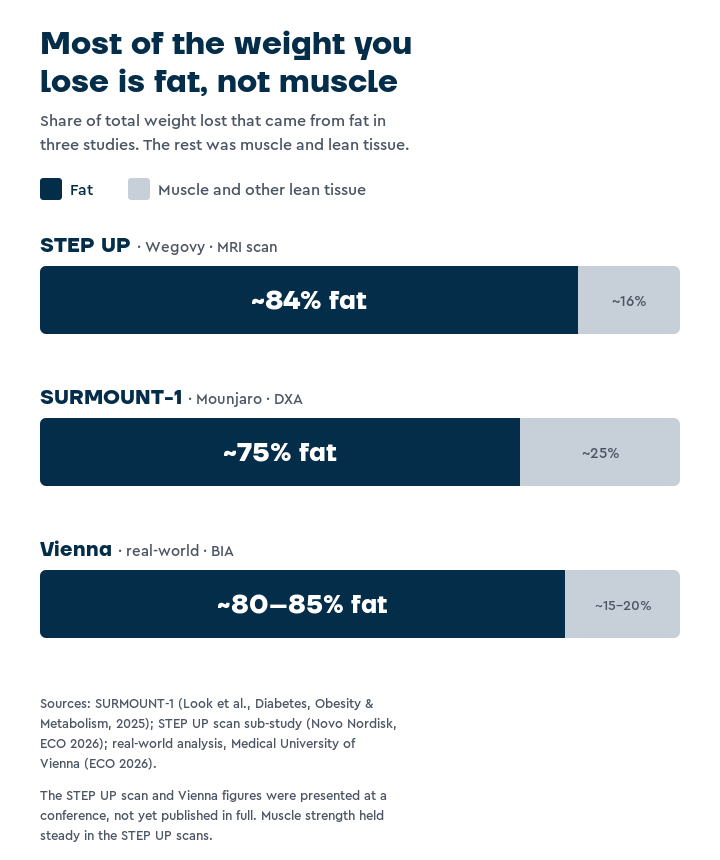
New body scans presented at the 2026 European Congress on Obesity found that around 84% of the weight lost on Wegovy came from fat, and that people were no weaker on a muscle strength test.1
The scans came from the STEP UP trial of Wegovy’s higher 7.2 mg dose, and were shown at the congress in Istanbul in May.1,2
A separate real-world analysis of 486 people from the Medical University of Vienna, presented at the same meeting, showed the same results.7
One of the most common concerns about GLP-1 medications (which has been overexaggerated in the media) is that they make you lose muscle as well as fat.
The newer evidence suggests that concern is overstated. You do still lose some muscle, but the majority of the weight you lose is fat.
Additionally, by eating a diet based on whole foods rich in protein, losing weight at a slow pace, and doing resistance training, you can largely prevent the majority of muscle loss during weight loss.
Important safety information: Mounjaro (tirzepatide) and Wegovy (semaglutide) are prescription-only medications for managing obesity. This article is for informational purposes only. Always consult your healthcare professional before starting, stopping, or changing a medication.
What the new scans found
In the STEP UP scan sub-study, 55 participants underwent detailed body MRI scans before and after their time on Wegovy. Around 84% of the weight they lost was fat.1
Their muscle mass fell by about 10% from the start, but their muscle strength didn’t decline with it.
On a 30-second sit-to-stand test, the group on Wegovy performed as well as the placebo group.1
Common scales can’t separate fat from muscle, which is part of why people worry about losing muscle. An MRI scan can tell the two apart, and it showed that most of the weight lost was fat.
These are early findings, presented as a conference poster rather than a published paper, so we need to approach these results with caution until the research is published in a peer-reviewed journal.1
Still, the Vienna analysis followed 486 people for about 14 months, most of whom were on Wegovy or Mounjaro.7
Fat accounted for roughly 80-85% of the weight they lost, and relative muscle mass was maintained or increased in more than 70% of them.7
It used a simpler body composition method than MRI scans and was also presented at the congress rather than published in full. But when two different methods show similar results, the findings are more reliable.
Existing trials show most weight loss is fat, not muscle
The new scans match the trial evidence already published.3,4
In a body-composition substudy of the SURMOUNT-1 trial of Mounjaro, fat mass decreased by 33.9% and muscle mass by 10.9% over 72 weeks. About 75% of the weight lost was fat, and 25% was lean tissue (not all lean tissue is muscle).3
The independent SEMALEAN study followed 106 people on Wegovy for a year.4
Fat mass dropped by 18% over the year. Muscle mass fell by about 3 kg in the first seven months and then stabilised, while handgrip strength improved.4
Interestingly, the share of people who met the definition of sarcopenic obesity, meaning low muscle combined with obesity, fell during the weight loss period, from 49% to 33% over the year.4
The proportions are similar across Mounjaro and Wegovy, and across the higher and lower doses. That suggests the pattern comes from the weight loss itself rather than any single medication.
| Study |
Medication |
Share of weight lost as fat |
| SURMOUNT-1 (DXA scan) |
Mounjaro |
About 75% |
| STEP UP (MRI sub-study) |
Wegovy |
About 84% |
| Vienna real-world analysis |
Wegovy or Mounjaro |
About 80 to 85% |
Why you still lose some muscle
Some muscle loss is normal with any weight loss, whether through traditional ‘dieting’, surgery, or medication.
Across the published GLP-1 trials, lean tissue accounts for around a quarter of the total weight lost.
Not all of that lean tissue is muscle.
Lean tissue is everything in our body that isn’t fat. That includes water, our organs, bone, and the non-fat tissue stored within our body fat.
So the actual amount of muscle lost is smaller than the lean-tissue figure suggests.
Research shows that when you lose weight quickly, or lose a large amount, the actual amount of muscle you lose is greater, even though the proportion of fat to muscle stays similar, or improves.
Still, some people should pay more attention to maintaining their muscle than others. Older adults, anyone who started with low muscle mass, and those living with a bone, muscle, or joint condition, such as osteoporosis or arthritis.
The risk of muscle increases on the highest doses. When people lose 20% or more of their body weight, the amount of muscle lost is larger (particularly if the rate of weight loss exceeds 1lb per week), even though the proportion that comes from fat stays much the same.
Muscle is crucial for your health, not just your strength. Most of the sugar from a meal is taken up by your muscles, which helps keep your blood sugar steady. Muscle also keeps you mobile and independent as you get older.
How to maintain muscle mass while taking Mounjaro or Wegovy
There are a few key habits that we recommend on the Second Nature programme that support our members maintain muscle mass while losing weight.
Losing weight at a steady pace
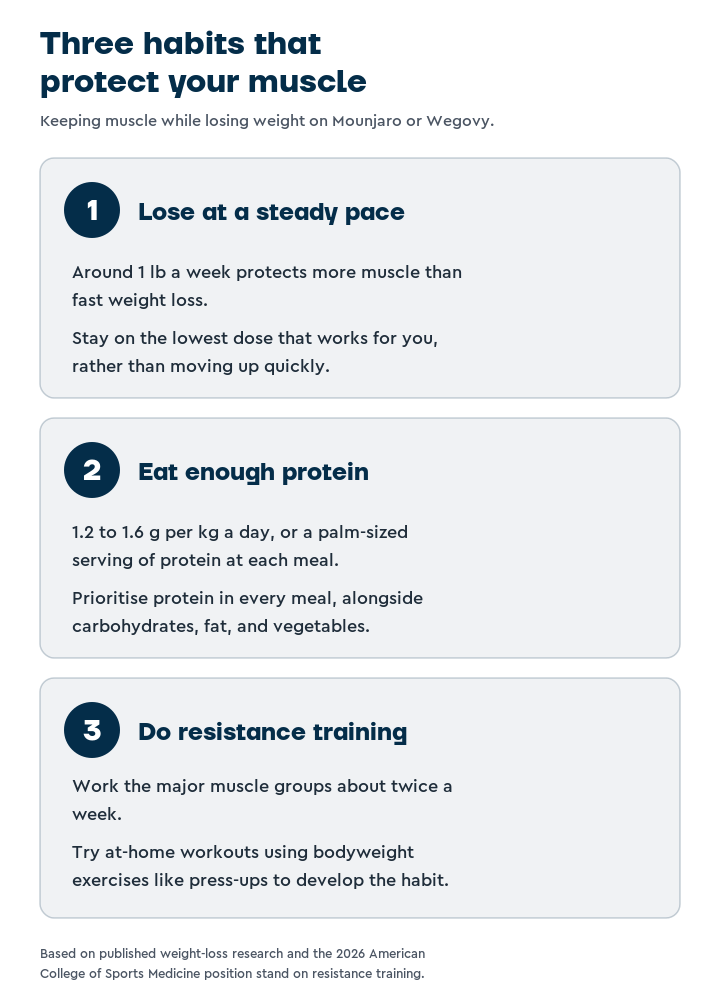
When you lose weight quickly, a greater share of it comes from muscle. A steady rate of around 1 lb a week protects more muscle as you lose weight.
To achieve a slower rate of weight loss on Mounjaro or Wegovy, we recommend staying on the lowest effective dose for as long as possible.
Many of our members stay on lower doses and still achieve significant weight loss without losing excess muscle.
Eating enough protein
Research on adults losing weight points to 1.2 to 1.6 grams of protein per kilogram of body weight a day.
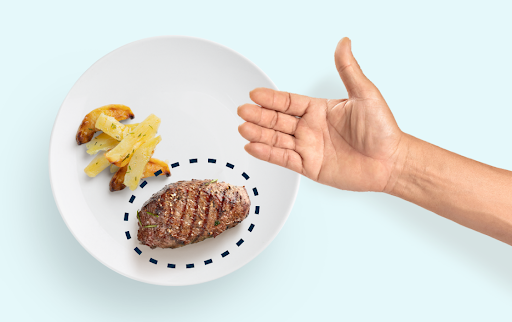
For someone weighing 90 kg, that’s around 110 to 145 grams a day, or a serving the size of the palm of your hand at each meal.
Protein needs rise while you’re losing weight, which is why our protein recommendation is higher than the usual adult recommendation.
Wegovy and Mounjaro reduce appetite and quieten food noise, so most people feel full before they’ve eaten enough protein.
So, we recommend prioritising building your meal around a quality protein source, and opting for easy-to-digest protein sources, like minced beef or scrambled eggs, if you’re struggling to eat enough.
Eggs, Greek yoghurt, chicken, fish, tofu, beans, and lentils are all other excellent sources.
Resistance training
Resistance training is any exercise that works your muscles against resistance, from bodyweight squats and press-ups to resistance bands and weights.
The 2026 American College of Sports Medicine review, which pooled 137 research reviews covering more than 30,000 people, found that working the major muscle groups around twice a week builds and maintains muscle and strength.5
If you’re new to strength training, try at-home workouts that use bodyweight exercises so you don’t need to purchase any equipment.
You could also try ‘snacking on exercise’ throughout the day by doing calf raises while the kettle boils, or press ups each time you’ve been to the toilet.
Of the three habits, resistance training is the one most likely to build muscle rather than just preventing its decline during weight loss.
Our GLP-1 muscle and protein planner turns the protein and training targets into a daily plan, and our guide to exercise on Mounjaro covers simple ways to start.
Second Nature has worked with the NHS since 2017, pairing Mounjaro with registered dietitian support to help you lose fat while holding on to muscle.
Take our 3-minute eligibility quiz, and a clinician will review your answers.
Frequently asked questions
Do you lose muscle on Mounjaro or Wegovy?
You lose some muscle and lean tissue, as you would with any weight loss. Across the trials, around a quarter of the total weight lost is lean tissue, and the rest is fat.3
Is the weight you lose on Wegovy fat or muscle?
Mostly fat. In the STEP UP scan sub-study, around 84% of the weight lost on Wegovy came from fat.1
How much muscle do you lose on Wegovy or Mounjaro?
In the scans reported above, muscle mass fell by about 10% from the starting point on Wegovy, and by 10.9% over 72 weeks on Mounjaro in the SURMOUNT-1 sub-study.1,3
Despite that drop in lean mass, the people in these studies were no weaker on the strength tests.1
How do I keep muscle while taking Mounjaro or Wegovy?
Three things help: losing weight at a steady pace on the lowest effective dose, eating enough protein, and doing some resistance training.
How much protein should I eat on Mounjaro or Wegovy?
Research on adults losing weight points to 1.2 to 1.6 grams of protein per kilogram of body weight a day, or a serving the size of the palm of your hand at each meal.
Does losing weight quickly cause more muscle loss?
Research shows that faster, larger weight loss tends to mean a greater actual amount of muscle lost, even though the proportion of fat to muscle stays similar.
Do I need to lift weights to keep muscle on these medications?
It helps more than anything else. Of the three habits, resistance training is the one most likely to add muscle back rather than just slow its loss.5
Bodyweight exercises such as squats and press-ups work well, and short sessions a couple of times a week are a good start.
Will I lose muscle if I’m older and taking Mounjaro or Wegovy?
Older adults have higher protein requirements and are more at risk of losing muscle during weight loss, because muscle is harder to rebuild with age.
Eating enough protein and doing some resistance training will help to prevent muscle loss.
Does muscle come back after stopping the medication?
Muscle responds to protein and resistance training whether or not you’re on the medication.
So, by building a habit of doing some strength training once or twice a week, and eating enough protein, you’ll be able to increase muscle mass during and after weight loss.
Our guides cover what Wegovy is and how it works, average weight loss with Wegovy, and current UK prices.
Take home message
On Wegovy and Mounjaro, most of the weight people lose is fat, and muscle strength tends to stay the same or even improve.
Some loss of muscle mass still occurs, as it does with any weight loss. Eating enough protein, doing some resistance training, and losing weight at a steady pace on the lowest effective dose help to prevent muscle and lean mass loss on these medications.
If a fear of losing muscle has been putting you off these medications, it’s a manageable part of treatment, not a reason to avoid losing weight.
Second Nature’s medication programme combines Mounjaro with structured nutrition guidance from registered dietitians, built around the balanced plate model (half vegetables, quarter protein, quarter complex carbohydrates such as wholegrain bread, brown rice, or oats, plus a serving of fat).
Our peer-reviewed JMIR study reported an average weight loss of 19.1% at 12 months among active subscribers, with 77.7% achieving at least 10% weight loss.6
Second Nature's Mounjaro and Wegovy programmes
Second Nature provides Mounjaro or Wegovy as part of our Mounjaro and Wegovy weight-loss programmes.
Why choose Second Nature over other medication providers, assuming you're eligible?
Because peace of mind matters.
We've had the privilege of working with the NHS for over eight years, helping people across the UK take meaningful steps toward a healthier, happier life.
Our programmes are designed to meet people where they are, whether that means support with weight loss through compassionate one-to-one health coaching, or access to the latest weight-loss medications (like Mounjaro and Wegovy) delivered alongside expert care from a multidisciplinary team of doctors, psychologists, dietitians, and personal trainers.
At the heart of everything we do is a simple belief: real, lasting change comes from building better habits, not relying on quick fixes. We're here to support that change every step of the way.
With over a decade of experience, thousands of lives changed, and a long-standing record of delivering programmes used by the NHS, we believe we're the UK's most trusted weight-loss programme.
We hope to offer you something invaluable: peace of mind, and the support you need to take that first step.