Jump to: What the apitegromab trial found | Muscle loss isn’t unique to Mounjaro and Wegovy | Most of the weight you lose is fat, not muscle | How to protect muscle while you lose weight | Who might benefit from a muscle-protecting drug | Frequently asked questions | Take home message | References
A new drug called apitegromab reduced how much muscle people lost while losing weight on Mounjaro, in a phase 2 trial (mid-stage human trials, usually a few hundred participants) published in Nature Medicine on 8th June 2026.1
People who added apitegromab kept about 1.9 kg more lean mass than those on Mounjaro alone, while losing a similar amount of weight overall.1
Still, keeping that extra lean mass didn’t make them stronger based on the measurements of strength used in the trial.
Apitegromab improved body composition on a scan, but it made no measurable difference in grip strength or how easily people stood up from a chair.1,4
Many people on Mounjaro and Wegovy are concerned about losing muscle as well as fat, which is why a drug aimed at protecting muscle has drawn attention.
However, that concern is often bigger than the evidence justifies. Most of the weight people lose on these medications is fat, not muscle.
When muscle mass is reduced, it usually reflects how quickly someone is losing weight, and whether they eat enough protein and stay active, rather than anything unique to GLP-1 medication.
Important safety information: Apitegromab is an investigational drug. It is not approved in the UK or anywhere else for weight loss, and it isn’t available for prescription. Mounjaro (tirzepatide) and Wegovy (semaglutide) are prescription-only medicines for managing obesity. This article is for informational purposes only. Always consult your healthcare professional before starting, stopping, or changing any medication.
What the apitegromab trial found
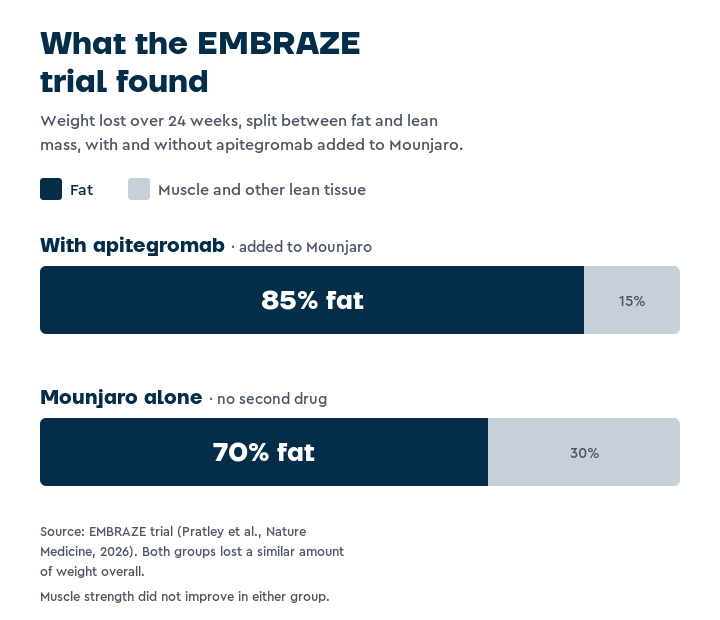
The trial, called EMBRAZE, gave 102 adults with overweight or obesity either Mounjaro plus apitegromab or Mounjaro plus a dummy injection for 24 weeks.1
Both groups lost a similar amount of weight, but the proportion of fat to muscle loss varied between groups.1
In the apitegromab group, about 85% of the weight lost was fat, and 15% was lean mass.1 In the Mounjaro-only group, it was 70% fat and 30% lean mass.1
Lean mass is the body tissue that isn’t fat. It includes muscle, bone, organs, water, and other non-fat tissue.
Apitegromab helped participants maintain about 1.9 kg more lean mass, which works out to roughly 55% less lean mass loss than with Mounjaro alone.1
Still, maintaining greater lean mass didn’t translate into greater strength, as measured by the strength tests used in the trial.
Participants on apitegromab performed no better on grip strength or on a test of standing up from a chair.1
A scan measures total lean mass, not muscle itself. So it isn’t certain that all the mass apitegromab preserved was working muscle, rather than water or other non-fat lean tissue. It’s also possible the trial was too short for a strength benefit to appear.
Apitegromab didn’t improve blood sugar control either, even though muscle plays a major role in maintaining steady blood sugar levels.1,4
Dr Marie Spreckley, an obesity researcher at the University of Cambridge who was not involved in the trial, described the findings as “encouraging early evidence rather than definitive proof of clinical benefit.”4
Apitegromab blocks myostatin, a protein that limits muscle growth.1 It’s made by Scholar Rock, was first developed for a muscle-wasting condition, and is still investigational.1
The trial was also small, ran for only 24 weeks, was predominantly female, and excluded people living with diabetes.1,4
Muscle loss isn’t unique to Mounjaro and Wegovy
Some muscle loss can occur during weight loss, regardless of the method you use.
A 2025 meta-analysis, which combined results from 9 trials, found that lean tissue accounted for about 31% of the weight people lost on GLP-1 medications.3
The researchers pointed out that this is similar to what happens after weight-loss surgery and with traditional low-calorie dieting.3
So there’s nothing about Mounjaro or Wegovy that makes you lose muscle in a way diet or surgery doesn’t.
Dr Brendan Gabriel of the University of Aberdeen said muscle loss “is normal during weight loss, and there is no clear evidence that obesity drugs reduce muscle more than dieting.”4
Research shows that when you lose weight quickly, you’re more likely to lose a greater share of muscle as a proportion of the total weight you lose.3
Bone density can fall during rapid weight loss3, too, which is one of the reasons Second Nature supports our members to lose weight slowly and sustainably.
Most of the weight you lose is fat, not muscle
You might have come across the term ‘Ozempic butt’. It describes the loss of fat and volume that can come with rapid weight loss, rather than muscle loss specifically.
Even when some muscle mass is reduced, most of what you lose on Mounjaro or Wegovy is fat.
In the apitegromab trial, 70% of the weight lost in the Mounjaro-only group was fat.1
In other trials of these medications on their own, that share has often been higher.
In the STEP UP Wegovy scans, about 84% of the weight loss was fat, with no muscle-protecting drug added.6 These results were presented at a conference and haven’t been published in full.
That 84% is close to the 85% seen with apitegromab. The trials aren’t directly comparable, but together they suggest that you don’t need to take more medication to protect lean tissues during weight loss.
Our guide to why the weight you lose on Wegovy and Mounjaro is mostly fat, not muscle covers these figures in detail.
Some of the muscle changes are also expected rather than being inherently problematic. A lighter body needs less muscle to carry it around, so a small amount comes off simply as your weight decreases.
How to protect muscle mass while you lose weight
On the Second Nature programme, we recommend a few habits that help our members maintain muscle mass as they lose weight.
Losing weight slowly
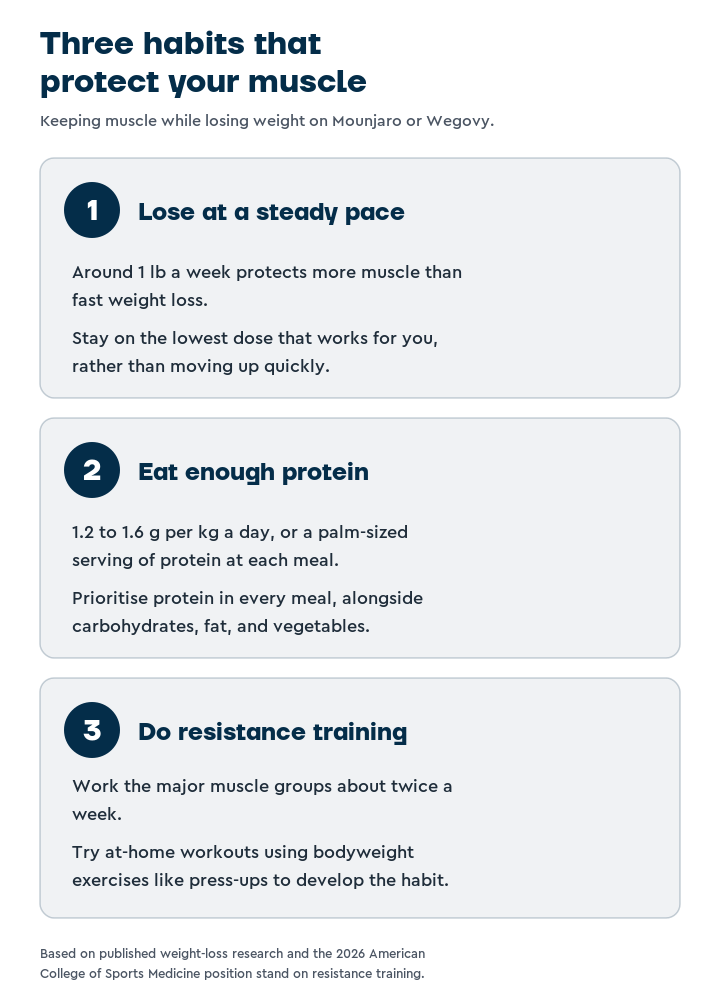
We recommend losing weight at a sustainable rate of around 1 lb per week, because faster weight loss increases the risk of losing excess lean mass.
On Mounjaro or Wegovy, we recommend staying on the lowest effective dose for as long as possible, rather than automatically increasing the dose each month.
Many of our members stay on lower doses of Wegovy and Mounjaro and lose significant weight without losing excess muscle.
Eating enough protein
Research on adults losing weight points to 1.2 to 1.6 grams of protein per kilogram of body weight a day.
For someone weighing 90 kg, that’s around 110 to 145 grams of protein daily, or a serving the size of a palm at each meal.
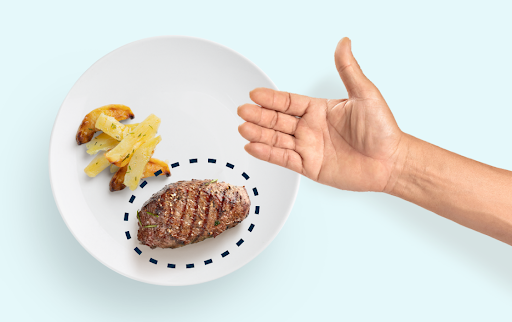
Mounjaro and Wegovy reduce appetite and food noise, so it can be challenging to eat enough protein before you feel full at each meal.
We recommend prioritising protein at each meal, and opting for easier-to-digest protein sources if you’re struggling to eat enough.
Good sources include eggs, Greek yoghurt, chicken, minced beef, fish, tofu, lentils, beans, and cottage cheese.
Our GLP-1 muscle and protein planner can provide you with a personalised plan to maintain muscle mass during GLP-1 treatment.
Resistance training
Resistance training is any exercise that works your muscles against resistance, from bodyweight squats, lunges, and press-ups to resistance bands, dumbbells, and machines.
Even short sessions a couple of times a week help maintain muscle mass while you lose weight.
Our guide to exercise with Mounjaro includes simple at-home resistance routines.
Second Nature has worked with the NHS since 2017, pairing Mounjaro or Wegovy with registered dietitian support to help you lose fat while holding on to muscle.
Take our 3-minute eligibility quiz, and a clinician will review your answers.
Who might benefit from a muscle-protecting drug
For most people, it’s unlikely that apitegromab is needed to maintain lean mass during weight loss on GLP-1 medications.
Still, for people living with sarcopenic obesity, where low muscle mass and obesity occur together, and some older adults are at higher risk of losing too much muscle, this could be a beneficial addition to their weight-loss treatment.
If a doctor or pharmacist recommends extra support for maintaining lean mass, that’s a different situation from the average person reaching for a second drug by default.
Apitegromab isn’t the only candidate either. A separate phase 2 trial paired bimagrumab, another muscle-targeting drug, with Wegovy, with similar results.2
| Feature |
Apitegromab |
Bimagrumab |
| How it works |
Blocks myostatin, a brake on muscle growth |
Blocks the activin receptor, reducing fat and building muscle |
| Tested with |
Mounjaro (tirzepatide) |
Wegovy (semaglutide) |
| Trial stage |
Phase 2, 24 weeks |
Phase 2, 72 weeks |
| UK status |
Investigational, not approved |
Investigational, not approved |
Additionally, using a second drug means more cost, more potential side effects, and more unknowns, for a benefit that hasn’t yet been shown to make people stronger or healthier.
For most people, that trade-off won’t be worth it, and both drugs remain investigational and would need larger trials before any UK approval.2,4
Frequently asked questions
What is apitegromab?
Apitegromab is an investigational drug that blocks myostatin, a protein that limits muscle growth.
It was first developed for a muscle-wasting condition and is now being tested alongside weight-loss medications.1
Does apitegromab help you lose more weight?
No. People lost a similar amount of weight with or without it, and the difference was that more of the weight lost came from fat rather than muscle.1
Can you get apitegromab in the UK?
No. Apitegromab is investigational and isn’t approved or available to prescribe in the UK, or anywhere else, for weight loss.
Do you lose muscle on Mounjaro or Wegovy?
You lose some, as you would with any weight loss. Across the trials, around a quarter to a third of the total weight lost is lean tissue, and the rest is fat.3
Is muscle loss on Mounjaro or Wegovy worse than with dieting?
No. A 2025 meta-analysis found that muscle loss with GLP-1 medications is similar to that seen with dieting and weight-loss surgery.3
How do I protect muscle while losing weight on Mounjaro or Wegovy?
Three things help: losing weight at a steady pace on the lowest effective dose, eating enough protein, and doing some resistance training.
They work best together, not one on its own.
How much protein should I eat on Mounjaro or Wegovy?
Research on adults losing weight points to 1.2 to 1.6 grams of protein per kilogram of body weight a day, or a serving the size of the palm of your hand at each meal.
Do I need a muscle-protecting drug like apitegromab?
Most people don’t. Eating enough protein, doing some resistance training, and losing weight at a steady pace protect muscle mass without a second medication.
Still, some individuals, such as those with sarcopenic obesity and those over 65, may benefit from extra medication to support muscle maintenance.
What is sarcopenic obesity?
Sarcopenic obesity is when low muscle mass and obesity occur together.
People living with it have more reason to focus on maintaining muscle mass, as they are at higher risk of losing muscle mass during weight loss.
Our guides cover what Wegovy is and how it works, average weight loss with Wegovy, and current UK prices.
Take home message
The apitegromab trial shows that muscle can be protected with a drug during weight loss on Mounjaro.1
Still, while the results showed greater maintenance of muscle mass compared to Mounjaro without apitigromab, it didn’t translate into improved muscular function, as defined by the grip test and sit-to-stand. Plus, it was small, short, and investigational.1,4
Losing some muscle when you lose weight is normal, and it happens with dieting and surgery just as it does with these medications.3
Other research shows that most of what you lose on Mounjaro or Wegovy is fat.1
For most people, eating enough protein, doing some resistance training, and losing weight at a steady pace will protect muscle, without a second drug, its cost, or its side effects.
For people who start with low muscle mass, or whom a clinician has flagged as higher risk, a muscle-protecting drug could one day be a useful option.
The open question is whether keeping that lean mass actually makes people stronger and healthier.
Until a larger, longer trial answers that question, the case for adding a second drug remains unproven.1,4
Second Nature’s medication programme combines Mounjaro with structured nutrition guidance from registered dietitians, built around the balanced plate model (half vegetables, a quarter protein, a quarter complex carbohydrates such as wholegrain bread, brown rice, or oats, plus a serving of fat).
Our peer-reviewed JMIR study of the GLP-1RA-supported programme reported an average weight loss of 19.1% at 12 months among active subscribers, with 77.7% achieving at least 10% weight loss.5
Second Nature's Mounjaro and Wegovy programmes
Second Nature provides Mounjaro or Wegovy as part of our Mounjaro and Wegovy weight-loss programmes.
Why choose Second Nature over other medication providers, assuming you're eligible?
Because peace of mind matters.
We've had the privilege of working with the NHS for over eight years, helping people across the UK take meaningful steps toward a healthier, happier life.
Our programmes are designed to meet people where they are, whether that means support with weight loss through compassionate one-to-one health coaching, or access to the latest weight-loss medications (like Mounjaro and Wegovy) delivered alongside expert care from a multidisciplinary team of doctors, psychologists, dietitians, and personal trainers.
At the heart of everything we do is a simple belief: real, lasting change comes from building better habits, not relying on quick fixes. We're here to support that change every step of the way.
With over a decade of experience, thousands of lives changed, and a long-standing record of delivering programmes used by the NHS, we believe we're the UK's most trusted weight-loss programme.
We hope to offer you something invaluable: peace of mind, and the support you need to take that first step.